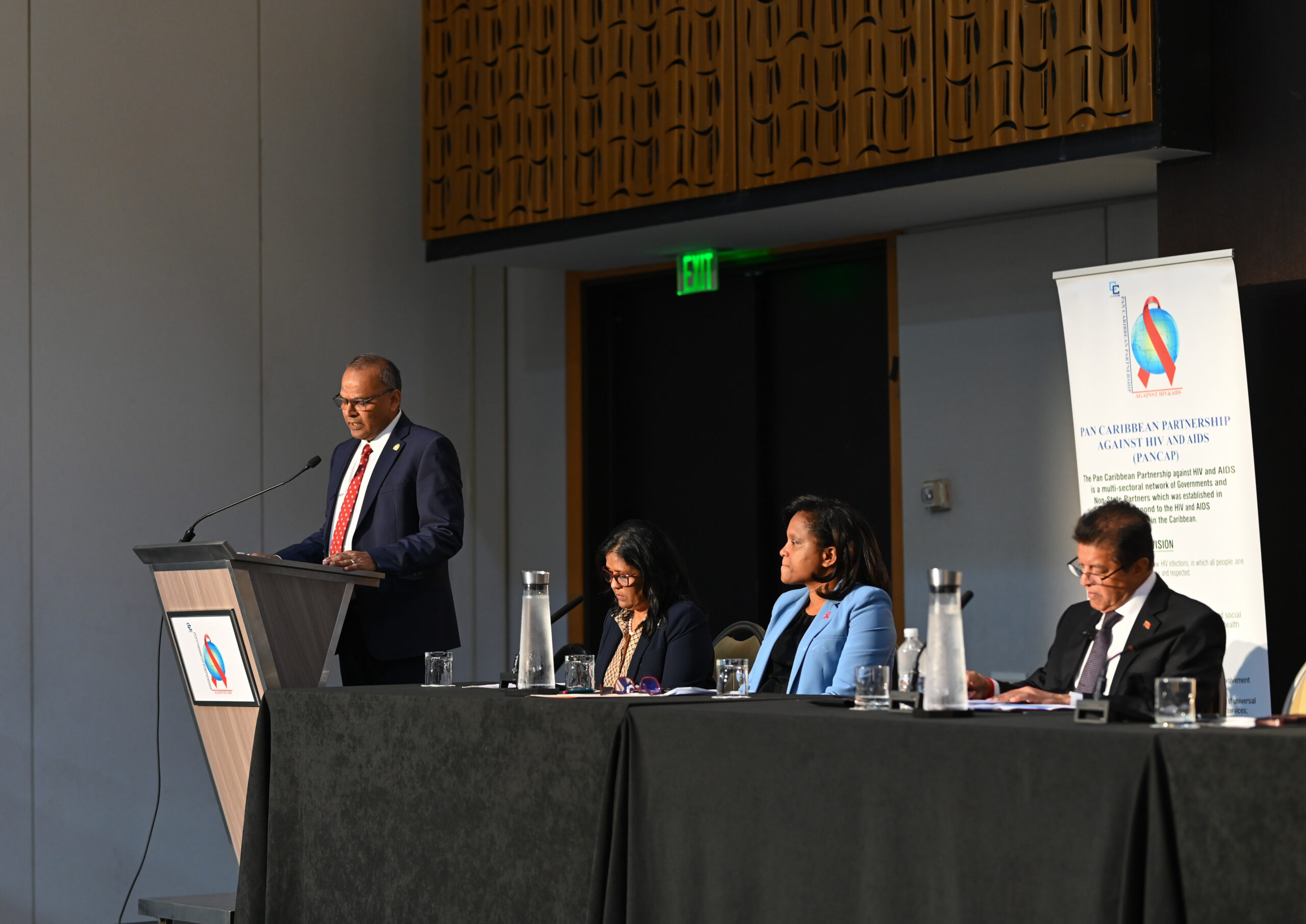
Honourable Minister of Health Lackram Bodoe,
Colleagues from CARICOM and PANCAP,
Distinguished ladies and gentlemen.
Good morning.
Let me begin by thanking PANCAP and our host, the Government and people of Trinidad and Tobago, for their warm hospitality and for their continued leadership in advancing public health across the Caribbean.
But above all, I want to acknowledge the doctors, nurses, programme managers, and public health professionals across our region who have dedicated their lives to confronting HIV and AIDS.
Many of you have been on the frontlines of this fight for decades. You stood with patients when treatments were scarce. You challenged stigma when silence surrounded this disease.
You built the programmes and health systems that today save lives across the Caribbean. Because of your work, thousands of Caribbean families today live with hope. And for that, we owe you our deepest gratitude.
Across the Caribbean, we have made remarkable progress. According to UNAIDS, AIDS-related deaths in our region have fallen by more than sixty percent since 2010, the steepest decline of any region in the world.
Think about what that means.
In 2010, nearly twelve thousand people in the Caribbean died from AIDS-related illnesses. Today, that number has fallen to fewer than five thousand deaths each year.
This progress did not happen by accident. It happened because governments invested in treatment. It happened because of our collective work to provide dignity and care.
And it shows us something important. It shows that when the Caribbean commits to a challenge, it can deliver results.
But let us also be honest with ourselves. Progress is not the same as victory.
Because while deaths have fallen dramatically, new infections are not declining fast enough. Across our region, approximately fifteen thousand people still become infected with HIV every year.
And perhaps the most troubling statistic of all is this: One in four of those new infections occurs among young people between the ages of fifteen and twenty-four. That means that even as we celebrate the lives we have saved, the epidemic continues to affect a new generation.
So the question before us today is simple. Will we be the generation that manages AIDS? Or will we be the generation that ends it?
I believe we can end it. Because today, for the first time in human history, we have the tools to do it.
We know that the journey to ending AIDS begins with knowledge. Today, about eighty-five percent of people living with HIV in the Caribbean know their status. That represents enormous progress compared with just a decade ago.
But it also means thousands of people still do not know they are living with HIV. And too many people are diagnosed late, when their immune systems are already severely compromised. That is why testing must become routine. Routine through new self-testing technologies that allow individuals to know their status quickly, privately, and with dignity. Because when people know their status earlier, treatment can begin earlier.
Treatment itself has become one of the most powerful tools we have ever had in public health.
Today around seventy-four percent of people living with HIV in the Caribbean are receiving treatment, and about two-thirds have achieved viral suppression. That is extraordinary progress. However, much work still remains if we are going to end AIDS as a public health threat.
For many years, HIV prevention relied largely on education and condoms, until we added Pre-exposure prophylaxis and HIV self-testing. And now, that arsenal has been fortified with long-acting injectable medicines. One of the most exciting of these innovations is lenacapavir, a twice-yearly injectable prevention medicine that has shown remarkable effectiveness in clinical trials. Even more encouraging is the progress being made to ensure this breakthrough is affordable.
New partnerships among global donors, manufacturers, and international organisations are working to reduce the cost of generic lenacapavir to about forty dollars per person per year, roughly the same price as daily oral prevention medicines.
Think about what that could mean. A single injection twice a year. Protection against HIV infection. At a price many countries could afford. That kind of innovation has the potential to change the trajectory of this epidemic.
But innovation alone does not end epidemics. Access does. And that means ensuring Caribbean countries must obtain these technologies quickly, affordably, and equitably.
Yet even as science moves forward, another challenge is emerging.
Financing.
The global HIV response is entering a difficult moment. Funding pressures are growing.
Some international support is declining. And prevention programmes are often the first to feel the impact. In fact, UNAIDS warns that if prevention services decline significantly, the world could see nearly four million additional HIV infections over the next five years. We must therefore ensure that adequate funding is available to sustained the progress that has been made.
So where do we go from here? We strengthen regional cooperation so Caribbean countries can negotiate better access to medicines and technologies. We accelerate prevention so that new infections decline faster than the epidemic spreads. We embrace innovation while ensuring that every country in our region benefits from it. And we continue to place people, especially the most vulnerable, at the centre of our response.
Because epidemics are not just statistics. They are human stories. Stories of resilience. Stories of courage. Stories of hope.
My friends,
History will not remember the reports we wrote or the meetings we held. History will remember whether we finished the work. Because we are living in a moment unlike any before it. For the first time in human history, we have the science to stop HIV transmission.
We have medicines that allow people living with HIV to live long and healthy lives. We have prevention tools powerful enough to turn the tide of this epidemic. What remains is not a scientific challenge. What remains is a choice. A choice to invest in prevention. A choice to expand access to innovation. A choice to stand with the communities most affected. A choice to ensure that no Caribbean nation is left behind.
If we make that choice, together, then the story of HIV in the Caribbean will not end in struggle. It will end in triumph.