As Guyana marks Women’s History Month, the story of Major Joan Granger unfolds not as a distant historical account, but as a living testament to courage, leadership and quiet transformation. At a time when the nation was young and uncertain, and when the idea of women in uniform was still untested, Granger stepped forward—not simply to serve, but to redefine service itself.
Her journey into history began in a moment of national urgency.
In 1966, the seizure of Ankoko Island by Venezuela sent shockwaves through Guyana’s newly independent state. The Guyana Defence Force, barely established, was confronted with the immediate need to defend the country’s sovereignty. But there was a problem: not enough soldiers.
The solution would change the course of military history in Guyana.
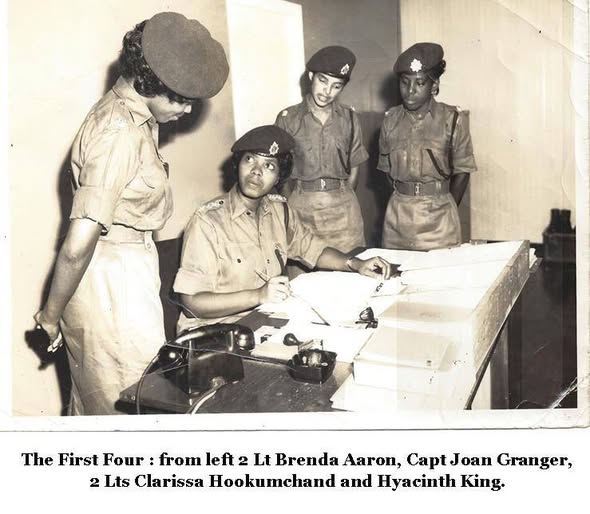
On January 30, 1967, Joan Granger, alongside Brenda Aaron, Clarissa Hookumchand and Hyacinth King, reported for training at Timehri. Within a week, they were joined by 56 other women—forming the first intake of what would become the Women’s Army Corps (WAC).
According to a tribute published by former members of the Guyana Defence Force, Granger stood out from the beginning—defined by maturity, confidence and conviction. She was appointed Captain-Officer Commanding of the Corps-placing her at the helm of an experiment that would soon evolve into a defining institution.
What began as a response to crisis quickly became something far more profound.
The Women’s Army Corps was initially conceived as a support unit—a practical solution to a manpower shortage. But under Granger’s leadership, that narrow vision expanded. The women trained rigorously. They marched, endured jungle exercises and learned combat tactics. In time, they stood shoulder to shoulder with their male counterparts, challenging entrenched assumptions about women’s place in the military.
Granger did not merely lead the Corps—she shaped its identity.
She pushed for more than participation; she demanded equality. She advocated for women reservists to be integrated into the Regular Force and insisted on equal conditions of service. In doing so, she confronted the structural limitations placed on women and steadily dismantled them from within.
Yet her leadership was not defined by advocacy alone.
Within the Force, she became known for her high standards and insistence on discipline. But those who served under her also remembered her warmth, her mentorship and her commitment to their growth. She was, in equal measure, commanding officer and guide—someone who understood that building a corps required both authority and care.
Her career would span 18 years, during which she held key roles in logistics and personnel before being appointed Commanding Officer of the Catering Corps. It was a position that would test her leadership in unexpected ways.
During the global economic hardships of the early 1980s, Guyana faced severe shortages, including food supplies. Ensuring that soldiers were properly fed became a critical challenge. In that moment, Granger’s leadership proved indispensable. She innovated, adapted and ensured that the Force remained sustained—demonstrating that military strength depends as much on resilience and organisation as it does on combat readiness.
In 1980, she was promoted to the rank of Major—a recognition of her service and influence. She continued to defend the rights and advancement of women within the military until her retirement in 1985.
By then, the path she had carved was no longer fragile.
The Women’s Army Corps had evolved from a temporary solution into a permanent and respected arm of the Guyana Defence Force. Women were no longer an exception—they were an integral part of the institution.
Major Joan Granger passed away on June 8, 2003. But her legacy did not end there.
Today, women serve across the Guyana Defence Force in roles that span administration, operations and frontline deployment. They patrol borders, participate in national security operations and continue to expand the boundaries of what is possible.
That reality can be traced directly back to 1967—to a moment of crisis, and to a woman who chose to lead.
The tribute from former GDF officers describes her simply: “a soldier, a pioneer, a patriot.” It is a fitting summation, but perhaps an incomplete one.
Because Joan Granger was more than all three.
She was a builder of systems, a challenger of norms and a quiet architect of change. She did not seek recognition, but she left behind a structure that endures—one that continues to carry the aspirations of Guyanese women in uniform.
And in the context of Women’s History Month, her story stands as both remembrance and instruction: that progress is often forged not in moments of visibility, but in the steady, determined work of those willing to step forward when history calls.
————
Sources:
- Ex-Guyana Defence Force Officers (Facebook Group). “Tribute to Major Joan Granger: A Soldier, A Pioneer, A Patriot.” (Primary source used for biographical narrative and historical context of her leadership, formation of the Women’s Army Corps, advocacy, and legacy.)
- Women’s Army Corps celebrates golden jubilee- Kaieteur News
- GDF’s Women’s Army Corps celebrates 57th anniversary- DPI