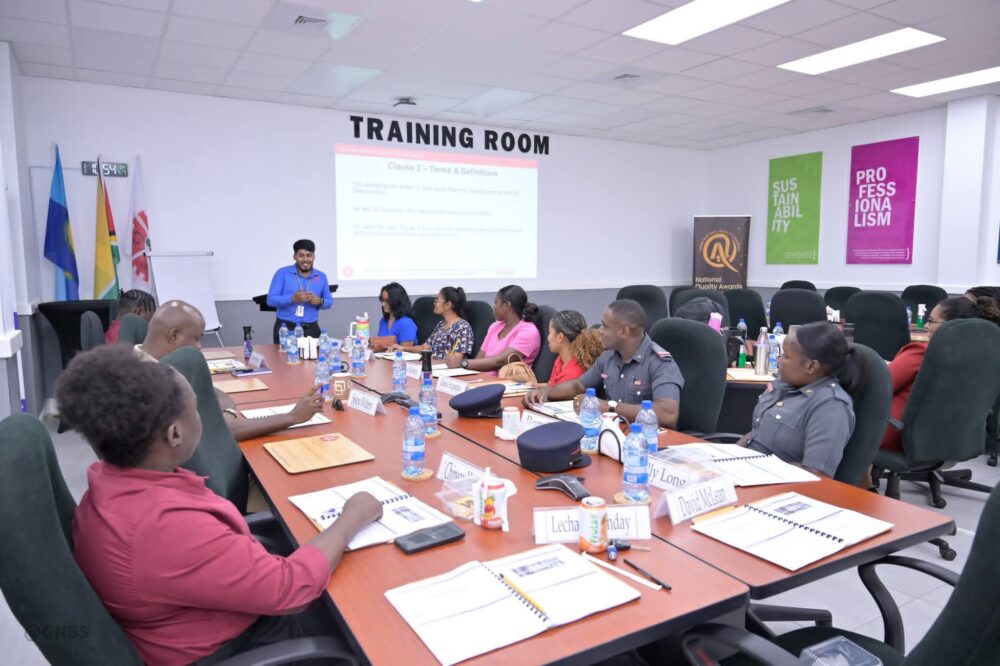
The Guyana Geology and Mines Commission (GGMC) has strengthened its operational capacity and compliance with international standards through a decade-long partnership with the Guyana National Bureau of Standards (GNBS), which continues to provide standards-based training to the agency’s staff.
The collaboration forms part of GGMC’s efforts to maintain its certification to the ISO 9001 Quality Management Systems (QMS) Standard, which the Commission achieved in 2011. The certification requires continuous staff training to ensure compliance with evolving international standards, safety requirements and industry best practices.
GGMC, which was established in 1979 from the former Department of Geological Surveys and Mines and operates under the Ministry of Natural Resources, is responsible for facilitating, monitoring and regulating the sustainable use of Guyana’s mineral resources, including petroleum.
Through its ongoing partnership with GNBS, the Commission has been able to train staff across several divisions, including Land Management, Audit, Human Resources and Environment. According to GGMC Training Officer Jevon King, employees have completed a range of courses offered by the GNBS, including Understanding and Implementing ISO 9001, Process Mapping, Risk Management, Internal Auditing of QMS, GYS 170 – Requirements for the Operation of a Laboratory, and ISO 45001 – the international standard for Occupational Health and Safety (OH&S) Management Systems.
Mr. King said the training has significantly improved staff performance and organisational effectiveness. “Employees are more confident in their work. They know what to do and how to deliver, which puts the organisation in a better position to perform because it makes the job easier for both employees and customers.”
“Of course, if I know what I have to do, then my output will be great and the Commission will be able to fulfil its mandate,” he added.
According to the Commission, the training programmes have also helped strengthen safety practices within the organisation, support staff transitions and promotions, and improve overall morale and competitiveness.
Mr. King also praised the quality of the training delivered by the GNBS. “It was excellent, and the other reviews were good. We had no complaints from the persons who were trained, so I must say it was well received,” he said.
Safety Inspector Irvie London also credited the programmes with enhancing his ability to perform his duties. He noted that the training has helped him “tremendously” in carrying out his daily responsibilities.
“The facilitators and trainers understood their course content, and it was delivered at a level where everyone was able to participate. Everyone was able to ask questions and interact based on what was delivered, which made the experience better,” London said.
While he previously studied elements of safety standards at the tertiary level, London explained that the GNBS training provided deeper practical insights. “We had to start from a documentation level, and this soon became critical as we embarked on different investigations in the mining sector requiring key documents to be completed to determine the next steps,” he explained.
He added that he has encouraged others to participate in GNBS training programmes. “I have already started encouraging others to get trained by the GNBS, especially colleagues I attended the University of Guyana with.”
Officials from the Commission expressed appreciation to the GNBS for its continued commitment to delivering quality training to both public and private sector organisations, which they say contributes to improving the delivery of safe and quality services in Guyana.
The GNBS has also announced that its 2026 training schedule is available on its website.