The CARICOM Secretariat and the Ministry of Education in Guyana are strengthening efforts to advance the Region’s education transformation agenda following high-level discussions on the key drivers of educational change across the Caribbean Community.
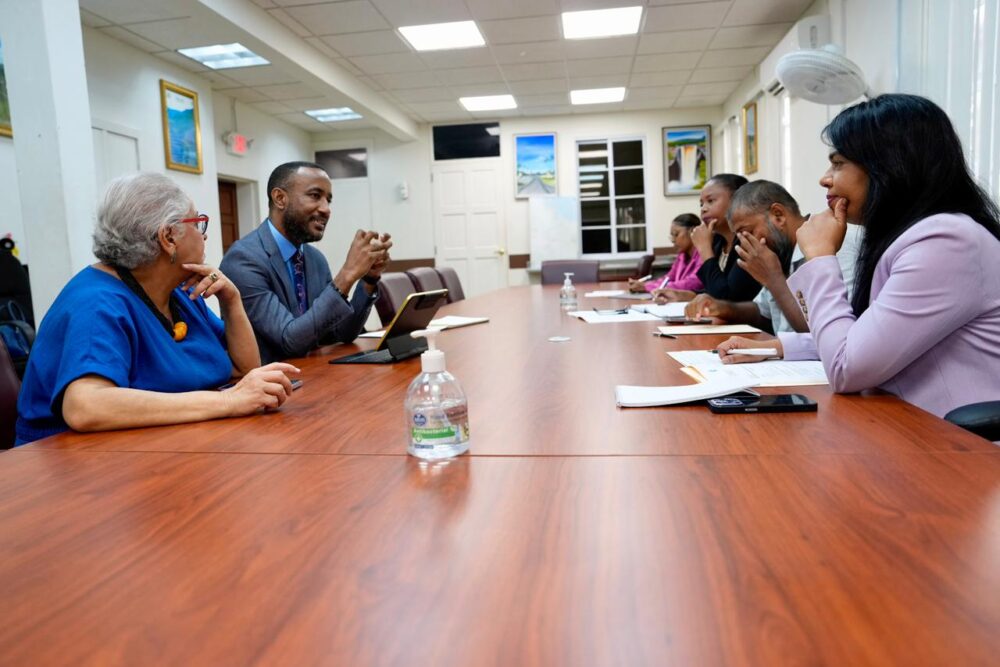
In February, CARICOM Assistant Secretary-General for Human and Social Development, Ms Alison Drayton, and Programme Manager for Human Resource Development, Mr Davion Leslie, met with Guyana’s Minister of Education, the Honourable Sonia Parag, to discuss regional education priorities.
Minister Parag assumed the role of Chair of the Council for Human and Social Development (COHSOD) – Education on 1 October 2025, and her tenure will continue until 30 September 2026.
According to the CARICOM Secretariat, the meeting allowed officials to examine the transformational imperatives for education across the Region, review progress on regional education strategies and frameworks, identify areas requiring stronger political support and policy harmonisation, and determine priority issues for the upcoming COHSOD meeting.
During the discussions, Drayton commended Guyana for its efforts to improve education access and quality, particularly as the country undergoes significant economic and social changes.
She noted Guyana’s strong commitment to strengthening access, quality and relevance within the education system and expressed optimism about the country’s progress toward achieving Universal Secondary Education by 2026.
Minister Parag also reaffirmed Guyana’s commitment to using its chairmanship of COHSOD to advocate for policy changes at the regional level. Among the priorities identified were the development of climate-resilient school infrastructure, the advancement of digital transformation within education systems, and stronger literacy initiatives across the Caribbean.
However, while access to early education has improved significantly, data indicates that challenges persist within Guyana’s education system as students advance through higher levels. The country has achieved near universal access to primary schooling, with approximately 98 percent of students completing primary education. Completion rates decline sharply at higher levels, however, with only about 62 percent of students finishing upper secondary school—meaning nearly four out of every ten students do not complete high school.
Academic performance also remains uneven, particularly in mathematics, where only about one-third of students pass the Caribbean Secondary Education Certificate (CSEC) examination. Disparities between coastal and hinterland regions continue to affect outcomes, with significantly fewer students from interior communities obtaining secondary school certificates.
Socio-economic factors also play a role. Poverty and child nutrition challenges continue to affect learning outcomes, with a notable portion of the population living below international poverty thresholds and some children experiencing malnutrition that can hinder academic performance.
These structural challenges persist despite decades of governance by the People’s Progressive Party, and the education sector being overseen in recent years by Sonia Parag and previously Priya Manickchand. Observers say the issues raise ongoing concerns about whether the system is adequately preparing Guyanese youth for the demands of a modern, knowledge-based economy.
The Council for Human and Social Development (COHSOD) is responsible for promoting human and social development across CARICOM Member States. Under Article 17 of the Revised Treaty of Chaguaramas, the Council—comprising Ministers designated by Member States—works to promote the development of education through the efficient organisation of educational and training facilities within the Community, including elementary, vocational, technical and advanced training institutions.
The CARICOM Secretariat said continued engagement between the regional body and Guyana’s Ministry of Education reflects the Region’s focus on strengthening education systems to better respond to economic, technological and social change.