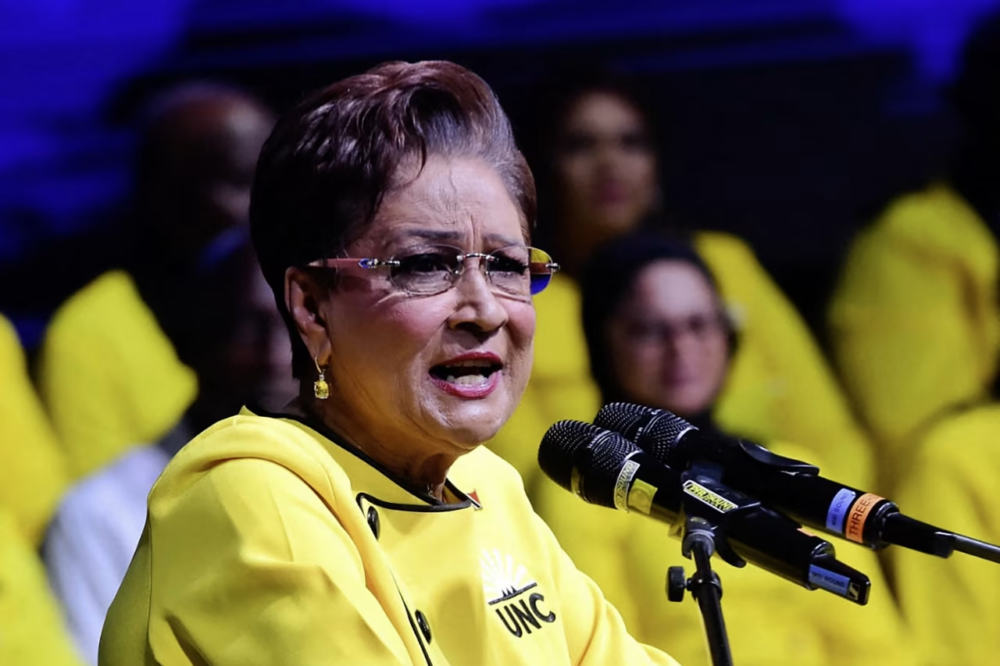
Trinidad and Tobago’s Prime Minister Kamla Persad‑Bissessar and several current and former Caribbean Community (CARICOM) leaders have engaged in a series of public rebukes over the past week, highlighting rising diplomatic tensions within the regional bloc ahead of the 50th Regular Meeting of the Conference of Heads of Government, held from February 24–27, 2026, in Basseterre, St. Kitts and Nevis.
Over the weekend, Persad‑Bissessar publicly criticised a group of former CARICOM leaders for issuing a statement on the United States executive order targeting Cuba’s oil imports, which they described as “economic warfare.” In remarks to local media, the Prime Minister said the former leaders’ comments were ironic, asserting that if they had lived under a communist dictatorship they would not have been free to publish their views.
Persad‑Bissessar said such freedom of expression is a hallmark of democracy — implicitly contrasting that condition with Cuba’s political system.
The former CARICOM leaders had voiced concern about the humanitarian impact of the U.S. sanctions on Cuba — a stance at odds with the position advanced by Persad‑Bissessar, who has taken a more pro‑U.S. diplomatic line.
In response, former Trinidad and Tobago Prime Minister Dr. Keith Rowley and former Jamaican Prime Minister PJ Patterson issued a rebuke of their own, criticising Persad‑Bissessar’s attacks and pointing to past regional policy consensus. Rowley noted that, historically, Trinidad and Tobago addressed similar issues through long‑standing policy positions at forums such as the United Nations.
The exchanges reflect broader discord in the region over foreign policy alignment, particularly regarding the U.S. embargo on Cuba and the presence of U.S. military operations in the Caribbean, where Persad‑Bissessar’s government has signaled support. Other CARICOM leaders, including those from Barbados and Antigua and Barbuda, have reaffirmed the organisation’s longstanding aspiration to maintain the Caribbean as a “zone of peace,” resisting foreign military escalation.
At the same time, diplomatic engagement at the institutional level continues: CARICOM Chair Dr. Terrance Drew recently visited Trinidad and Tobago for talks with Persad‑Bissessar and other officials, seeking to bridge differences ahead of the upcoming summit.
Political analysts say the public spats underscore an emerging fault line within CARICOM between member states that favour a more assertive regional diplomatic posture and those, like Trinidad and Tobago under Persad‑Bissessar, that are pursuing a more Western‑aligned security and foreign policy strategy.
With the CARICOM heads meeting underway, the recent public rebukes are set to cast a shadow over the summit, potentially redefining discussions on regional unity and testing the bloc’s ability to coordinate on security, economic policy, and foreign relations.




![Andre Coley: "For me, it's going back to those processes [and asking the player] when we were doing well, what was the thinking?" • Gareth Copley/Getty Images](https://villagevoicenews.com/wp-content/uploads/2024/08/colley-120x86.webp)