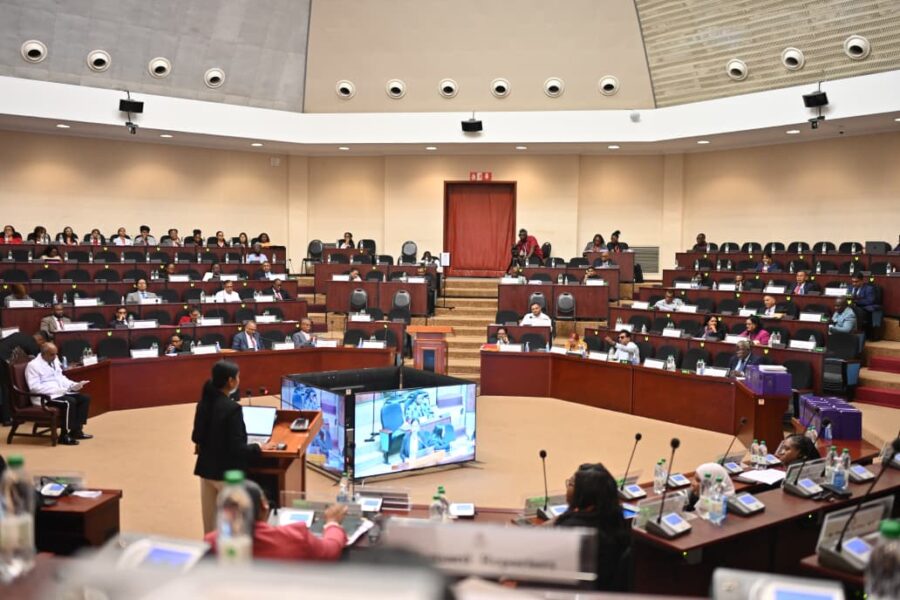
By Mark DaCosta- In the wake of recent budget debates, discontent among the Guyanese public has intensified, according to journalist and commentator Adam Harris, who says the government’s justifications for key policy decisions—particularly in education and public welfare—have deepened public concern. He argues that as the ruling People’s Progressive Party (PPP) advances its budget, its commitment to vulnerable citizens has come into serious question.
Harris highlighted the decision to scrap the “Five Bs” programme introduced under the former administration of David Granger. The initiative—buses, boats, bicycles, breakfast and books—was aimed at reducing the burden of school attendance on families. According to Harris, opposition A Partnership for National Unity (APNU) parliamentarian, Saiku Andrews, underscored the impact of the change on parents in Georgetown, noting that “Parents somewhat removed from the schools would pay $200 per day for transportation,” amounting to about $39,000 annually for one child.
In hinterland and riverain communities such as Pomeroon, Harris said daily transportation costs can reach $2,000, far exceeding the $10,000 cash grant previously offered under the Because We Care programme. He said the contrast illustrates a failure by the administration to understand the financial pressures faced by families.
Harris also criticised what he described as the government’s tendency to justify poverty as a cultural choice. During a recent parliamentary exchange, the Minister of Amerindian Affairs, Sarah Browne-Shadeek, suggested that some Indigenous communities preferred traditional living in troolie huts. According to Harris, that position was challenged by We Invest in Nationhood (WIN) parliamentarian Deon La Cruz, who pointed out that neither the minister nor her colleagues live in such conditions. La Cruz described the huts as “a representation of the extent of poverty.”
Another area of concern raised by Harris is the performance of Charles Ramson Snr, Commissioner of Information. He noted that Ramson has not submitted a single annual report since being appointed, despite the requirements of the Right to Information Act. The failure, Harris said, has contributed to growing public mistrust and frustration.
He added that Ramson has repeatedly refused to engage with requests for information, sometimes citing minor procedural issues, which has resulted in protests and court action. As Harris stated, “It has been more than ten years since he should have presented the first report.”
Harris further questioned the allocation of public funds to the Office of the Commissioner of Information, pointing to a $40 million budget despite what he described as non-performance. He reported that Minister Gail Teixeira defended the allocation, saying Ramson was aware of his responsibilities. Harris said the episode raises wider questions about priorities and accountability.
Public servants, Harris argued, have also been overlooked. Despite rising living costs and a larger national budget, workers have seen little improvement in their conditions. He quoted Dr David Hinds as saying, “There was nothing in that budget for them.” While the government has emphasised infrastructure investment, Harris said this does little to ease the immediate hardships facing families.
Education outcomes were also highlighted as a growing concern. Harris pointed to declining pass rates and an apparent crisis in youth engagement. He said political interference has undermined teacher training, and cited a case in which a trainee teacher reportedly graduated with a credit despite not completing the required programme, describing it as evidence of deep institutional failure.
The gas-to-energy project has also come under scrutiny in Harris’ commentary. He said the project has expanded significantly in both cost and construction time. Intended to strengthen Guyana’s energy capacity, it has instead become associated with inefficiency and poor management. Harris referenced the Vice President’s comment that he would “field no more questions on the project,” which he described as symbolic of a government unwilling to face scrutiny.
Harris also criticised what he described as a pattern of deflecting blame for education failures and rising inflation. He said insufficient resources continue to be directed to key institutions such as the University of Guyana, while funding is channelled into initiatives like the Guyana Online Academy of Learning (GOAL)
According to Harris, public frustration is growing as citizens see continued disparities in budget allocations and little improvement in their daily lives. He said the recurring use of justifications and explanations has begun to mask a deeper disregard for public welfare.
He concluded that Guyana requires leadership grounded in transparency, accountability and genuine concern for citizens, and that the issues raised in the budget debates reflect a wider crisis of governance.