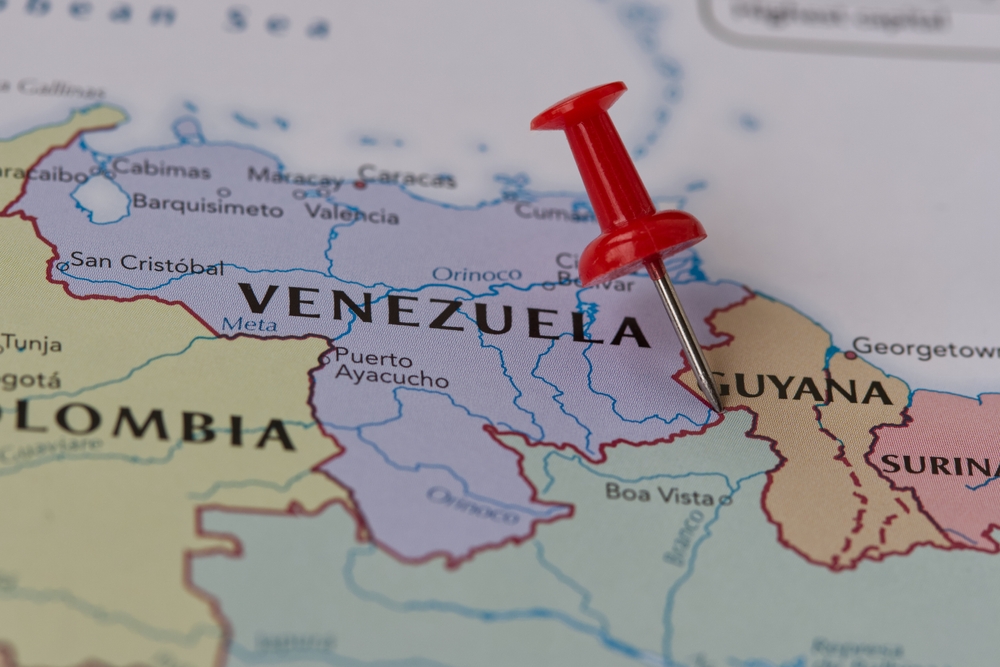
By Dr. Scott B. MacDonald (National Interest) -Guyana’s Finance Minister Ashni Singh has presented his budget for 2026. The US$7.5 billion budget is the country’s largest ever, focusing on economic expansion and infrastructure, long-term diversification of the economy away from oil, major investments in gas-to-energy projects, and support for the country’s Amerindian communities.
Next door in Venezuela, home to the world’s largest known oil reserves, the economy remains deeply troubled. Basic staples remain in short supply, prices are high, and over the last decade, around 8 million people left the country due to economic and safety concerns.
Guyana and Venezuela’s Diverging Oil Strategies
Guyana and Venezuela are both oil-based economies. That said, their experiences could not be more different. Over more than two decades of socialist experimentation, Venezuela forced out most foreign energy companies (losing their expertise), nationalized their assets (as with ExxonMobil and ConocoPhillips), grossly mismanaged the industry by replacing skilled workers and managers in the state-owned PDVSA with Chavista loyalists, and let corruption run rampant. As Caleb Jasso, an analyst at the Institute for Energy Research, observed, this left the oil sector in “significant disrepair, abandonment, and, in certain cases, it has been stripped entirely for parts.”
Despite help from Chinese, Iranian, and Russian state-owned oil companies, which sent assistance to repair refineries and provided the use of shadow tankers to evade US sanctions, Venezuela’s oil industry failed to turn around. Venezuela’s oil production was estimated at around 1 million barrels per day (bpd) as of 2025, down from over 3 million bpd in the late 1990s. In comparison, Guyana produced close to 900,000 bpd in late 2025.
Guyana chose a different path, offering an open investment environment to foreign energy companies, benefiting from their expertise, and providing better (though not perfect) transparency and disclosure than its neighbor. Although certain tensions exist in the country’s polity, electoral politics have been upheld (including a change of government and three national elections since 2020). Socioeconomic turmoil has been minimal. Important in this picture is that Guyana has reinvested much of its oil money back into the Guyanese economy, including funding alternative energy projects such as hydroelectric power. In Venezuela, parts of the country are lucky to have electricity, and alternative energy sources are an afterthought.
Growth, Inflation, and Investment Outcomes in Guyana and Venezuela
Economic performance shows another stark difference between the two countries. Guyana has enjoyed rapid real gross domestic product (GDP) growth, hitting 33.8 percent in 2023, 43.6 percent in 2024, and 10.3 percent in 2025. In contrast, the Venezuelan economy contracted by over 75 percent from 2014 to 2021, one of the worst economic performances in the world. According to the International Monetary Fund (IMF), Guyana is forecast to grow at 23 percent this year, whereas Venezuela is expected to contract by three percent. Guyana has also largely been able to contain inflation, which is forecast at 4.5 percent this year. In comparison, over the past 10 years, Venezuela suffered some of the worst bouts of hyperinflation in the Western Hemisphere, with the IMF forecasting over 600 percent for 2026.
One of the sharpest contrasts between Guyana and Venezuela is foreign direct investment (FDI). According to the United Nations Economic Commission for Latin America and the Caribbean, in 2024, Guyana was the fourth-largest destination for FDI projects announced by value, attracting $13 billion. In contrast, Venezuela recorded a single project announcement for a plan by Russian automaker Kamaz to build a vehicle assembly plant.
Political Stability Versus Post-Maduro Uncertainty
While Guyana’s democratic political system is stable, there are substantial questions about what happens next to its neighbor. Operation Absolute Resolve removed Venezuela’s authoritarian president Nicolás Maduro from power, leaving Delcy Rodríguez as the acting president. The Chavista state is also largely in place, with many of the voices opposed to capitalism and the US remaining present. This includes the powerful head of the nation’s security forces, Diosdado Cabello. As Insight Crime observed: “Interior Minister Diosdado Cabello has been one of the most important figures within the Chavista regime and is as central as anyone to its corruption.” That includes the transnational drug trade.
Another prominent figure in the country’s power structure and a core part of its corruption is Vladimir Padrino López, who has been the defense minister since 2014. Against these autocratic figures, there is a wide range of opposition groups, including those who were cheated out of victory in the fraudulent 2024 elections. To put it mildly, the political situation remains highly uncertain. In addition, Venezuela claims the Essequibo, a region encompassing two-thirds of Guyana, and Maduro was quite happy to build up a military presence along the border.
Venezuela’s Conditional Reopening to Foreign Oil Companies
Under intense pressure from the United States, Caracas has bent to Washington’s demands to make the oil industry more welcoming to foreign investment.
An important step forward was taken in late January, when Rodríguez signed legislation that gives private companies control over the production and sale of oil, ending PDVSA’s monopoly over those activities and pricing. In response, the United States eased sanctions on the sale and export of Venezuelan oil and returned $500 million from oil sales to Venezuela.
While Guyana benefits from the sale of sweet crude and has a wide range of buyers (the United States, the Netherlands, Panama, Germany, and India), Venezuela’s oil exports are heavily weighted to its heavy crude, which requires a more costly refining process. The United States figures prominently as a buyer, as does China, and, in the past, India (which might now seek to replace Russian crude with Venezuelan crude). Much work is required to rebuild Venezuela’s supply chain operations, and the legal mess created by the 2007 nationalization of ExxonMobil’s and ConocoPhillips assets will further complicate Venezuela’s efforts to recapture its past glory as a major oil exporter
President Donald Trump has stated that the United States is assuming control of Venezuela’s oil exports and intends to restructure its business via foreign investment. To revitalize the Venezuelan oil sector, US companies are being asked to pony up around $100 billion. While some companies appear willing to take the plunge, others remain skeptical. Indeed, ExxonMobil’s CEO Darren Wood stated, “If we look at the legal and commercial constructs—frameworks—in place today in Venezuela, today it is uninvestable.” He later added, “Those priorities start with one, stabilizing the country. Second is to kick-start the economy and try to recover some of the damage that’s been done over the decades of abuse that the dictators brought in, and then ultimately to transition into representative government.”
Risk Versus Reliability in the Southern Caribbean
There is considerable hype about investing in Venezuela’s oil sector. Indeed, there is considerable upside if conditions unfold positively. However, Venezuela also remains a high-risk proposition, even for major companies such as ExxonMobil and ConocoPhillips. Tough questions nag at investment decisions. Does Rodríguez survive? Will she be replaced by a more hardline Chavista who is willing to return to confrontation with Washington? How long-term will a return on investment be for those companies willing to return to or enter Venezuela? When will there be a transition to a more representative government?
In comparison, Guyana maintains a welcome investment environment, is openly pro-US, is upgrading its local workforce, and is reinvesting in the country. When looking out over the geopolitical map in the Caribbean, Washington’s policymakers should remember that it is better to have a bird in hand than two in the bush. Guyana has become an important geo-economic and geopolitical pro-Western neighbor in the Southern Caribbean. Who knows where Venezuela is heading?
—————————————————-
About the Author: Scott B. MacDonald
Dr. Scott MacDonald is the chief economist for Smith’s Research & Gradings and a fellow with the Caribbean Policy Consortium. Prior to those positions, he worked for the Office of the Comptroller of the Currency, Credit Suisse, Donaldson, Lufkin and Jenrette, KWR International, and Mitsubishi Corporation. His most recent book is The New Cold War, China and the Caribbean (Palgrave Macmillan, 2022).