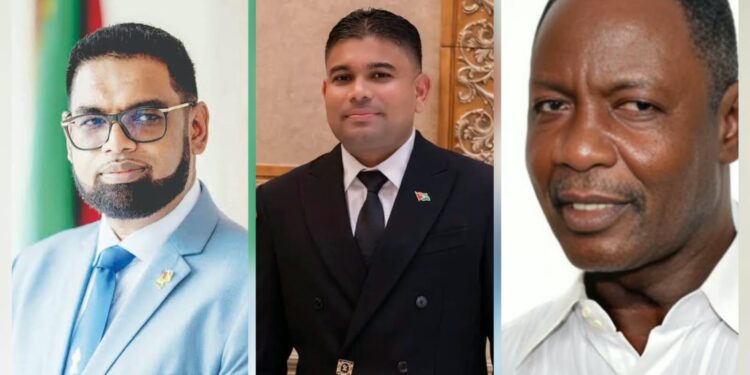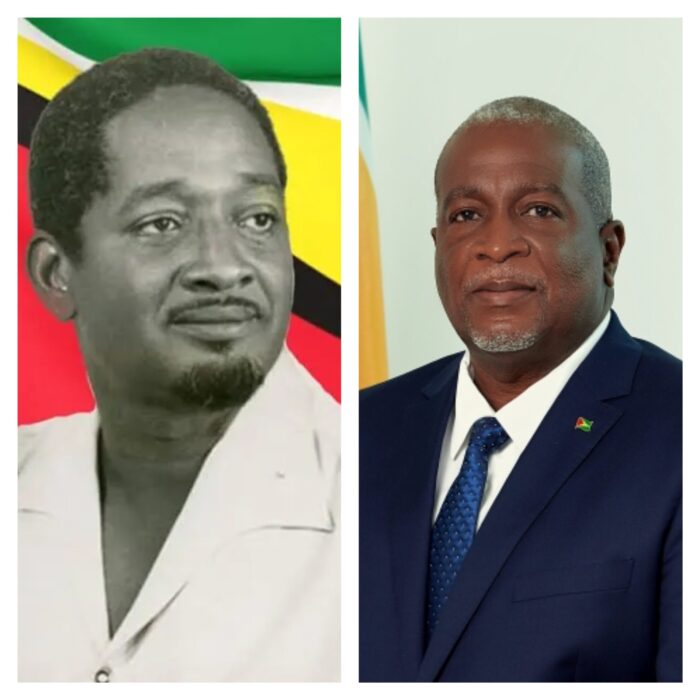
Former government minister and parliamentarian Annette Ferguson and citizen Martin Gaul have mounted a fierce joint public attack on Prime Minister Mark Phillips, accusing him of using last Friday’s Budget 2026 debate to recycle what they describe as a politically driven and historically dishonest portrayal of the late President Linden Forbes Sampson Burnham.
During his presentation, the Prime Minister cast aspersions on the governance of Linden Forbes Sampson Burnham and sought to disparage his contributions to Guyana’s development. Burnham led the Co-operative Republic of Guyana from 1964 until his death in 1985. He served as Premier of British Guiana (1964–1966), Prime Minister of Guyana (1966–1980), and the country’s first Executive President (1980–1985).
Gaul, in a social media post responding directly to Phillips’ presentation, said the Prime Minister had publicly declared that Burnham “failed us” and condemned Phillips for attacking the very leader who shaped his early career.
“Brigadier (Ret’d) Mark Phillips, I’ve been hearing since my small days, that we must never curse the bridge we cross,” Gaul wrote.
He reminded the Prime Minister that Burnham had personally opened the door to his military advancement.
“The Late President Linden Forbes Sampson Burnham, give you your first break at the tender age of 20. He sent you to the Royal Military Academy Sandhurst, where you graduated from in 1981. So how can you say he failed us, when he is the one that cause you to excel and succeed in the [Guyana Defence Force] GDF,” Gaul said.
At the same time, Ferguson, in a letter to the editor, said she listened to Phillips’ Budget 2026 presentation “with keen interest” but left “deeply disappointed,” accusing him of abandoning a serious discussion on present-day governance in favour of attacking Burnham’s legacy.
“Rather than confining his remarks to current economic stewardship and measurable outcomes, the Prime Minister once again resorted to a distorted portrayal of Guyana’s past, implicitly casting the era of the late Linden Forbes Sampson Burnham as one defined solely by political favouritism and exclusion,” Ferguson wrote.
Gaul and Ferguson both argued that Phillips’ comments during the budget debate ignored historical context and were driven by political messaging rather than balanced analysis.
According to Gaul, the contradiction is especially glaring because policies once condemned under Burnham are now being embraced by the current administration.
“The same policies and programs that your present bosses condemn and sabotage during LFS Burnham leadership, they are now implementing,” Gaul wrote, adding, “Does the Burnham phrase ‘Grow More Food’ sounds familiar to you? And that’s just one.”
He questioned whether Phillips understood the importance of Burnham’s self-reliance agenda.
“Did you ever understand what it meant for a young independent country, to feed, clothe and house ourselves??” Gaul asked.
Ferguson echoed that argument, saying Burnham’s record cannot be reduced to a one-dimensional political narrative.
“The historical record is neither singular nor simplistic. Burnham’s tenure, like that of many post-colonial leaders, included serious shortcomings; economic difficulties, governance challenges, and democratic concerns. Yet it also encompassed foundational contributions to nation-building; free education, public infrastructure expansion, national self-assertion, and the deliberate effort to craft a Guyanese identity in the early post-independence period. To reduce this legacy to a recurring political caricature is intellectually dishonest,” she said.
Ferguson said it is now four decades since Burnham’s death and accused the governing People’s Progressive Party/Civic of continually reviving his name to escape accountability. Burnham died on August 6, 1985.
“It is time for the People’s Progressive Party/Civic to allow his soul to rest in eternal peace, rather than continually resurrecting his name as a political convenience whenever accountability for present governance is required,” she wrote.
She accused the PPP/C of failing to properly account for its own record in office.
“The persistent failure of the PPP/C to meaningfully account for its own actions is increasingly evident. Issues of transparency, oversight, and institutional accountability are too often concealed behind layers of political messaging and sustained propaganda,” Ferguson stated.
Gaul, in turn, accused Phillips of aligning himself with what he described as party propaganda against Burnham and of turning his back on the leader who helped shape his career.
“This post is to highlight how shameful it is for you of all persons, to be piggy backing on the Corrupt Jagdeo-PPP party propaganda, that Burnham failed,” Gaul wrote, referring to President Bharrat Jagdeo.
“Come on big man, you’re a direct product of President Linden Forbes Sampson Burnham leadership. I don’t have to go into the other thousands of achievements that your now boss, Corrupt Jagdeo will never reach bro.”
Ferguson stressed that her defence of Burnham is not rooted in political loyalty or nostalgia.
“I was a young girl when Forbes Burnham died. My assessment of his leadership is therefore not shaped by lived political allegiance, nostalgia, or inherited loyalties. Nor do I permit propaganda, past or present, to occupy my mind. I read. I study. I educate myself on who Forbes Burnham was, what he attempted to do, and the geopolitical and economic constraints under which he governed,” she wrote.
Both critics argued that Phillips’ approach in the budget debate avoided confronting present-day governance failures.
“A responsible Budget debate should be anchored in the present: transparency in the management of public resources, accountability in decision-making, respect for institutions, and tangible outcomes for citizens,” Ferguson said.
“Continual reliance on historical distortion cannot substitute for these obligations.”