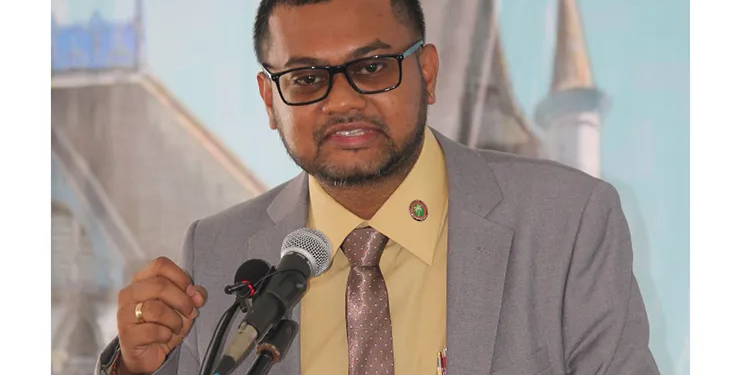
Leader of the Forward Guyana Movement and lone parliamentarian Amanza Walton-Desir on Day Three of the 2026 Budget Debates delivered a wide-ranging critique of the government’s spending plan, warning that while Guyana’s global profile has changed dramatically as an oil-producing state, the institutional capacity reflected in the budget has not kept pace.
Walton-Desir, Opposition Shadow Minister of Foreign Affairs and International Trade, argued that foreign affairs, governance, and essential services must be treated as matters of national risk management, not routine administration. She said the budget’s rhetoric projects confidence and international respect, but the allocations fall short of building the strategic framework needed to protect sovereignty, influence outcomes abroad, and safeguard social cohesion at home.
“Foreign affairs can no longer be treated as routine administration. It must now be treated as national risk management,” Walton-Desir told the House, adding that respect internationally “is not conferred by growth alone” but earned through “clarity of purpose, institutional strength, and the capacity to shape outcomes.”
She said the government speaks the language of a petroleum-era Guyana, but continues to fund diplomacy and governance structures suited to a pre-oil reality, leaving the country vulnerable to pressure.
Sovereignty beyond litigation
Addressing what she described as the first pillar of foreign policy—protection of sovereignty and national interest—Walton-Desir acknowledged the importance of Guyana’s case before the International Court of Justice. However, she cautioned that sovereignty cannot be defended by litigation alone.
Walton-Desir brought strong credentials in foreign policy and international relations to her presentation, having served as Shadow Minister with responsibility for those areas in the 12th Parliament under the opposition A Partnership for National Unity and Alliance For Change (APNU+AFC) coalition.
“Sovereignty is not defended by litigation alone. Nor is sovereignty defended by announcements or appearances,” she said, arguing that real sovereignty is a capability grounded in law, diplomacy, institutional strength and international legitimacy.
She warned that credibility abroad is shaped by conduct at home, noting that when media freedoms are constrained, journalists sidelined, or Parliament treated as a rubber stamp, international partners take note. “They see it, they clock it, and it counts against us,” she said.
Walton-Desir argued that in an oil-producing Guyana, budgets themselves have become instruments of foreign policy, as development is increasingly financed through multilateral loans and international agreements that carry long-term legal and diplomatic obligations. When parliamentary and institutional capacity fails to keep pace, she warned, sovereignty is eroded incrementally rather than lost in a single crisis.
Examining Budget 2026, she said the emphasis is on outputs—meetings attended, statements issued and resolutions supported—rather than preparedness. What is missing, she argued, is architecture.
She again called for the establishment of a standing Foreign Policy Council to integrate legal, diplomatic, security, energy and migration expertise into a permanent framework capable of anticipating pressure before it becomes confrontation.
Engagement without strategy
Turning to strategic engagement, Walton-Desir said international influence does not automatically follow oil revenues or economic growth. Influence, she argued, must be earned through preparation and clarity of national interest.
While acknowledging provisions for a Foreign Service Institute, she cautioned that buildings alone do not create influence. “People do. Preparation does,” she said, stressing the need for diplomats trained in energy geopolitics, international law, treaty compliance and crisis response.
She warned against treating diplomatic postings as rewards or placements, saying representation abroad must be based on skill and allegiance to the national interest, not political convenience. Walton-Desir also cautioned against overreliance on external lobbyists, arguing that while advocacy can amplify a position, it cannot substitute for internal capacity.
“Preparedness cannot be outsourced, and neither can we subcontract our sovereignty,” she said.
Migration and social cohesion
Walton-Desir said the consequences of weak foreign policy do not remain at international forums but are felt directly by citizens. She pointed to unmanaged migration as a growing pressure on housing, public services and social cohesion.
She said migration is a reality, but unmanaged migration is “poor governance,” adding that delays in delivering a comprehensive migration framework have had tangible consequences. She criticised the lack of transparency surrounding arrangements involving third-state nationals, noting their direct impact on labour markets, housing demand and national security.
“Acknowledgement is not delivery,” she said, calling for clear rules, enforcement mechanisms and parliamentary accountability.
Aviation, maritime affairs and essential services
On aviation, Walton-Desir welcomed investment but stressed that development must follow Guyana’s existing 25-year Civil Aviation Master Plan rather than ad hoc initiatives. She underscored the importance of safety, regulatory independence and transparency, renewing calls for the release of the aircraft accident investigation report relating to the deaths of servicemen.
“Families deserve closure. The aviation sector deserves the lessons. And trust demands transparency,” she said.
Addressing maritime affairs, Walton-Desir said the budget prioritises physical assets such as dredging and ferry rehabilitation while neglecting institutional governance. She warned that Guyana is operating a fragmented, outdated port governance model and called for an autonomous ports authority to manage what she described as strategic national assets.
She raised similar concerns about water and electricity, saying billions are being spent while Guyanese continue to face discoloured water, blackouts and voltage fluctuations. According to Walton-Desir, when massive expenditure fails to translate into reliability, the issue is governance, not funding.
“Money alone does not create strategy. Money funding the wrong mindset is mischief,” she said.
In closing, Walton-Desir said the debate is not about halting development but improving its quality and integrity. Governance, she argued, must be judged by whether budgets deliver broad, fair and durable improvements in people’s lives.
“Another year has passed. Another budget has been presented. And the question Guyanese are asking is not who won the debate, but how has my life changed for the better,” she said.