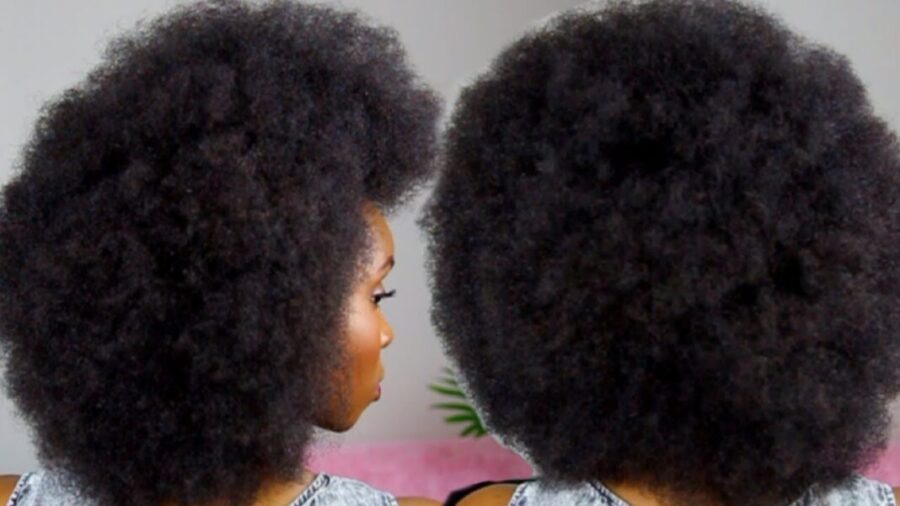
By Joanne Clark (CNW)- The Trinidad and Tobago Ministry of Education has issued a clarification on student hairstyles and grooming policies following public backlash over rules circulated by Fyzabad Secondary School that some parents, students and activists have described as discriminatory.
The controversy erupted after a school document outlining grooming rules for female students circulated on social media. The guidelines stated that hair should not extend more than ten inches below the shoulder blades, must be tied back once longer than shoulder length, and that buns should not exceed three inches in height. Certain styles, including “pineapple buns” and “half-up, half-down” hairstyles, were also prohibited. The rules further required that female hairstyles be properly groomed.
The document included photos of Afro-textured hairstyles labelled as “Samples of what is NOT ACCEPTED,” prompting accusations of racial and cultural bias. Some parents argued that the rules were unnecessarily punitive and said schools should focus on education rather than policing students’ appearance.
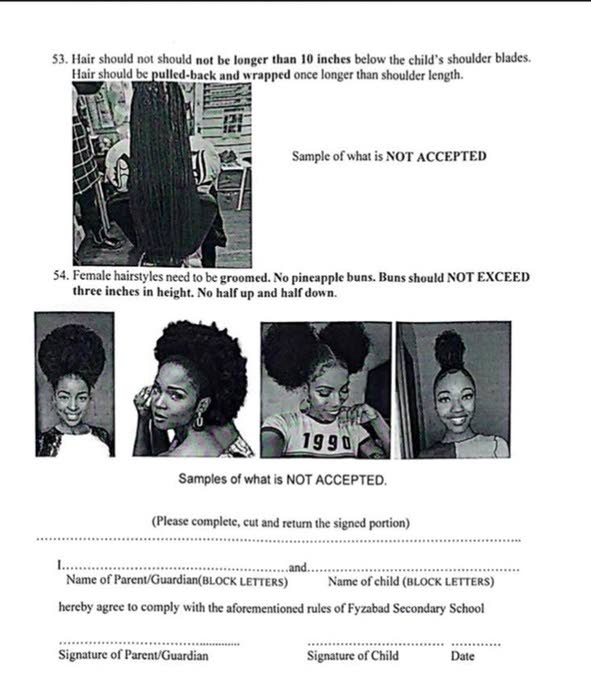
The issue intensified after a post on January 17 showed a contract sent to parents of Fyzabad Secondary School outlining items 53 and 54 of the school’s 2026 rules. The document included signature lines for both parent and child, indicating agreement to comply with the rules.
Item 53 stated, “Hair should not should not [sic] be longer than ten inches below the child’s shoulder blades. Hair should be pulled-back and wrapped once longer than shoulder length.” A photo accompanying the rule showed braids extending below a person’s buttocks as an example of what was not accepted.
Item 54 stated, “Female hairstyles need to be groomed. No pineapple buns. Buns should not exceed three inches in height. No half up and half down.” The examples shown featured Black women, including images of afros and pineapple buns.
On social media, commenters questioned why no images of Indian women were included, noting that Trinidad and Tobago is a multicultural society and that Indian girls often wear long hairstyles similar to those depicted.
Comparisons were quickly drawn to the 2023 Trinity College Maraval incident, where 23 students were barred from crossing the stage at graduation because their hairstyles were deemed inappropriate. That incident led to national discussions between the Ministry of Education and key stakeholders and ultimately resulted in the introduction of a National School Hair Code on July 6, 2023.
The code states, “Students shall maintain neat and clean hair at all times. Hair that crosses shoulder length should be tied back at all times for safety reasons. Locs, twists, plaits, afros, cornrows, shall be allowed for all students, in compliance with individual School Hair Rules. Female students shall be allowed to wear hair extensions, including weaves and braids, in compliance with individual School Hair Rules. Wigs and dyed or coloured hair for students are not allowed. In exceptional cases, as determined by the school principal, approval may be granted to students.
“Hairstyles that obstruct the normal view of others are not allowed, except for religious reasons. Eyebrow markings and eyelash extensions are not allowed. Haircut parting designs should be simple. Intricate designs are not allowed. Hair ornaments should be in compliance with individual School Hair Rules.”
Under the policy, individual schools were mandated to form committees to develop their own hair policies and submit them to the Ministry of Education by October.
In a release dated January 19, 2025, the ministry reiterated that the National School Code of Conduct does not prescribe or prohibit specific hairstyles.
“Instead, it requires that any school-level guidelines on grooming and appearance be reasonable, non-discriminatory, respectful of students’ dignity, and consistent with the best interest of the child.
“Schools are permitted to establish guidelines on uniform and grooming to support order, safety, and discipline. However, these guidelines must be applied fairly and consistently, respect cultural identity and personal expression, and avoid humiliation, exclusion, or denial of access to learning.”
Education Minister Dr Michael Dowlath said, “Our approach is clear: schools may set grooming guidelines, but they must be reasonable, respectful, and never deny a child their right to education.”
The ministry emphasised that students should not be excluded from school, instruction, or school activities solely based on hairstyle or grooming concerns and said it will continue working with schools to ensure that grooming guidelines align with the National School Code of Conduct while protecting students’ well-being and upholding values of respect, responsibility and inclusion.