


HAVANA, Cuba |WiredJa Staff | In the grey dawn of Thursday morning, Cuban soldiers in white gloves marched stiff-legged across the tarmac of José Martí International Airport, carrying urns draped in the Cuban flag.
Inside those vessels lay the cremated remains of 32 men—sons, brothers, fathers—killed twelve days ago when American missiles and gunfire tore through Caracas in a raid that spirited Venezuelan President Nicolás Maduro from his homeland to a Manhattan jail cell.
Waiting on the tarmac stood two figures who embody Cuba’s revolutionary continuity: President Miguel Díaz-Canel in military dress, and beside him, 94-year-old Raúl Castro—the retired former leader in mourning uniform with black epaulets, silent throughout the ceremony.
Their presence spoke volumes about what this moment means for the island nation: these are not merely military casualties, but martyrs in an ideological struggle that Washington has now reignited with devastating force.
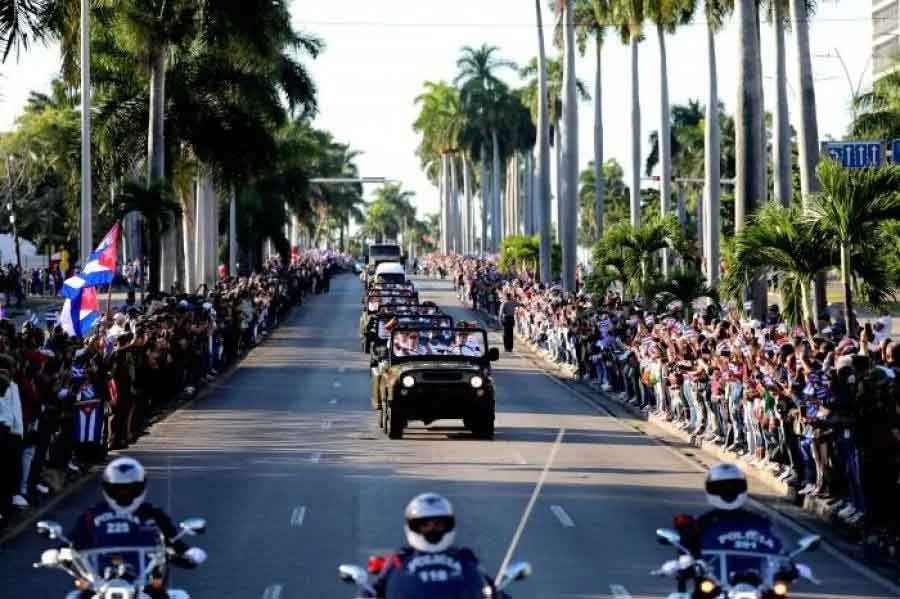
The motorcade that later carried the remains along Rancho Boyeros Avenue to the Ministry of the Revolutionary Armed Forces passed thousands of Cubans standing in a heavy downpour, waving flags and saluting.
Many waited for hours in the rain to pay respects at the ministry throughout the day—a display of national solidarity that the government clearly orchestrated, but which nonetheless reflected genuine grief and defiance.
The Faces Behind the Numbers
Cuban Interior Minister Lázaro Alberto Álvarez delivered the ceremony’s most pointed rebuke of American triumphalism. “The enemy speaks to an audience of high-precision operations, of troops, of elites, of supremacy,” he said. “We, on the other hand, speak of faces, of families who have lost a father, a son, a husband, a brother.”
Twenty-one of the fallen served in Cuba’s interior ministry, which oversees intelligence services. The remainder were military personnel. All have been granted posthumous promotions.
What they were doing in Venezuela—training troops, restructuring intelligence agencies, protecting Maduro—has been documented for years by international observers, including a United Nations fact-finding mission. But their deaths have transformed years of quiet documentation into an immediate geopolitical crisis.
A Caribbean Fracture
For the Caribbean, this funeral marks something more than Cuban grief—it exposes the shattering of regional consensus. CARICOM convened an emergency meeting within hours of the January 3 raid, describing the situation as one of “grave concern.” Yet the responses that followed revealed a community divided against itself.
Trinidad and Tobago’s Prime Minister Kamla Persad-Bissessar, a vocal supporter of increased U.S. military presence in the Caribbean, welcomed the prospect of “renewed cooperation” with a post-Maduro Venezuela.
Guyana’s President Irfaan Ali, long locked in territorial disputes with Caracas, announced troop deployments to the border while praising Washington’s “leadership.”
Meanwhile, Brazil’s President Lula da Silva warned the action “recalls the worst moments of interference in the politics of Latin America and the Caribbean and threatens the preservation of the region as a zone of peace.”
The “Zone of Peace”—that cherished Caribbean doctrine declaring the region off-limits to great power military adventurism—now lies in tatters.
When the United Nations Secretary-General called the raid “a dangerous precedent,” he articulated what smaller nations already understood: if Washington can abduct a sitting head of state from his capital, no sovereignty is safe.

The Noose Tightens
President Trump has made clear that Cuba is next in his sights. Days after the Caracas raid, he warned Havana to “make a deal” before it’s “too late,” promising to sever the Venezuelan oil lifeline that has kept Cuba’s economy from complete collapse.
“Cuba literally is ready to fall,” Trump told reporters. Secretary of State Marco Rubio, the Cuban-American son of immigrants and longtime advocate of regime change in Havana, has called Cuba’s leaders “incompetent, senile men” who should be “concerned.”
For an island already staggering through its worst economic crisis in decades—a crisis deepened by Hurricane Melissa’s devastation last October—this is existential pressure.
The calculation in Washington appears to be that economic asphyxiation will accomplish what six decades of embargo could not.
The March Continues
Tomorrow, Havana will gather again at the Anti-Imperialist Tribune for what officials have termed a “March of the Combatant People.” Provincial ceremonies will honour the fallen across the island. The message from Cuban leadership is unmistakable: defiance, not capitulation.
But defiance cannot feed a hungry population or restore the oil shipments that kept the lights on. As those 32 urns were carried into the Ministry of the Revolutionary Armed Forces, Cuba confronted not merely the loss of its sons, but a future in which the hemisphere’s most powerful nation has demonstrated—with terrifying precision—exactly what it is willing to do to reshape the Caribbean in its image.
The rain that fell on Havana today will pass. The storm gathering over Cuba shows no sign of breaking. But the million dollar question is: Will Cuba become the 21st century Alamo?




![Former President Barack Obama gestures as he campaigns on behalf of Democratic presidential nominee and his former Vice President Joe Biden in Philadelphia, Pennsylvania [Kevin Lamarque/Reuters]](https://villagevoicenews.com/wp-content/uploads/2020/10/Obama-1.jpg)

