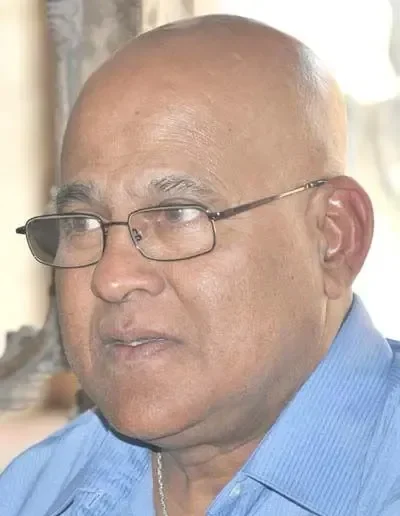
Former Auditor General Anand Goolsarran has raised serious questions about the government’s failure to announce salary increases for public servants and other government workers for 2025, intensifying concerns over transparency, budget execution, and equity at a time of widening economic disparity.
Writing in his Accountability Watch column on December 29, 2025, Goolsarran described the situation as “most disappointing,” pointing as well to what he said was a reneged promise at the highest level of the State to provide a cash grant.
Central to his concerns is the 2025 National Budget allocation for the Ministry of Finance, which includes $19.354 billion under Sub-head 6141 for “other employment costs.” Goolsarran noted that this line item is normally used primarily to finance salary increases. “This amount is normally reserved mainly for the payment of salary increases,” he wrote, questioning whether the allocation was instead used to cover other expenditures and, if so, what those costs were.
He further pointed out that established financial procedures require the presentation of a Supplementary Estimate to the National Assembly when approved allocations prove insufficient during budget execution. “When budgetary allocations prove insufficient during the execution of the budget, a Supplementary Estimate is normally required, in which case the National Assembly has to be convened to enable parliamentary approval of the said Estimate. Why was this not done?” Goolsarran asked.
He also raised the prospect that the government may have decided not to grant any salary increases for 2025, a move he described as unprecedented under current economic conditions.
“Is it that the Government decides that there will be no increase in salaries for 2025?” he queried.
The concerns arise against the backdrop of persistent poverty and rising living costs. While a recently released Inter-American Development Bank report indicates that 58 percent of Guyana’s population lives below the poverty line, with 32 percent in extreme poverty, local experts believe the actual figures are significantly higher, particularly when informal employment, underemployment, and household debt are taken into account.
Trade unions have repeatedly called on the government to pay a livable wage, arguing that public sector salaries continue to lag far behind the real cost of food, housing, transportation, and utilities. Despite sustained advocacy by organised labour, no formal announcement on wage adjustments has been made for the new year.
Guyana’s oil-fuelled economic expansion has further sharpened public scrutiny. By the last quarter of 2025, the country is estimated to have earned more than US$8 billion in oil revenues since first oil in 2019, deepening public concern over how the benefits of this windfall are being distributed. The economic disparity is increasingly visible across the country, from rapid luxury development to communities struggling with stagnant incomes and rising prices.
The uncertainty over wages is compounded by unresolved questions surrounding promised cash grants. During the height of the September 2025 General and Regional Elections campaign, President Irfaan Ali had promised that if the People’s Progressive Party (PPP) was re-elected, every adult aged 18 years and older would receive a $200,000 cash grant for Christmas, a pledge that was not delivered. By the end of December, the President indicated that a $100,000 cash grant would instead be provided in the 2026 Budget, only to later state that cash grant distribution is a “failed model,” despite evidence of successful cash transfer programmes in countries such as Alaska in the United States and Norway.
In this context, Goolsarran also questioned the continued policy of granting the disciplined services a one-month tax-free bonus, while other categories of government workers receive no comparable benefit.
“We note that the disciplined services continue to receive one month’s tax-free bonus, and we once again ask whether other government workers are also not deserving of a similar bonus,” he wrote.
Goolsarran’s intervention adds to mounting pressure on the government to clarify its wage policy for 2025, explain the use of key budgetary allocations, and address growing concerns that Guyana’s oil-driven growth is not translating into meaningful relief for the majority of its citizens.