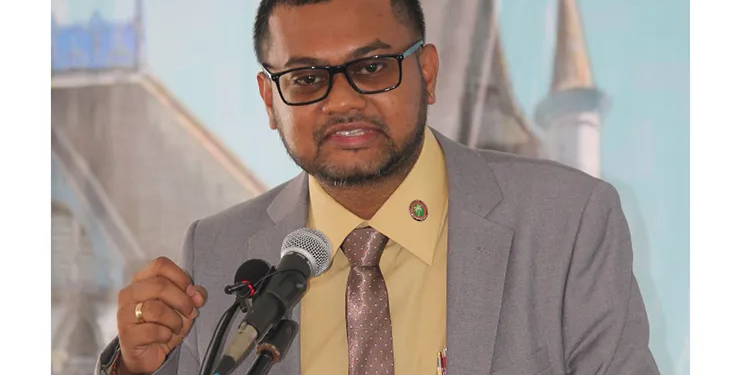
By Mark DaCosta-In a sharp critique of the government’s recent housing initiatives, A Partnership for National Unity (APNU) Member of Parliament Sherod Duncan has drawn attention to what he described as glaring inconsistencies in the Minister of Housing’s recent statements. Rather than demonstrating tangible progress in the housing sector, Duncan said details revealed during the minister’s address on December 27, 2025 underscore what APNU contends is a systemic failure in policy implementation. He argued that a programme intended to deliver affordable and sustainable housing has instead deteriorated into what the opposition characterises as a “land distribution lottery.”
During his address, the Minister of Housing and Water, Collin Croal, proudly reported the allocation of 53,000 house lots over the last five years. However, this accomplishment is overshadowed by the alarming admission that only 4,000 homes have been constructed in that same period. The APNU was quick to calculate that this translates to a mere 7.5 percent conversion rate, indicating that for every 100 families who have received promises of land, fewer than eight have seen their dreams of home ownership fulfilled. “A 7.5 percent conversion rate is not a success; it is a statistical failure,” they emphasised, highlighting that tens of thousands of citizens remain without adequate housing despite being given meagre allocations.
The severity of the situation is compounded by the government’s revelation regarding property titles. While 53,000 lots have been distributed, only 25,000 titles have been processed. Consequently, approximately 28,000 families now find themselves as “Paper Landlords”, unable to leverage their allocations for mortgages or even commence construction on their homes. The APNU pointedly remarked, “An allocation without a title is not an asset; it is a debt.” This stark reality leaves many families trapped in a bureaucratic limbo, unable to move forward with their housing plans.
The Minister characterised his government’s housing strategy as “aggressive,” yet the backlog of pending applications has swelled to a staggering 78,000. The APNU has underscored this alarming trend, asserting that after five years of purported growth and expenditure, the waiting list has only grown longer. “The government is printing allocation letters slower than the needs of the population are growing,” they said, framing this as evidence of a flawed system unable to meet the increasing demands for housing.
Furthermore, Duncan took aim at what he describes as “election mathematics” in the Minister’s promise to construct 40,000 homes in the next term. Coming on the heels of constructing just 4,000 homes over five years, such a dramatic increase in projected output is viewed with scepticism. They labelled the government’s optimism “insulting to the intelligence of the Guyanese people,” inferring that these promises were a mere tactical diversion aimed at voters rather than a genuine policy shift.
In stark contrast to the current administration’s approach, the APNU has proposed a comprehensive overhaul of the nation’s housing policies under their “Housing Guyana” initiative. They argue that housing policy should focus on real outcomes — actual keys in hand rather than just letters in files. The APNU’s strategy introduces several key measures designed to enhance accessibility and equity.
To begin with, they plan to lower the housing application age to 18 and offer free house lots to those earning less than $400,000 monthly. Additionally, a Rent-to-Own scheme will be rolled out to bridge the gap between allocation and ownership, making it easier for families to transition into their own homes with minimal upfront costs. The APNU also plans to extend monthly rent assistance to cap housing expenses at 30 percent of individual income, thereby alleviating the burdens of homeownership and living costs.
In terms of expanding housing supply, the party intends to take a proactive stance by converting unused lands and abandoned properties into viable housing stock. This would include a focus on climate-smart development, steering major new projects inland to reduce strain on coastal areas that are increasingly vulnerable to climatic challenges. Crucially, they intend to ensure that these plans are supported by the establishment of a Renters’ Bill of Rights and improved transparency in the housing application process to eliminate favouritism and inequality.
Duncan maintains that it is the government’s responsibility to provide actual homes rather than mere promises. “Guyanese do not live on allocations. They live in homes,” the parliamentarian stated firmly, positioning the APNU’s plan as a robust alternative to the current administration’s apparent shortcomings.