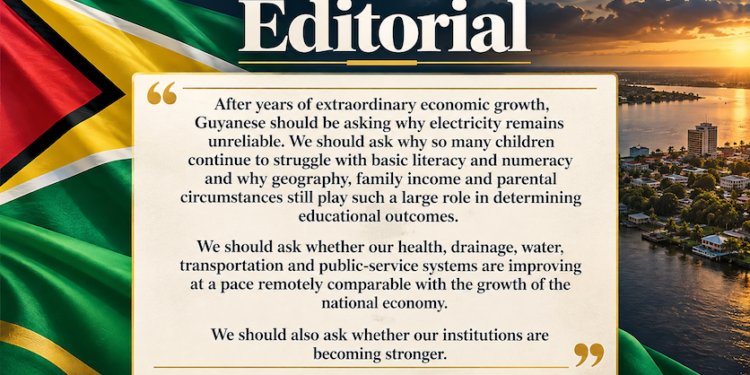
Guyana today stands as one of the cruelest contradictions in the modern world. Hailed internationally as the fastest-growing economy on Earth, the country is drowning in oil wealth, foreign investment, and trillion-dollar budgets. Yet for the majority of its people, daily life has become a relentless struggle marked by hunger, anxiety, and deprivation. This is not growth; it is grotesque inequality. Guyana has become a tale of two cities. One of glittering excess reserved for the politically connected, and another of quiet desperation endured by the many.
The figures alone are damning. The Inter-American Development Bank reports that 58 percent of Guyanese live in poverty, a staggering indictment of governance in an oil-producing state. Many believe the reality is even worse. Guyana’s data-collection systems are weak, outdated, and politically convenient. Fear also plays a role—fear of victimisation, fear of job loss, fear of state retaliation—silencing those who might otherwise expose the true depth of hardship. Poverty here is not just widespread; it is hidden, normalised, and ignored.
While ordinary citizens are forced to choose between food and electricity, rent and medicine, school supplies and transportation, a narrow elite linked to the People’s Progressive Party/Civic (PPP/C) government thrives. Contracts circulate among the same names. Access flows to the same networks. Opportunities concentrate where political loyalty is assured. Oil wealth, instead of lifting the nation, has hardened class divisions and entrenched privilege.
President Irfaan Ali bears direct responsibility for this moral collapse. During the 2025 election campaign, he stood before struggling Guyanese and promised a $200,000 Christmas cash grant—a promise made explicitly to ease hardship during the most expensive time of the year. “We will have a beautiful Christmas,” he said. That pledge raised expectations, shaped household budgets, and gave desperate families a reason to hope.
Today, with 11 days left until Christmas, that promise rings hollow. There is no timetable. No clear announcement. No administrative readiness. The silence is deafening—and revealing. It increasingly appears that the cash grant was never a serious policy, but a calculated election gimmick designed to extract votes from a suffering population. If so, it represents one of the most cynical acts of political deception in Guyana’s modern history.
In an oil-rich nation, broken promises are not harmless. They translate into empty cupboards, unpaid bills, and children going without. When leaders toy with hope, they deepen despair. When they dangle relief and then withdraw it, they erode trust not just in government, but in democracy itself.
The PPP/C government cannot continue to celebrate macroeconomic growth while micro-level misery spreads unchecked. GDP figures do not feed families. Oil revenues do not automatically reduce poverty. Development that benefits only the connected is not development at all—it is extraction with a national flag.
Guyana’s crisis is no longer about resources. It is about choices. Choices to prioritise cronies over citizens. Choices to invest billions in vanity projects while social protection remains weak. Choices to reward loyalty instead of need. Choices to govern for the few while the many endure sacrifice after sacrifice.
History will not judge this era by oil output or growth rates. It will judge it by how a government treated its people when it had unprecedented wealth and power. Right now, that judgment looks bleak.
Guyana does not suffer from a lack of money. It suffers from a lack of fairness, honesty, and moral leadership. Until that changes, this so-called economic miracle will remain exactly what millions already know it to be: a mirage—visible from afar, unreachable up close, and cruel to those forced to chase it.