Wednesday, October 7, 2026
Village Voice News
ADVERTISEMENT
  • Home
  • News
  • Sports
  • Editorial
  • Letters
  • Global
  • Columns
    • Eye On Guyana
    • Hindsight
    • Lincoln Lewis Speaks
    • Future Notes
    • Blackout
    • From The Desk of Roysdale Forde SC
    • Diplomatic Speak
    • Mark’s Take
    • In the village
    • Mind Your Business
    • Bad & Bold
    • The Voice of Labour
    • The Herbal Section
    • Politics 101 with Dr. David Hinds
    • Talking Dollars & Making Sense
    • Book Review 
  • Education & Technology
  • E-Paper
  • Contact Us
No Result
View All Result
  • Home
  • News
  • Sports
  • Editorial
  • Letters
  • Global
  • Columns
    • Eye On Guyana
    • Hindsight
    • Lincoln Lewis Speaks
    • Future Notes
    • Blackout
    • From The Desk of Roysdale Forde SC
    • Diplomatic Speak
    • Mark’s Take
    • In the village
    • Mind Your Business
    • Bad & Bold
    • The Voice of Labour
    • The Herbal Section
    • Politics 101 with Dr. David Hinds
    • Talking Dollars & Making Sense
    • Book Review 
  • Education & Technology
  • E-Paper
  • Contact Us
No Result
View All Result
Village Voice News
No Result
View All Result
Home Columns Diplomatic Speak

Mexico’s $7.5 Billion Gamble to Disrupt the Panama Canal; 11 Things Mentally Strong People Do, Versus Leader Traits

Admin by Admin
December 13, 2025
in Diplomatic Speak
0
SHARES
0
VIEWS
Share on FacebookShare on Twitter
A NEW RAILWAY is transforming communities, livelihoods, and landscapes—and could SHAKE UP GLOBAL TRADE.

COATZACOALCOS, MEXICO—For over a century, Mexican planners have strived to connect the Pacific Ocean to the Caribbean Sea via railways crossing the Isthmus of Tehuantepec in the country’s south. The idea, first undertaken by President Porfirio Díaz in 1907, is finally coming together with renewed proportions and reach.
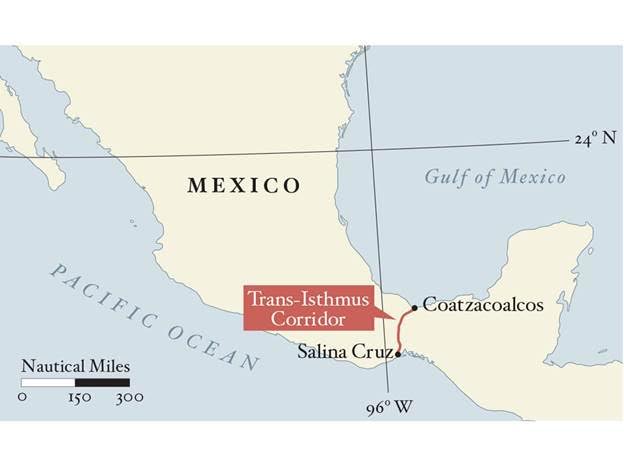
NEW RAILWAY on RED line.
Tehuantepec Interoceanic Corridor aims to compete with the Panama Canal, industrialize towns and cities along its path, and turn southern Mexico into a world-class logistics and manufacturing hub. It centers around three new rail lines; involves two major port upgrades, industrial initiatives, new gas lines, and highways; and offers sweeping incentives to attract private companies to four states: Veracruz, Oaxaca, Chiapas, and Tabasco.

Since its start in 2019, the project, known by its Spanish acronym CIIT, has received massive public investment—around $4 billion—from the administrations of President Claudia Sheinbaum and her predecessor, Andrés Manuel López Obrador. It has also attracted $1 billion in projected private funding.

READ ALSO

Guyana SunFresh: US$25K Solar Cold Hubs, Solar Tiles and Trees for Rural Farmers

Sir Dr. Arthur Lewis — only BLACK NOBEL Economist — Guyana can use OIL CASH to Achieve THE LEWIS MODEL — LAND is Strength, SKILLS GAP Weakness, INDUSTRY Opportunity, OIL CURSE Threat.

Alongside the railways, the government plans to create “development poles,” industrial parks designed to attract private investment in specific sectors including semiconductors, pharmaceuticals, automotives and clean energy, among others. Companies including Mota-Engil México, Grupo Carso and ProIstmo have already been granted licenses to develop them.

Because the CIIT connects two major ports and its backbone, Line Z, will move maritime cargo between them, the project is administered by the Mexican navy, which provides security for railway operations and industrial park construction. Policymakers have promised abundant energy and water resources for investors, but Indigenous communities and environmental advocates are concerned over displacement and water use.

In April, the corridor made its first major delivery. Its 308-kilometer Line Z transported 900 U.S.-bound Hyundai vehicles from Salina Cruz in Oaxaca to Coatzacoalcos, Veracruz. The operation took about a week and bested the Panama Canal on time and cost.

A PANAMA CANAL ALTERNATIVE

Mexico links its Atlantic and Pacific coasts without a canal through the Interoceanic Corridor of the Isthmus of Tehuantepec, a project that uses existing and modernized rail lines, roads, and ports to transport goods across the narrowest part of the country.
This multi-modal corridor aims to serve as a FASTER and CHEAPER  alternative to the Panama Canal by transferring cargo BETWEEN  ships on each coast via TRAIN.

How it works
Route: The project is built on the Isthmus of Tehuantepec, an 188-mile strip of land where the Atlantic (Gulf of Mexico) and Pacific coasts are closest.

Infrastructure: It involves modernizing and building new rail lines, roads, and port facilities on both coasts.

Process
: Cargo is loaded onto a ship at a Pacific port (like Salina Cruz), transported by train across the isthmus, and then loaded onto another ship at an Atlantic port (like Coatzacoalcos/Kawasako).

Purpose: The main goal is to offer a more efficient option than the Panama Canal, particularly during periods of congestion, and to become a major logistics and manufacturing hub.

Key advantages and challenges

Advantages:
 The project promises shorter transit times compared to a full sea journey and can be a cheaper option for certain types of cargo. It also aims to stimulate economic development in southern Mexico.

Challenges
: Transferring cargo between ships and trains adds complexity and time compared to a direct canal route. Some experts are also skeptical about its ability to fully replace the Panama Canal due to capacity and infrastructure considerations.

https://www.americasquarterly.org/article/mexicos-answer-to-the-panama-canal/
ShareTweetSendShareSend

Related Posts

Diplomatic Speak

Guyana SunFresh: US$25K Solar Cold Hubs, Solar Tiles and Trees for Rural Farmers

by Admin
October 2, 2026

For Guyana's Hinterland and Food Security Push SWOT for Solar-Powered Cold Storage Units for Rural Farmers — Guyana Model THE...

Read moreDetails
Diplomatic Speak

Sir Dr. Arthur Lewis — only BLACK NOBEL Economist — Guyana can use OIL CASH to Achieve THE LEWIS MODEL — LAND is Strength, SKILLS GAP Weakness, INDUSTRY Opportunity, OIL CURSE Threat.

by Admin
September 26, 2026

Sir Dr. Arthur Lewis shared the 1979 NOBEL PRIZE AWARD with American Economist Dr. Theodore Schultz for their pioneering work...

Read moreDetails
Diplomatic Speak

Rich Americans Pick ITALY and PORTUGAL; Singapore the # 1 for Wealth Mobility; KENYA’S Roam e-bikes = IDEA for Guyana to START with $50K

by Admin
September 19, 2026

Demand for additional CITIZENSHIP, RESIDENCY, and INVESTMENT opportunities overseas has never been higher, “as AFFLUENT AMERICANS seek international diversification in...

Read moreDetails
Next Post

Concerns Raised Over CHPA’s Expanding Mandate and Heroes Highway Widening


EDITOR'S PICK

AFC POSITION IN PARLIAMENT ON VENEZUELA MOTION PARLIAMENTARY COMMITTEE ON FOREIGN RELATIONS MEET 22 TIMES UNDER COALITION AND 3 TIMES UNDER CURRENT PPP

May 27, 2025
Kieran Powell.

Powell hits 102 to lead CCC to two-wicket win over Barbados Pride

November 9, 2024
ashwagandha (NCCIH Photo)

Health Benefits of Ashwagandha, Based on Research

July 15, 2024
President Irfaan Ali (R) U.S Secretary of State, Marco Rubio and Prime Minister Mark Phillips during Rubio's March 2025 visit to Guyana (Photo credit: President Ali's facebook)

U.S. Police Role in Elections Raises Sovereignty Concerns, Says Retired Diplomat

July 10, 2025

© 2024 Village Voice

No Result
View All Result
  • Home
  • News
  • Sports
  • Editorial
  • Letters
  • Global
  • Columns
    • Eye On Guyana
    • Hindsight
    • Lincoln Lewis Speaks
    • Future Notes
    • Blackout
    • From The Desk of Roysdale Forde SC
    • Diplomatic Speak
    • Mark’s Take
    • In the village
    • Mind Your Business
    • Bad & Bold
    • The Voice of Labour
    • The Herbal Section
    • Politics 101 with Dr. David Hinds
    • Talking Dollars & Making Sense
    • Book Review 
  • Education & Technology
  • E-Paper
  • Contact Us

© 2024 Village Voice