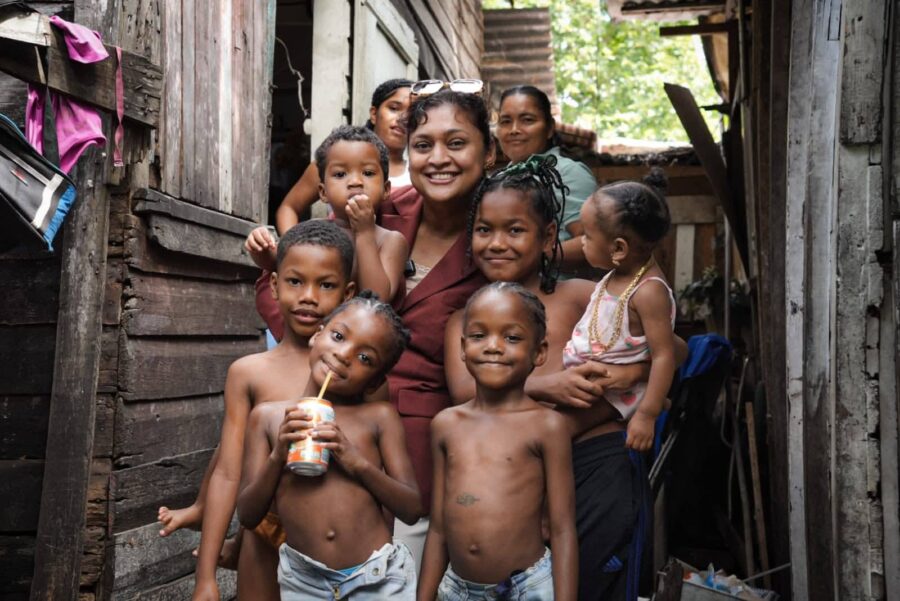
A photograph of Minister of Local Government and Regional Development Priya Manickchand posing with half-naked children, some showing visible signs of malnutrition, has ignited widespread criticism—even among supporters of her own People’s Progressive Party (PPP). The image has become a stark symbol of the disconnect between Guyana’s rapid accumulation of oil wealth and the everyday reality faced by its children, thousands of whom continue to live in poverty. Analysts argue that, despite billions flowing into the Natural Resource Fund (NRF) since first oil in 2019, the country has failed to convert its resources into meaningful improvements in child welfare, education, and health.
Images of children living in deprived conditions underline a harsh reality: despite being one of the fastest-growing oil economies in the world, Guyana has yet to tackle widespread child poverty. According to UNICEF, 333 million children globally—about one in six—live on less than US$2.15 per day, a crisis worsened by economic shocks, conflict, and climate change. UNICEF emphasizes that poverty in childhood damages not only immediate well-being—through poor health, nutrition, and lack of education—but also long-term development, locking entire generations into cycles of deprivation.
In Guyana, the scale of the problem is acute. Forty percent of children experience “moderate child food poverty,” receiving barely three to four food groups per day—half of what is needed. “That is the truth of the masses. And this is happening in our country, an agriculture-based economy now with the added bonus of oil, the fastest-growing economy in the world,” noted a local analyst.
Since the country began producing oil in December 2019, cumulative revenue reached US$5.44 billion by late 2024, with the NRF alone receiving US$2.57 billion in 2024. Continued revenue growth is projected to surpass US$12 billion between 2025 and 2028. Yet, analysts warn that these funds have not translated into meaningful improvements in child welfare, education, or health outcomes.
Pockets of extreme poverty remain widespread. Hinterland regions such as Barima-Waini (Region 1), Cuyuni-Mazaruni (Region 7), Potaro-Siparuni (Region 8), and Upper Takutu-Upper Essequibo (Region 9) report poverty rates exceeding 70 percent, particularly among indigenous communities with limited access to services and infrastructure.
Urban centers are not exempt: in Georgetown, neighborhoods like Tiger Bay, Charlestown, and Albouystown continue to grapple with overcrowding, poor sanitation, and underemployment. President Irfaan Ali visited Tiger Bay in August 2020, distributing relief hampers and pledging housing and employment programmes, and returned in November 2025 to announce plans to make it the city’s first “model neighborhood.” Yet, local observers argue that these efforts remain largely symbolic, failing to address structural neglect and chronic deprivation.
Education and health outcomes compound the crisis. The World Bank notes that while enrollment at nursery and primary levels is high, a child born in Guyana today will be only 50 percent as productive as they could be with complete education and full health. Learning-Adjusted Years of Schooling (LAYS) are just 6.8 years, far below regional norms, and school closures due to COVID-19 threaten further losses.
Health indicators remain troubling, with infant and under-five mortality rates significantly above Latin American and Caribbean averages, a high prevalence of HIV/AIDS, tuberculosis, malaria challenges, and non-communicable diseases accounting for 70 percent of deaths.
Commentators argue that these failures reflect the PPP’s government mismanagement of Guyana’s oil wealth and broader economy, leaving children to suffer despite one of the fastest-growing economies in the world. “Our country is rich in resources, but our children are impoverished,” commented an independent analyst. The images of Minister Manickchand with malnourished children, therefore, are more than a moment of political theater—they are a symbol of policy failure, misplaced priorities, and the human cost of poor governance, prompting concern even among party loyalists.