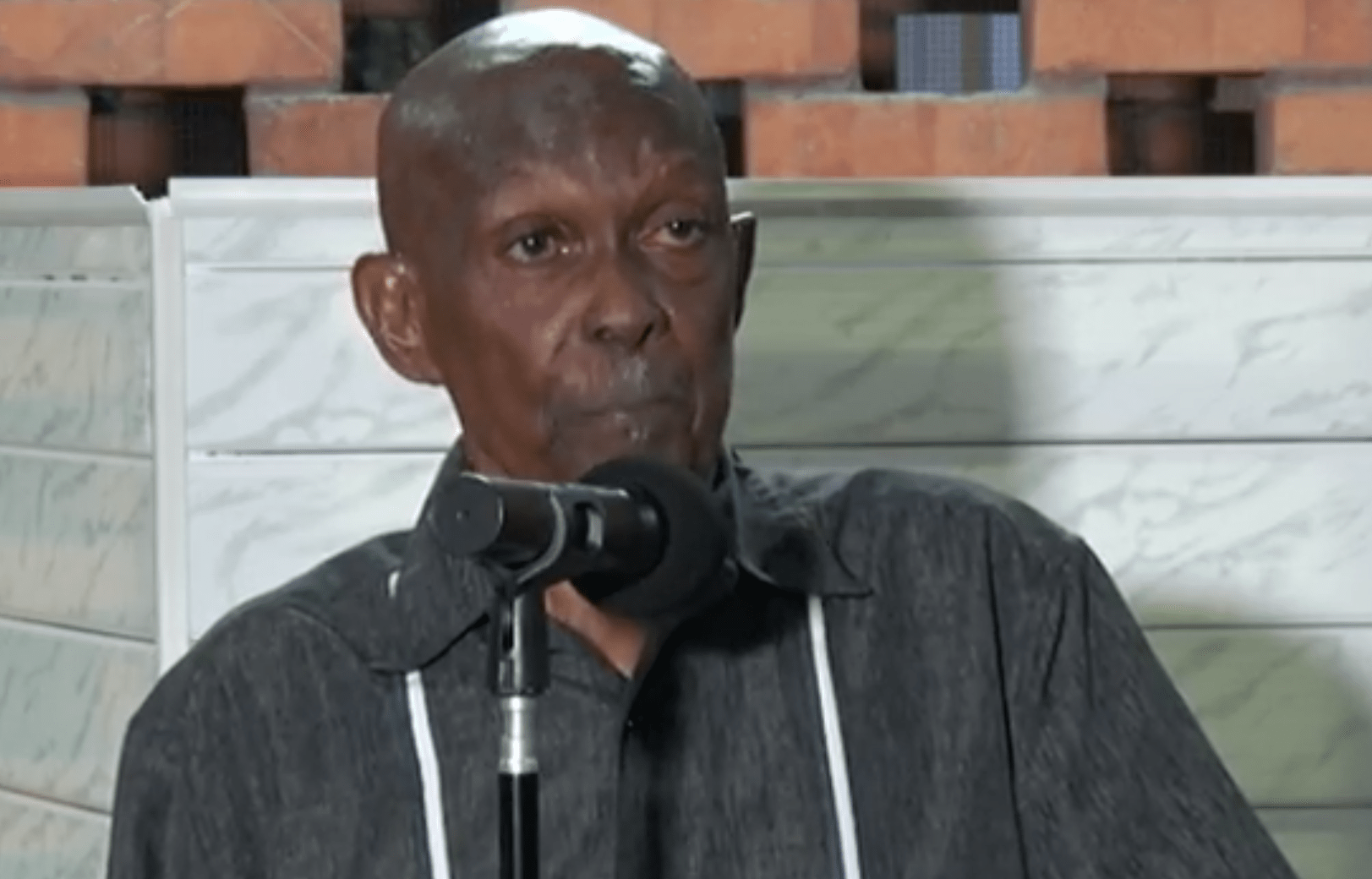
In part two of what was a profound and emotionally charged interview on Nation Watch, former Prime Minister and Mayor of Georgetown Hamilton Green delivered a sobering truth; “The Africans in this country are the only group who were completely severed from their roots.”
At ninety-one, Green remains the last living member of Guyana’s independence delegation. His memory of the nation’s birth and his analysis of its decline form a powerful indictment of how identity, pride, and history have been stripped away from the very people who built the foundation of modern Guyana.
“They Did an Excellent Job During Slavery”
When asked by host Eden Corbin about the disconnection between Afro-Guyanese and their history, Green’s tone darkened. “The Europeans did an excellent job during slavery,” he said flatly. “They made sure the Africans who came here were completely severed from their roots.”
He explained that while other ethnic groups arrived in Guyana with their religion, cultural tools, and family structures intact; the Portuguese, Chinese, and East Indians carrying their drums, their gods, their rituals, Africans were violently robbed of theirs. “They were not even allowed to bring their cultural symbols. The drums were thrown overboard,” he said.
That deliberate erasure, he argued, created generations of Africans “not proud of the fact that they were Black,” and that shame has silently shaped Guyanese society for decades.
Green said efforts by Afro-Guyanese to organize around empowerment are too often smeared as racism. “When Africans talk about what they should be doing to promote themselves, the arch enemy says you’re racist, and so a lot of people back down. That is unfortunate,” he told Corbin.
He challenged the nation’s silence around that fear and the hypocrisy of those who weaponize racial accusations to preserve dominance. “We must speak without being shy, without being afraid,” he urged. “Because the truth can be very difficult in these days.”
Green emphasized that even the nation’s naming conventions reflect its colonial inheritance. “Look around Guyana. If you see a man called Ching, you know he’s Chinese. If you hear someone named Singh or Persaud, you know their origin. But when you come to Hamilton, Corbin, John, Jack—you see how completely unconnected we are to Africa. Those fellas did a good job.”
The Theology of Submission
Turning to religion, Green described what he called “an inherited theology of subordination.” He noted that most churches still rely on the King James Version of the Bible, written during the height of empire. “Even the Bible apologizes for being black,” he said, quoting from the Song of Solomon: ‘I am Black, but comely.’
“The word ‘but’ is the problem,” Green said. “It suggests that being Black requires an apology, that somehow our place is not at the top. And as we read that every day, it sinks into the subconscious of a people.”
He urged pastors to “preach an enabling theology, not what was handed down from the white master,” warning that spiritual dependency has become an extension of the old plantation system.
The Politics of Erasure
Corbin pressed Green on the government’s trend of renaming national landmarks after political figures, such as the Demerara River Bridge and the Timehri International Airport. Green’s response was biting. “It’s the worst form of vulgarity,” he said. “When you name a bridge after a sitting Vice President or former president without consultation, that’s not pride, it’s narcissism.”
He contrasted this with Burnham’s era, when naming was rooted in collective ownership. “We never sought to brand it Burnham’s Bridge,” he said. “When Linden was named, it was after community consultation. Burnham didn’t even know until after.”
He described the renaming of Timehri Airport, originally honoring the Indigenous people of Guyana, as “an abomination” and “an insult to the entire Amerindian community.”
“This is how history is rewritten,” Green warned. “They know that in twenty years, nobody will remember the truth. That’s why we must keep telling it.”
A Call to Reconnection and Resistance
In his closing reflections, Green’s message to Afro-Guyanese youth was urgent and deeply moral. “Pick a street, pick a yard, pick a family, and talk to them about our history,” he said. “Give them a sense of pride in who they are.”
He reminded them that their ancestors “jumped overboard when they realized they were being enslaved,” their bones “still rattling in the Atlantic, begging us to deal with that tragedy and rise higher through study, morality, and excellence.”
“We must remember,” he said quietly, “that the world will not respect a people who do not respect themselves.”
“The Task Is Monumental, But Possible”
Green admitted the work ahead is immense but insisted it can be done. “Before I leave this plane,” he said, “I hope I can see a cadre of young people ready to change things around, to move away from this nonsense we’ve held for years: if you’re black, stay back; if you’re brown, stick around; if you’re white, you’re all right. That is not a joke, it’s a sickness.”
His voice softened near the end, but his message stayed sharp: “Afro-Guyanese must rid themselves of the shame of their history. They must study, organize, and teach others. Because the technological age will not forgive the unprepared.”