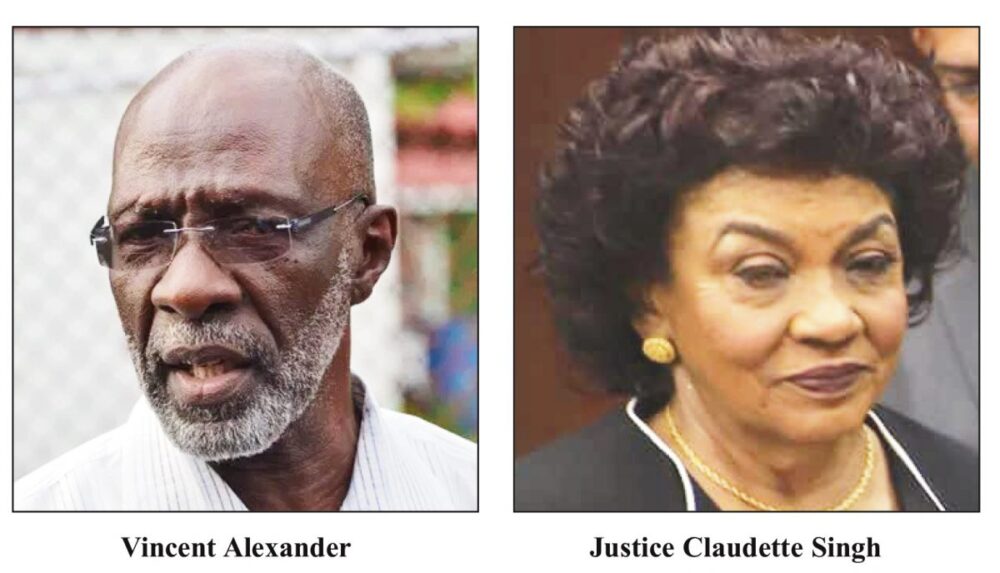
A simmering dispute within the Guyana Elections Commission (GECOM) has escalated, as opposition-nominated Commissioners Vincent Alexander, Desmond Trotman, and Charles Corbin issued a scathing rebuke of GECOM Chairperson, Justice (Ret’d) Claudette Singh. The Commissioners allege serious violations of electoral law and a failure by the Commission to fulfill its constitutional responsibilities following the September 2025 General and Regional Elections.
In two separate letters dated September 11 and October 16, 2025, seen by Village Voice News, the trio of Commissioners detail what they describe as a “grave dereliction of duty” by Justice Singh and an imposed “state of comatose” within the Commission. The controversy centers on the alleged absence of a public declaration of election results, as required under Section 99 of the Representation of the People Act, and the failure to produce the mandatory report on the Regional Elections as outlined in Section 96(2) of the same Act.

Declaration Without Transparency
In the September 11 letter, the Commissioners highlighted that although the presidency was declared during a late-night meeting on Saturday, September 6, there was no public declaration in accordance with Guyanese law. “The results of the General Election were ostensibly declared, albeit there was no Public Declaration as required by the laws of Guyana,” the letter reads.
They further noted that nearly five weeks had passed without GECOM providing the promised copies of the official declarations or the Regional Elections report to the Commission for ratification.
Chair Responds, Commissioners Reject
In a response dated October 10, Justice Singh acknowledged receipt of the original letter and confirmed that the results were gazetted on September 16. However, she appeared to sidestep the accusations of non-compliance with the Act and interpreted the Commissioners’ concerns as a request to summon a meeting. She cited Article 161(3)(b) of the Constitution, implying the Commission may not be duly constituted until the new Parliament is convened and a new Leader of the Opposition is appointed.

Her reply did not sit well with the Commissioners, who also copied their letter to the government-nominated Commissioners.
In their October 16 follow-up letter, they wrote:
“We wish to restate that GECOM, under your stewardship, failed to comply with the legal provisions… These are matters that were brought to your attention… however they were not addressed in your written response or by any action on your part.”
They dismissed Singh’s interpretation of Article 161(3)(b) as flawed and unprecedented, pointing out that since the adoption of the current framework in 2000, there has never been such a reading applied, including during Singh’s own tenure in 2020 and 2022.
Constitutional Dispute Over GECOM’s Composition
At the heart of this disagreement is a constitutional interpretation: does GECOM remain properly constituted after elections, or is it effectively dissolved until a new Opposition Leader is named?
Justice Singh’s reference to Article 161(3)(b) suggests that in her view, GECOM may be in limbo until the new Leader of the Opposition participates in naming opposition Commissioners — an assertion the opposition Commissioners flatly reject.
“To be clear, we… consider the Commission still to be properly constituted,” the Commissioners stated. They argued that legislative or judicial action is needed to change the current framework, and until then, the Commission remains functional.
They went further, warning that Singh’s line of reasoning could be extended to her own office under Article 161(2), which concerns the appointment of the Chairperson by the President on the advice of the Opposition Leader. If her interpretation were upheld, it could theoretically vacate her position upon the appointment of a new Leader of the Opposition.
Wider Concerns and Civil Society Pressure
This constitutional impasse unfolds as pressure mounts from across society. With Parliament constitutionally required to be convened no later than November 2, 2025, civil society bodies — including the Guyana Trades Union Congress — and members of the incoming parliamentary opposition are calling for an immediate sitting to end the uncertainty.
The delay in publicly affirming election results and the internal dysfunction at GECOM threaten to erode public trust in Guyana’s democratic institutions. As legal scholars and political observers watch closely, the case may yet head to judicial interpretation if the dispute is not resolved internally.
Democratic Credibility on the Brink
This is no mere administrative lapse. It is a direct challenge to the rule of law and the institutional credibility of GECOM. When electoral laws are ignored, when constitutionally mandated procedures are selectively interpreted, and when Commissioners are forced to rely on media reports rather than official channels, the legitimacy of the entire electoral process is put in jeopardy.
The Chair’s silence on clear breaches of the law, combined with an unprecedented interpretation of constitutional provisions, raises disturbing questions. Who is accountable? And what prevents further erosion of transparency in future elections?
Without urgent corrective action, whether through parliamentary scrutiny, judicial review, or public pressure, Guyana risks normalising institutional paralysis. That is not just a bureaucratic failure. It is a constitutional crisis in motion.