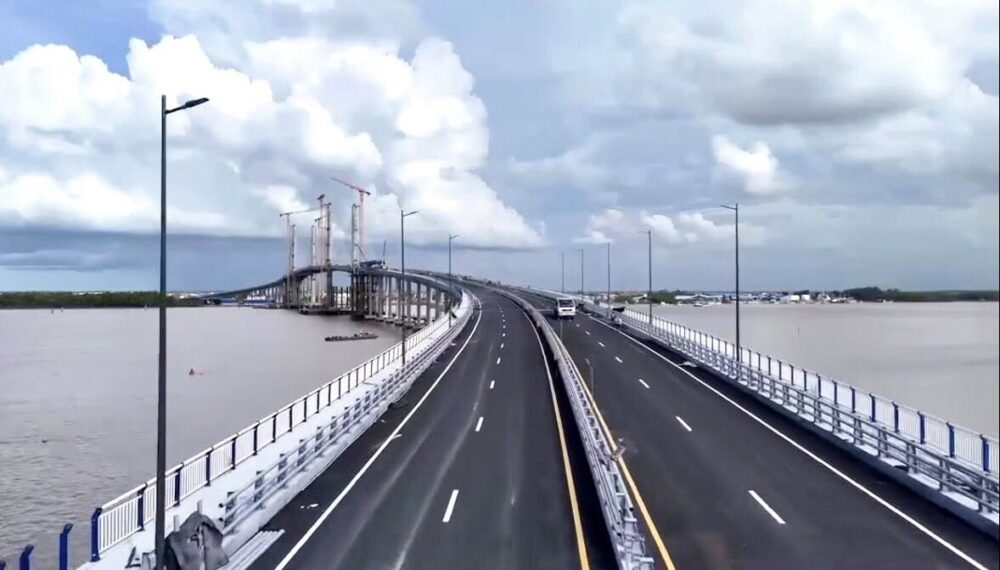
The long-anticipated New Demerara Harbour Bridge (NDHB) is set to be officially commissioned on Sunday, October 5, 2025, marking the culmination of more than a decade of planning and development that spanned three successive administrations and reflects a rare example of bipartisan cooperation in national infrastructure.
The project’s roots stretch back to October 2013, when a pre-feasibility study conducted by the Central Transportation Unit’s Engineer, R. Charles under the then People’s Progressive Party/Civic (PPP/C) government concluded that a high-level, four-lane fixed bridge at Houston–Versailles was the only economically viable option. The study estimated that such a crossing would generate at least US$223 million in societal benefits over a seven-year cycle, at a capital cost of around US$264.5 million.
Later that year, the National Industrial and Commercial Investments Limited (NICIL) publicly advertised for bids under a Public-Private Partnership model to design and construct the new bridge, referencing three potential sites: New Hope, Peters Hall, and Houston. However, no successful bids emerged. In November 2014, a Cabinet paper requested GY$103.5 million to fund a full feasibility study, which again confirmed Houston–Versailles as the most viable alignment.
When the A Partnership for National Unity and Alliance For Change (APNU+AFC) coalition came to office in 2015, then Minister of Public Infrastructure David Patterson took up the mantle and significantly advanced the project. Under his leadership, the Ministry conducted a full feasibility study and geotechnical assessments in 2017, confirming earlier findings. Patterson also began exploring financing options and refining technical specifications, pushing the project into a more advanced planning stage.
Despite the groundwork laid, the project did not move to procurement under the APNU+AFC administration. However, Patterson’s efforts were pivotal in shaping the technical and institutional readiness that allowed the project to move forward once the People’s Progressive Party/Civic returned to office in August 2020.
Under the leadership of President Irfaan Ali, the PPP/C government launched a competitive international tender in 2021, selecting a Design-Build-Finance model for the bridge’s construction. The new structure is a fixed high-span, four-lane bridge designed to improve daily traffic flow, enhance regional connectivity, and support Guyana’s accelerating economic growth—particularly in the context of its booming oil and gas sector.
The New Demerara Harbour Bridge is now regarded as one of the largest infrastructure investments in Guyana’s history, and its imminent commissioning underscores a project that has transitioned from concept to completion over more than a decade.
While the PPP/C government has overseen the final execution and delivery of the bridge, credit is also due to the APNU+AFC administration, which transformed initial studies into an actionable plan, and the earlier PPP/C government, which initiated the concept.
The NDHB stands as both a symbol of national progress and a testament to the value of long-term, sustained development planning. This timeline of collaboration—across both political and technical lines—underscores a rare instance of cross-government continuity in Guyanese public infrastructure.