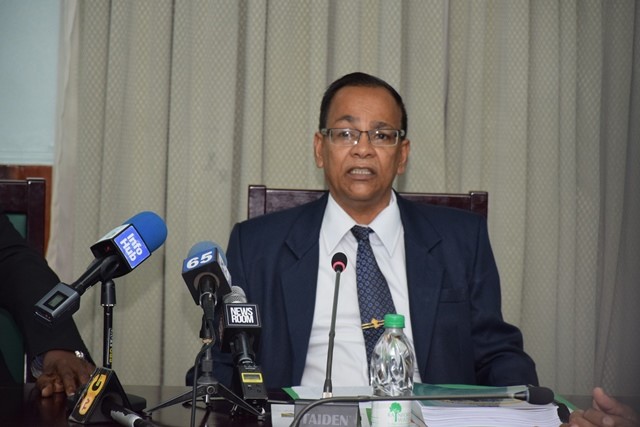
Auditor General Deodat Sharma has announced that new performance audits targeting the Guyana Fire Service and the country’s water and energy sectors are currently underway, with findings expected to expose inefficiencies and drive long-overdue reforms.
The update came during the official handover of the 2024 Public Accounts Report and other audit documents to Speaker of the National Assembly, Manzoor Nadir, on Thursday. Sharma confirmed that four audits are ongoing—two to be completed by the end of 2025 and two more expected to wrap up in 2026.
“We are looking at fire and the smoke that affects people when you have fire; that is with the Fire Service. We are also looking at one on water, to ensure everybody is getting water supply, and there is another one on energy so there are improvements,” Sharma explained.
The 2024 audit cycle also includes a new performance report titled “A Review of Asset Management at the National Drainage and Irrigation Authority (NDIA)”, bringing the total number of performance audits submitted to Parliament to 18.
But Sharma didn’t stop there. He sounded the alarm on massive over-payments to contractors and suppliers, once again highlighting mismanagement in public procurement and project execution. While he welcomed signs of improvement in fuel management, logbook usage, and general recordkeeping, he made it clear that contract management failures remain a major concern.
“Understanding contract management helps to determine whether contractors are adhering to the terms of the contract and whether over-payments were made,” he said, noting that contractors are now being forced to repay when discrepancies are found.
Sharma stressed the need for strict penalties for consulting firms and agencies responsible for delayed or incomplete capital projects, arguing that enforcement is key to improving transparency and delivery of public services.
Despite limited resources, the Audit Office has moved away from traditional “post-mortem” audits to conducting “real-time” audits during project implementation. This proactive approach aims to plug financial leaks before they spiral into national crises.
The Auditor General also pointed to the completion of a seven-year partnership with the Canadian Audit and Accountability Foundation (CAAF), which provided critical training in data analytics and AI-powered auditing. While that international partnership ended in March 2025, Sharma said local training initiatives through the Ministry of Public Service continue to enhance audit capacity across government agencies.
Even as Guyana’s oil and gas sector expands, Sharma admitted his office is still understaffed in this area. However, foundational training for MPs and auditors has begun in anticipation of increased scrutiny in the petroleum industry.
Sharma has tabled 21 to date, a national record. Speaker Manzoor Nadir praised Sharma’s office for meeting the September 30 statutory deadline for 14 consecutive years, calling the work “professionalism at the highest level,” though he acknowledged that over-payments remain a persistent obstacle to accountability.
Guyana’s economy is expanding, and critical sectors like oil, energy, and infrastructure are under growing public scrutiny. Sharma’s latest audits may prove pivotal in exposing systemic flaws. Whether government agencies and contractors will face real consequences — or whether the same cycles of inefficiency and overspending will persist — remains to be seen. The era of silent mismanagement is over, and the spotlight is on.