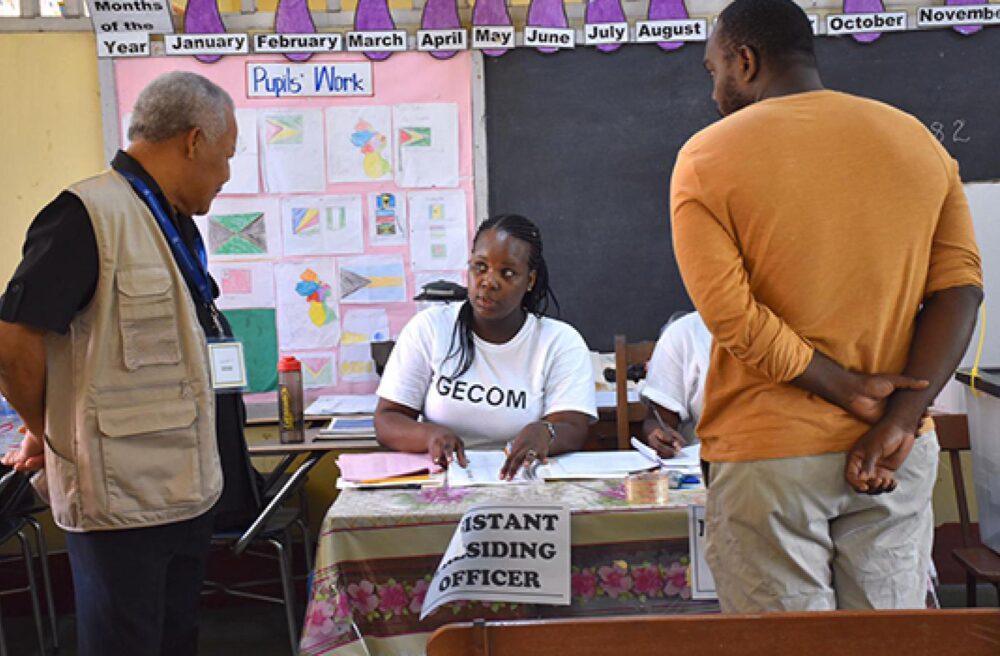
In the aftermath of Guyana’s September 1, 2025 General and Regional Elections, civil society organisations have raised urgent alarms about the credibility and legality of the electoral process. Chief among these concerns are allegations of foreign nationals voting under questionable circumstances, and broader questions about electoral inclusiveness and transparency.
While the Guyana Elections Commission (GECOM) issued a sharply worded press release on September 2, ostensibly responding to these claims, a closer reading reveals that the Commission’s response falls significantly short of addressing the substance and urgency of the issues raised by the eleven signatory organisations, including the Guyana Human Rights Association (GHRA), Red Thread, the Amerindian Peoples Association (APA), Guyana Trades Union Congress (GTUC) and the Transparency Institute Guyana Inc. (TIGI).
Civil Society’s Concerns: Specific, Documented, and Legal in Focus
The statement by the organisations identifies three primary areas of concern:
-
Foreign voter participation, specifically involving groups of Indian and Bangladeshi contract workers seen arriving at polling stations in organised formations, allegedly met by senior police officers.
-
Inconsistencies with ID cards, where the nationality field reportedly showed “Commonwealth” instead of “Guyanese”, which the organisations argue violates constitutional eligibility for voting under Article 59, which reserves the franchise for citizens.
-
Voting irregularities, including bloc voting, which undermines the principle of individual, secret suffrage.
The statement further calls for:
-
The release of full details on all foreign nationals registered to vote.
-
An investigation into whether coercion or employment-related pressures influenced foreign nationals’ participation.
-
Suspension of any observer endorsement of the election until these issues are investigated and addressed.
The tone is not inflammatory—it is legalistic, documented, and clearly targeted at safeguarding constitutional norms and electoral integrity, particularly in light of Guyana’s expanding oil wealth and its implications for national governance.
GECOM’s Response: Defensive, Dismissive, and Lacking Transparency
In contrast, GECOM’s press release offers a general denial of wrongdoing but fails to engage directly or transparently with the demands made by civil society.
Key Gaps in GECOM’s Response:
-
No Quantitative Disclosure
The civil society statement requests specific data: how many foreign nationals were registered, their origin, and how their eligibility was verified. GECOM provides no such figures. Instead, it simply reaffirms that Commonwealth citizens “who meet the criteria” are entitled to register. There is no verification that those identified in the reported incidents met the residency requirement of one year. -
Failure to Address ID Card Anomaly
The organisations allege that ID cards issued to foreign nationals listed “Commonwealth” instead of a valid nationality. GECOM deflects by stating that only the letter “C” is used and that this practice has been ongoing for two decades. However, it does not address the constitutional implications of this practice, nor why the system does not distinguish nationality for electoral purposes, a key legal point raised by the critics. -
Dismissal of Bloc Voting Concerns
GECOM calls the concern over bloc voting a “non-issue,” stating there is no regulation on how voters arrive. While legally true, the contextual concern—that en bloc arrivals of potentially ineligible voters raise red flags about coordination and coercion—is entirely ignored. -
Avoidance of the Coercion Question
GECOM states it “cannot and will not” comment on coercion. Yet coercion is central to the civil society critique, which specifically questions whether employment relationships influenced voting. Silence on this point is conspicuous and deeply problematic. -
No Independent Review or Remedial Process Offered
While GECOM claims to have followed registration procedures, it does not acknowledge that irregularities may have occurred—nor does it offer any mechanism for independent audit, review, or remedial action, all of which were explicitly demanded by the organisations.
A Crisis of Confidence, Not Just Compliance
What emerges from this exchange is not just a difference of opinion, but a deep institutional gap between procedural compliance and public accountability. GECOM appears to argue that because it followed its own processes, no further scrutiny is warranted. Yet the civil society organisations are arguing for a higher democratic standard—one where constitutional eligibility, transparency, and public trust are not just assumed but demonstrably upheld.
The Commission’s response seems to rely on a legalistic shield, without grappling with the real-world consequences: widespread doubt, erosion of trust, and the potential delegitimisation of the electoral outcome.
Implications for Observer Missions and Governance
Civil society’s warning that no observer mission should endorse the results without clarifying these allegations places GECOM under international scrutiny. Should international bodies like CARICOM, the OAS, or the Commonwealth endorse the outcome without full investigations, they risk being complicit in whitewashing possible irregularities.
With Guyana’s oil revenues set to define its future, the stakes could not be higher. The legitimacy of elections is not defined by whether they were “efficient,” but by whether every vote cast was legal, informed, and protected by law.
A Demand for Transparency, Not Denial
Civil society’s statement presents serious, documented concerns deserving of clarification and investigation, not deflection and dismissal. GECOM’s failure to engage substantively with these concerns deepens public scepticism at a moment when credibility is paramount.
To restore public trust, GECOM must move beyond procedural defensiveness and commit to transparent disclosure, external review, and open engagement with stakeholders—including its critics. Anything less risks making the 2025 elections a procedural success, but a democratic failure.