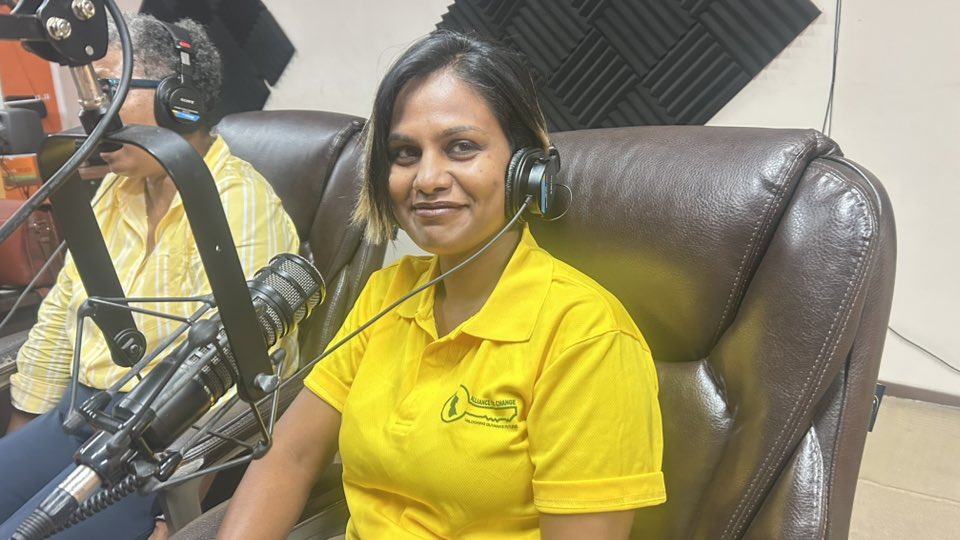
More than half of Guyana’s population is living in poverty or exclusion, yet the country earns over $1.5 billion in oil revenue each day. In a powerful call for economic justice, Alliance for Change (AFC) candidate Dianna Rajcumar has unveiled the party’s bold social protection policy, targeting the “poor,” “very poor,” and “extremely poor” with a plan designed to end generational poverty and create a more equal Guyana.
In a letter shared with the media, Rajcumar laid out a far-reaching framework of cash transfers and conditional support. She emphasised that “cash transfers will deal with structural problems in deprived societies” and be tied to long-term development indicators such as school attendance, child nutrition, and health care. The aim is to “strengthen human capital as a joint responsibility between government and families.”
Grounded in Reality
Drawing from empirical studies by the Inter-American Development Bank and the FAO, Rajcumar pointed to harsh realities: families skipping meals to survive, the cost of food increasing by up to 75 percent over four years, per the New Guyana Marketing Corporation (NGMC), and the growing presence of street dwellers in urban centres. She described a Guyana of stark contrast, where oil riches benefit the few while the many are “scraping a living.”
AFC’s community engagements—across rural villages and remote mountainous regions—confirmed the divide. “The complaint echoes,” she wrote. “The rich are getting richer; the poor are getting poorer. The resounding question is deafening: ‘Where is the oil money?’”
Inclusive and Equitable Targeting
Unlike typical government programmes that exclude citizens without formal documentation, the AFC policy is built around self-declared income. This would allow individuals in informal sectors or rural economies to access support, recognising that nearly half the population lives outside the formal economy.
“This sad reality in oil-rich Guyana is untenable,” Rajcumar wrote. “Citizens must know that the government is only the custodian of the oil revenues.”
Tackling Hunger, Education, and Health
AFC’s policy aims to link cash payments directly to social outcomes—school attendance, vocational training, vaccination, and child nutrition. These outcomes are especially critical given recent UNICEF data that show Guyana topping the charts for wasting, a severe form of child malnutrition, in Latin America and the Caribbean.
“There is a plausible correlation between poverty, learning outcomes, and the attendant high school dropout rate in our most vulnerable communities,” she noted.
Reaching the Marginalised
The AFC plan recognises that existing state services often fail the most isolated and underserved citizens—especially Indigenous communities, persons with disabilities, and the homeless.
Rajcumar proposed training Indigenous doctors and teachers and expanding schools in hinterland communities like Waramadong in the Upper Mazaruni. She also called for the development of a culturally relevant Indigenous curriculum focused on environmental and economic sustainability.
A Dual-Track Approach
The AFC social protection strategy follows a two-pronged approach:
- Keeping people out of poverty: Through social insurance such as rural credit, microfinance, and livelihood diversification that promote long-term income generation.
- Lifting people out of poverty: Via direct support such as conditional cash transfers, mother-to-child health programmes, and agricultural subsidies in the country’s poorest regions.
Rajcumar said the goal is to break the cycle of intergenerational poverty that traps families in economic despair. “One of its outcomes is to have the younger generations equipped to realise their innovative and creative ability,” she wrote.
She drew a sharp contrast between Guyana’s growing economy and its neglected citizens. “Surely, they deserve to navigate careers in Guyana’s economic boom… not have succeeding generations void of innovative career potential because of political greed.”
A Department to Fight Poverty
AFC intends to institutionalise a Family Grant Department within government. It would focus on poverty alleviation, with decentralised access points to ensure inclusion of citizens in interior regions often bypassed by central government agencies.
“This policy action will ensure a fair share of Guyana’s oil wealth,” Rajcumar said.
A Social Contract with the People
Rajcumar’s message resonated as both critique and commitment—a call for transformation rooted in justice, dignity, and inclusion. “Our vested oil wealth must serve every Guyanese—not merely reflect numbers on a sheet—but empower families, nourish children, and secure opportunity for all,” she concluded.
With elections on the horizon, the AFC’s promise of people-centred development could resonate deeply in communities that have long felt left behind.