By Mark DaCosta- The United States (U.S.) Treasury’s sanctions office has made clear that American sanctions do not automatically compel banks to sever relations with persons merely linked to a sanctioned individual. This rebuts the ruling People’s Progressive Party (PPP) party’s apparent rationale for reportedly and apparently pressuring local banks to drop accounts connected to the We Invest in Nationhood (WIN) movement and its leader, Azruddin Mohamed.
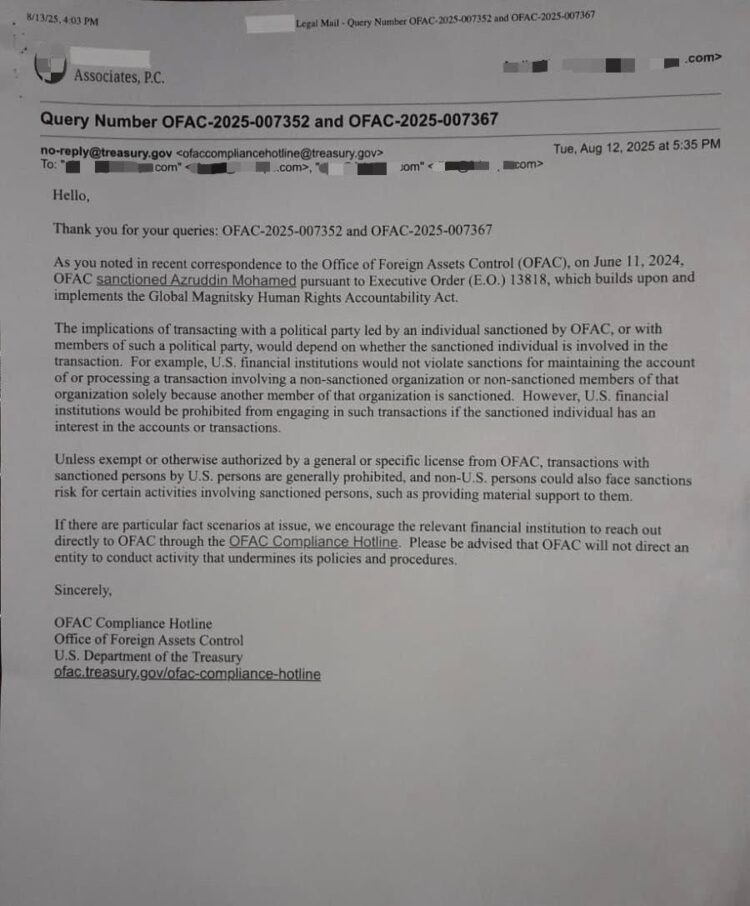
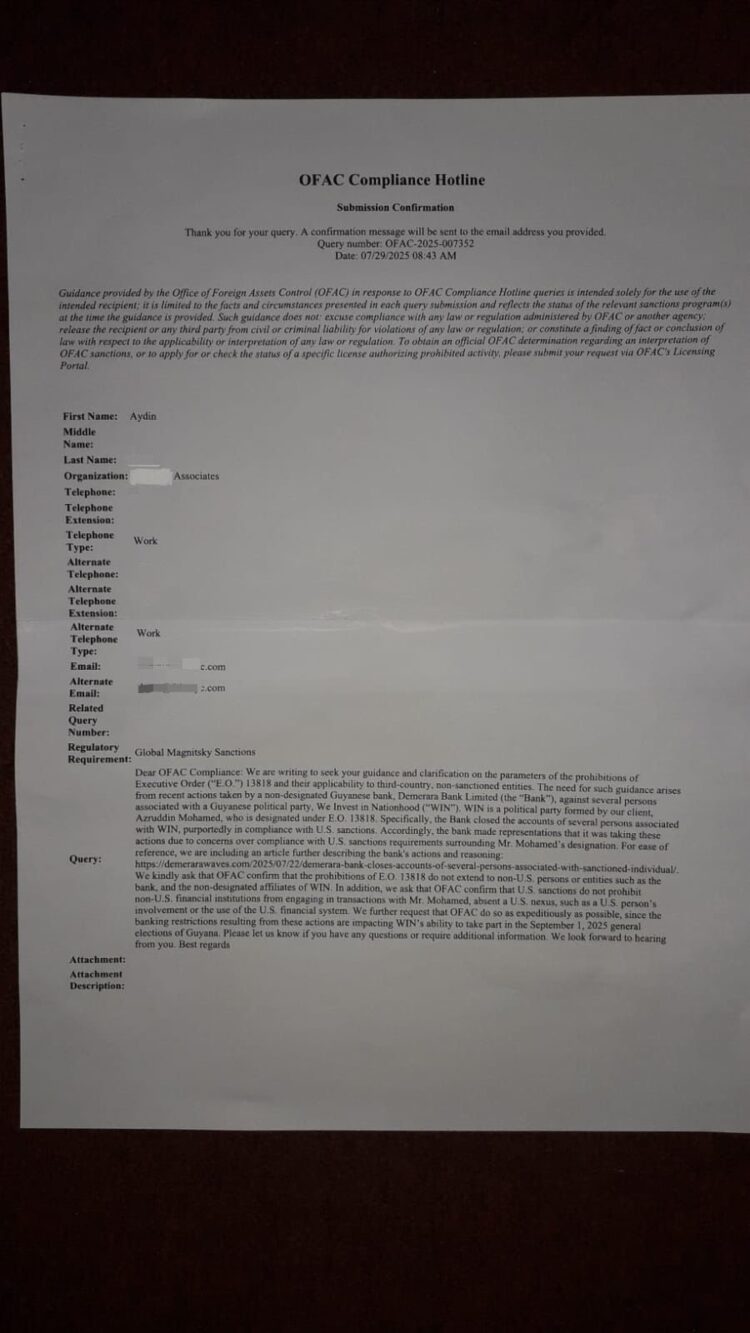
In a development that has sharpened political tensions at home, correspondence from the Office of Foreign Assets Control (OFAC) to local interlocutors makes it plain that U.S. sanctions on an individual do not, by themselves, require financial institutions to close accounts of non‑sanctioned associates.
OFAC’s response — made public by sources close to the WIN party — stresses that liability hinges on the sanctioned person’s actual involvement in the transaction or ownership interest, not on mere association. “The implications of transacting with a political party led by an individual sanctioned by OFAC, or with members of such a political party, would depend on whether the sanctioned individual is involved in the transaction,” the agency wrote.
The same correspondence also reminded enquirers that, “transactions with sanctioned persons by U.S. persons are generally prohibited,” underlining that clear lines exist between targeted prohibitions and broader, extraterritorial caution.
That clarification arrives amid a row in which several domestic banks in our nation cut ties with members of WIN after Azruddin Mohamed entered the political arena and became a force to be reckoned with. Sanctions that named Azruddin Mohamed and related parties.
The banks said they acted to align with international financial sector norms. Local political actors from the governing People’s Progressive Party (PPP) have publicly suggested that the moves were necessary to insulate the financial system and to comply with foreign rules. But OFAC’s intervention belies the assertion that U.S. sanctions automatically required such drastic measures by local institutions. In other words, the PPP is lying.
To be sure, OFAC is a formidable arm of U.S. economic system. It administers sanctions programmes under presidential and congressional authority, maintains listings such as the Specially Designated Nationals and Blocked Persons list, and can freeze assets, bar U.S. persons from dealings with listed parties, and impose significant penalties for breaches. Its remit extends beyond American soil where transactions touch the U.S. financial system or use U.S.-origin services. Yet its action is precise: it targets specific individuals and entities, not entire political movements by association.
The practical effect of OFAC’s guidance is twofold. First, it affords a legal and operational distinction that should protect non‑sanctioned individuals and organisations from automatic exclusion solely because of a shared political platform. Second, it leaves open the reality that banks may, independently and for prudential reasons, opt for more conservative measures to avoid perceived risk — a choice that is neither mandated nor uniformly required by OFAC.
Examined against the local political backdrop, the timing and pressure exerted on financial institutions risk looking less like compliance-driven prudence and more like partisan manoeuvring. The PPP, confronted with the rapid rise of a new party led by a businessman with significant local backing, has incentives to neutralise an emergent political competitor.
Encouraging or otherwise creating circumstances that lead banks to sever relationships with WIN candidates accomplishes a de facto political isolation that goes beyond the narrow intent of targeted sanctions. The fact that the U.S. Ambassador to our country publicly noted there was “absolutely no association” between OFAC’s listings and the banks’ decisions further undermines the PPP’s line that foreign sanctions left them no choice.
It is important to stress that banks possess legitimate discretion when evaluating counter‑party risk. International correspondent banks, exposure to dollar clearing, and reputational concerns can all prompt an institution to restrict services. Yet when those business decisions align almost exclusively with the interests of the dominant political party and follow little evident consultation with the sanctioning authority, suspicions of political motivation are reasonable. Citizens have a right to ask whether financial compliance is being used as a blunt instrument of political containment.
Ultimately, OFAC’s carefully worded reply reminds regulators, banks and politicians alike that sanctions policy is a technical instrument, not a tool for wholesale political exclusion at home. Our nation’s institutions should therefore act transparently, apply consistent risk criteria, and resist PPP partisan pressure that seeks to weaponise legitimate compliance concerns into instruments of political marginalisation. In the absence of evidence that the sanctioned figure has control or benefit in the accounts in question, the case for automatic disconnection is weak — and that is precisely the point OFAC’s correspondence appears to make.