The manifesto’s breadth, spanning infrastructure, industry, finance, security, and governance, signals an ambitious bid to position APNU as the party of economic transformation and social renewal. If implemented, Norton’s proposals could mark a decisive shift in Guyana’s political and economic trajectory.
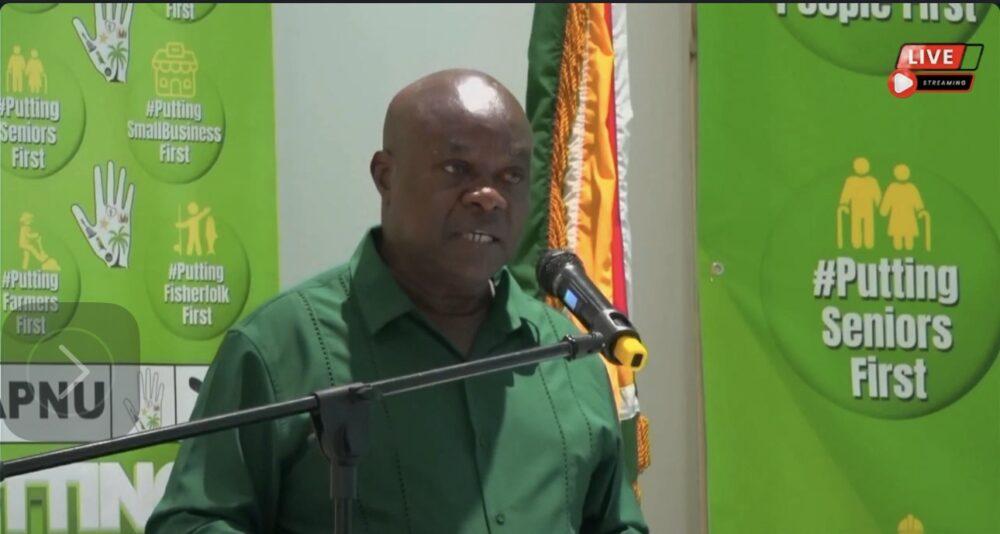
Georgetown, Guyana — In a spirited and far-reaching address, APNU Presidential candidate Aubrey Norton, today, unveiled a sweeping manifesto designed to reshape Guyana’s economy, tackle corruption, and restore public trust in government. Speaking to an energized crowd, Norton laid out a detailed, people-centered blueprint for development, one he said would “lower the cost of living, secure our communities, and create opportunities for every Guyanese.”
The plan, Norton declared, is grounded in economic self-reliance, diversification, and fairness. He challenged the idea that Guyana’s growth should be dictated solely by global market forces, urging a strategic expansion of domestic production even in industries where other nations may have a comparative advantage. “We must not be discouraged from increasing our domestic supply of goods and services,” he said, tying this to a broader commitment to reduce the cost of living for ordinary citizens.
The APNU manifesto promises significant investment in sustainable agriculture across all regions, with a focus on crop diversification, agro-processing, and strengthening industries like rice, sugar, and fishing. Hinterland communities, Norton pledged, would see new highways, upgraded airstrips, and universal access to free, fast, and reliable internet. He committed to directing 50% of carbon credit funds to Indigenous communities and mandating that major mining and forestry companies invest in approved local development projects.
To spur private sector growth, Norton vowed to progressively lower corporate taxes to between 20% and 30%, create special economic zones, and modernize regulations to give predictability to investors. Small businesses would receive prime vending locations, subsidized utilities, and easier access to foreign currency.
A central economic promise is the revival of a national development bank, closed under the PPP/C government, to bridge the financing gap for small and medium producers. Norton outlined plans for an export-import window to support Guyanese businesses entering foreign markets, a junior stock exchange for youth and small enterprises, and a robust expansion of the fintech sector, including openness to cryptocurrency.
Turning to security, Norton called the rise in homicides “intolerable” and promised a complete overhaul of the police force, with an emphasis on preventive policing and removing political interference. He accused the current administration of protecting drug traffickers, money launderers, and corrupt officials, citing estimates that Guyana has lost nearly $600 billion to corruption and mismanagement from 2020 to 2024.
“Robbing the Treasury has a greater impact on the public than the choke and robber on the street,” Norton declared, warning that continued borrowing to cover this loss burdens future generations.
Norton emphasized that effective governance depends on a strong, professional, and motivated public service. He pledged a 35% salary increase for public servants, special long-term financing for homes and vehicles, and incentives for retaining experienced staff. “We want the public service to function like a well-oiled machine for those who depend on its services,” he said.
Concluding his address, Norton said the APNU coalition’s compact with the people would streamline the public service, cut corruption, and restore transparency. “This is not the Guyana we want, and it is not the Guyana you deserve,” he told supporters. “We are on a path to a better life under APNU.”
The manifesto’s breadth, spanning infrastructure, industry, finance, security, and governance, signals an ambitious bid to position APNU as the party of economic transformation and social renewal. If implemented, Norton’s proposals could mark a decisive shift in Guyana’s political and economic trajectory.