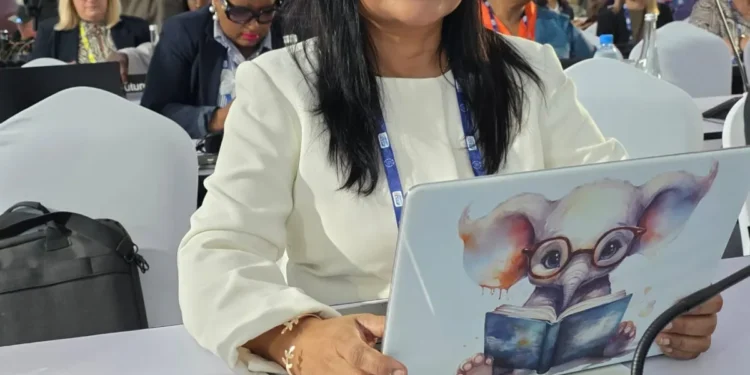
The Alliance for Change (AFC) has wrapped up its “listening and grounding” sessions in Guyana’s hinterland, with candidate Dianna Rajcumar highlighting major gaps in education and infrastructure in the North Rupununi and unveiling targeted policy proposals to address them.
Rajcumar said the interpretivist, qualitative data gathered during the outreach reflected the lived experiences of Indigenous people, revealing that “resources are not fairly/equitably distributed in the Hinterland” — a disparity that directly impacts standards of living.
Focusing on education, she noted that the scattered nature of Indigenous communities along the Lethem trail makes accessibility to schools and other essential services a challenge. “Paved roads bring economic activities, accessibility to schools, hospitals, and the decentralisation of public and provision of private services, such as internet connectivity,” she said.
She reminded that the construction of the Linden-to-Lethem road was signed under the A Partnership for National Unity and Alliance for Change (APNU+AFC) government, funded by a UK Caribbean Infrastructure Fund (UKCIF) grant and a Caribbean Development Bank (CDB) loan.
“The government even wanted to divert the funds from this road construction and with all the oil revenues has not continued with the remainder of the road from Mabura to Lethem,” Rajcumar stated, adding that the Kurupukari bridge feasibility study was completed under the coalition but later cancelled by the current administration.
The lack of infrastructure, she said, has ripple effects. In Toka, residents petitioned for a paved road from Bush Mouth to Toka to make school access easier, while in Annai, 73 students from surrounding villages “walk 4 miles in the heated sun to reach Annai Secondary School.” She noted that despite approval being sought for a school bus through a supplemental budget, students still trek the trails daily.
Rajcumar outlined the AFC’s regional infrastructure plan, which includes paving the road to Lethem, constructing the Kurupukari bridge, and providing buses, boats, and bicycles suited to local terrain “with the free prior and informed consent of the Indigenous people.”
Turning to education resources, she said hinterland schools lack “soft infrastructure” and face shortages that hinder optimal learning outcomes. “Teachers have limited means to continuous training, primary school students have poor internet access for research, limited textbooks, and coupled with poor electric power – these are structural problems which limit learning attainment,” she explained, pointing to consistently lower NGSA and CSEC results compared to coastal schools.
Rajcumar recalled that the APNU+AFC government had provided 200 internet hotspots in hinterland communities at government institutions, health centres, and schools. The AFC’s new policy plans, she said, would expand this with Starlink internet for all hinterland communities, equitable textbook distribution, learning modules, libraries, placement of expert teachers in core subjects, a revised curriculum including Indigenous languages, and continuous teacher training with higher wages.
The AFC also intends to implement redistributive cash transfer policies beyond the current GYD $55,000 “Because We Care” grant, targeting single-parent households, childhood nutrition, and business ventures that generate sustainable livelihoods, enabling parents to keep children in school.
“In effect, a comprehensive policy plan for children’s health, accessibility, and affordability to schools – our Indigenous students must have a fair share of educational attainment on par with coastal students,” Rajcumar said.