In scenes that raise urgent concerns about political exploitation, several 10-day government workers were spotted on the East Bank of Demerara on Wednesday wearing red People’s Progressive Party/Civic (PPP/C) t-shirts and distributing party flyers in the scorching midday sun.
This publication observed the workers going door to door with party literature. For their protection, we are withholding the specific names of the villages, as many expressed fear of losing their jobs if identified.
These so-called 10-day workers, paid by the state and earning $40,000 monthly, are expected to perform minor administrative and community services like drainage or clean-ups. A staggering sum of $12.7 billion has been set aside in the 2025 National Budget for these workers.
Yet, in what appears to be a gross misuse of public funds, these workers are now doing partisan campaign work. According to the Department of Public Information (DPI), as of December 2024, there were 15,283 such workers on the government payroll, a figure expected to rise in 2025—an election year.

When asked about their assignment, one worker explained, “Me supervisor seh is part of we wuk.” None expressed enthusiasm. “We gotta live. We need the money,” one added. “We ain’t really got a choice.”
When questioned about their support for the PPP/C, responses were evasive. One team member nudged another and warned, “Mind wha yuh talkin’,” revealing a culture of fear and silence. All declined to be photographed.
The PPP/C has also deployed 10-day workers to attend and disturb meetings held by presidential candidate Azruddin Mohamed of the We Invest In Nationhood (WIN) party. The strategy appears aimed at drowning out dissent and sabotaging opposing campaign efforts through intimidation.
Even more disturbing, this political work is being conducted during government hours by workers paid with taxpayer money. It erases the line between state service and partisan campaigning and raises serious ethical questions.
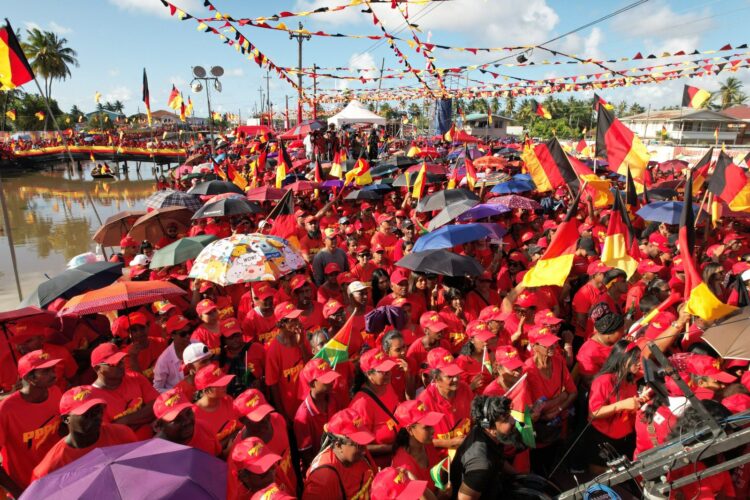
Meanwhile, the PPP/C continues its well-financed campaign blitz, relying not just on paid state workers but also on paid attendees to project the image of mass popularity.
At recent rallies—most notably in Anna Regina and Albion—this publication observed large, PPP/C-branded buses and minibuses ferrying crowds. For Anna Regina, buses, some emblazoned with PPP/C signs, were seen departing along the Georgetown/Parika road, while for Albion, traffic was observed along the Georgetown/East Coast corridor heading into Berbice. The operations appeared tightly organised, supporting the belief that the turnout is being manufactured rather than organic.
Three individuals traveling to the Albion rally admitted they were not genuine supporters but were enticed by promises of $5,000, free shirts, food, and drinks. One young man shrugged, “Is freeness, ma’am, ah going.” Asked if he would vote for the party, he replied bluntly, “Hell, no.”
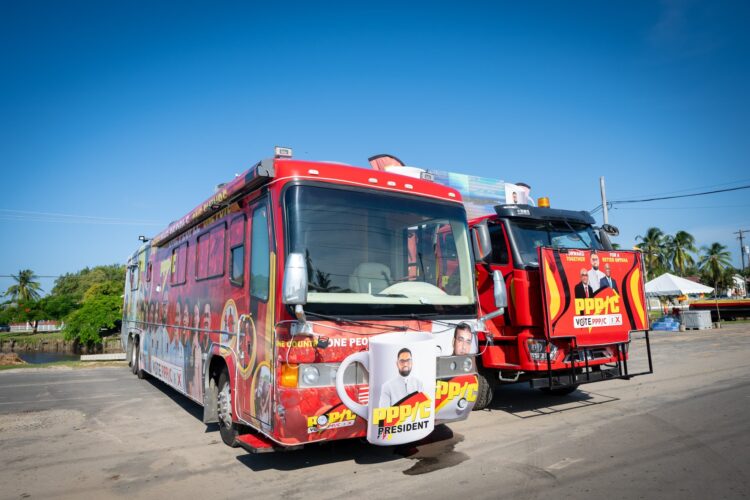
Onstage, government ministers boasted openly about securing a two-thirds majority in Parliament, a claim met with skepticism among civil society watchdogs.
The use of state workers and resources to boost a party’s campaign not only violates principles of good governance but deepens public distrust. It exploits the desperation of low-income citizens while presenting a false picture of national enthusiasm.
Perhaps most worrying is the pervading fear on the ground. Citizens are afraid to speak openly. Many go along silently—not out of loyalty, but out of economic need and fear of reprisal.
As election season intensifies, these developments suggest a troubling trend: a ruling party blurring the lines between state and campaign, using public resources and the vulnerable to stage a performance of popularity that may not reflect the will of the people.
In such an environment, democracy is not just under pressure—it is being undermined.