By Dr. Terrence Blackman (GBJ)- Artificial Intelligence is not merely a technological trend; it is a civilizational shift. It is not simply revolutionising industry, education, and healthcare—it is redefining what it means to know, to decide, and, increasingly, to govern. For Guyana—a young democracy amid an oil-fueled economic transformation—this moment demands more than a fascination with futuristic tools. It requires a critical and strategic reckoning with the nature of intelligence itself, its historical trajectory, and the paths it now opens or forecloses for a country on the cusp of radical transformation.
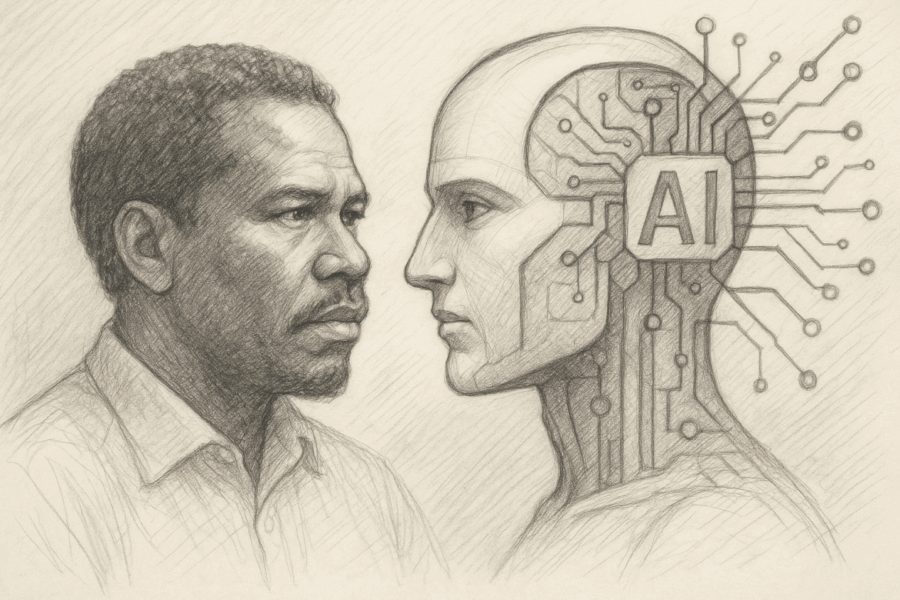
At its most basic level, artificial intelligence refers to the ability of machines to perform tasks that we typically associate with human intelligence, including learning, reasoning, perception, communication, and problem-solving. Today’s most powerful AI systems are built using machine learning, particularly deep learning—technologies that enable machines to detect patterns in vast quantities of data and improve over time without explicit programming.
These systems are not intelligent in the way that we are; they do not feel or understand. However, they can approximate human performance on tasks ranging from cancer diagnosis to music composition. As they scale, they do more than mimic intelligence—they reshape how we live, work, and understand truth and authority.
The idea that thinking could be made mechanical has deep philosophical roots. From Descartes’ mechanistic theories of the body to Leibniz’s dream of a universal logical calculus, the project of formalizing reason has been a constant presence for centuries. In the 20th century, Alan Turing gave this dream a mathematical form. By the 1950s, the field of artificial intelligence had formally emerged.
After cycles of disappointment and resurgence, the field has now entered a phase of breathtaking acceleration. The release of generative AI models—systems capable of producing language, images, code, and even scientific hypotheses—signals a turning point not only in technological history but in human self-understanding. What once seemed like science fiction is now an integral part of daily life’s infrastructure. The map is becoming indistinguishable from the territory.
The implications of this shift for Guyana are profound. Too often, we envision AI as a future concern, one relevant to global tech giants and major economies rather than small developing states. This is a dangerous misconception. In a world where data is the new oil and algorithmic decision-making governs everything from creditworthiness to crop planning, Guyana cannot afford to be a passive consumer of technologies created elsewhere.
We must recognise that AI is already influencing the extractive industries that drive our GDP. It is embedded in the supply chains, financial systems, and environmental monitoring platforms we are adopting. If we do not shape its implementation with clear principles and competent institutions, we risk surrendering our sovereignty in the very era when we appear to have gained it anew.
Yet the presence of this risk also signals an extraordinary opportunity. Guyana, precisely because so many of its systems are being built or rebuilt, has the chance to leapfrog legacy inefficiencies and design a development model grounded in 21st-century intelligence.
A well-governed AI ecosystem could enable us to make evidence-based public policy, optimise resource allocation, expand access to quality education, and deliver health services to remote communities. It could empower our farmers with real-time insights, help us model climate resilience, and match diaspora skills to national needs. These are not abstract promises; they are concrete tools for national transformation—if we are willing to invest in the talent, infrastructure, and ethics to wield them wisely.
That investment begins with our people. AI is not magic. It is math, computation, data, and design—all fields in which Guyanese students can excel if given the chance. We must radically expand and deepen our investments in STEM education.
We must do so in ways that also foreground the humanistic questions that AI raises. What should be automated, and what should not? How do we encode fairness, dignity, and cultural specificity into learning systems? How do we ensure that the data collected on our people, land, and customs is not simply exported to enrich foreign platforms but remains part of a sovereign knowledge commons?
This is where questions of ethics and governance become urgent. AI reflects the values of its makers. When those makers are corporations accountable only to shareholders or states pursuing geopolitical dominance, their systems often embed the biases and blind spots of their creators. We have already seen how AI can amplify discrimination, undermine privacy, and distort truth.
Guyana must not become a testing ground for systems we do not understand or control. We must establish our regulatory frameworks—ones informed not only by international best practices but also by the lived experiences and aspirations of our people. That means recognizing the cultural dimensions of intelligence and rejecting the idea that development must mean digitization without reflection.
Indeed, the deeper promise of this moment is not that we can adopt artificial intelligence but that we can cultivate a form of Guyanese intelligence—a synthesis of traditional knowledge systems, diasporic insight, youthful innovation, and postcolonial self-awareness.
We need not copy the extractive, surveillance-heavy models emerging in parts of the world. We can instead chart a path that uses technology to strengthen democracy, not weaken it; to amplify community, not isolate it; to protect the Earth, not plunder it. We must build AI systems that remember our rivers, honor our languages, and respect our histories, not just optimize profit.
This requires imagination. It requires risk. And it requires leadership. The decisions we make in the coming years about how we govern data, educate our youth, and deploy technology will shape the country our children inherit. If we approach this moment with care, courage, and creativity, we can become not just beneficiaries of the AI revolution but authors of a model of development that others may one day seek to emulate. We can transform intelligence—both real and artificial—into a tool of liberation rather than a means of control.
The machines are learning. The world is watching. And the future, uncertain and luminous, is being written—line by line, code by code, choice by choice. Let us be present to it. Let us be authors of it.
————–
Dr. Terrence R. Blackman is Associate Professor and Chair of the Department of Mathematics at Medgar Evers College, CUNY, and Founder of the Guyana Business Journal & Magazine.