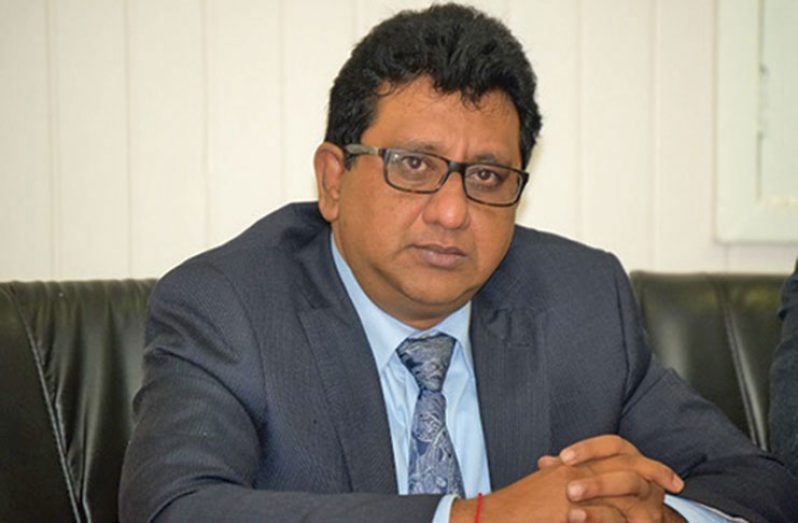
The Attorney General and Minister of Legal Affairs, Mohabir Anil Nandlall, S.C., has strongly rejected recent calls for prisoners to be allowed to vote in the upcoming 2025 general and regional elections, describing the proposal as a last-ditch attempt to disrupt the electoral process.
The calls have come from opposition-nominated commissioners at the Guyana Elections Commission (GECOM), who have urged the Commission to implement systems to allow convicted individuals to cast ballots in September 1 polls.
While there is no law that explicitly bars prisoners from voting, the Attorney General noted that no legal framework currently exists to facilitate voting by persons who are either serving sentences or are on remand.
Addressing the matter on Tuesday evening, the Attorney General questioned the timing and motive of the opposition-nominated Commissioners behind the push just three months before the polls are held.
He further pointed out that the People’s National Congress Reform (PNC/R) has been involved in Guyana’s political landscape for over seven decades, and at no time did the party raise any concern about prisoners voting.
“From 1964 to 1992, didn’t they know that prisoners were not voting? And even before that, in 1957, they didn’t know that prisoners were not voting in Guyana since elections started in Guyana in 1953? These are gentlemen who are in their seventies; they’re not spring chickens. They don’t know that prisoners have not voted before?” Nandlall said on his weekly programme ‘Issues in the News’.
The AG emphasised that even during their early years in government, particularly from 2015 to 2020, the PNC was aware that prisoners were not voting and did not address the issue.
“They never championed the cause of prisoners voting during all those years. There has not been any change in the law since. How is it, all of a sudden, three months before elections, this is an issue of some contention?” he questioned.
According to the AG, this situation is not unique to Guyana, since the nation has adopted a system from the British colonial era.
“Historically, in the Commonwealth… prisoners generally did not vote in England for hundreds of years. And that system was passed down. That tradition and that convention was passed down.”
He explained that imprisonment often results in loss of several freedoms, and historically, voting may have been one of them by default. To change this, the Attorney General noted that a clear policy decision would first need to be made, followed by new laws and proper planning.
He added that allowing prisoners to vote would require intense administrative work, including changes to how elections are conducted and how prisoners are registered to vote.
“You have to have the legislative framework… and then you will have to have the logistics and many, many logistics to think [through],” the Attorney General said.
The AG didn’t hold back in criticising the opposition-nominated GECOM Commissioners who raised the issue, describing it as a tactic to delay the elections.
“That is how you know that these guys can’t be genuine. They are not genuine when they purport to speak as though they are Democrats… You know that it is hypocritical. You know that it is duplicitous…The only ulterior motive would have been to frustrate and delay the elections, and they have lost abysmally.”
The position of the AG is supported by the People’s Progressive Party (PPP)-nominated Commissioner Sase Gunraj. He too, said that there is no legislation to enable GECOM to allow prisoners to vote. And like Minister Nandlall, he questioned the opposition’s motive with elections just three months away.
Gunraj revealed that GECOM has already voted on the matter, which means that prisoners will not be voting in the September 1, 2025 polls. DPI