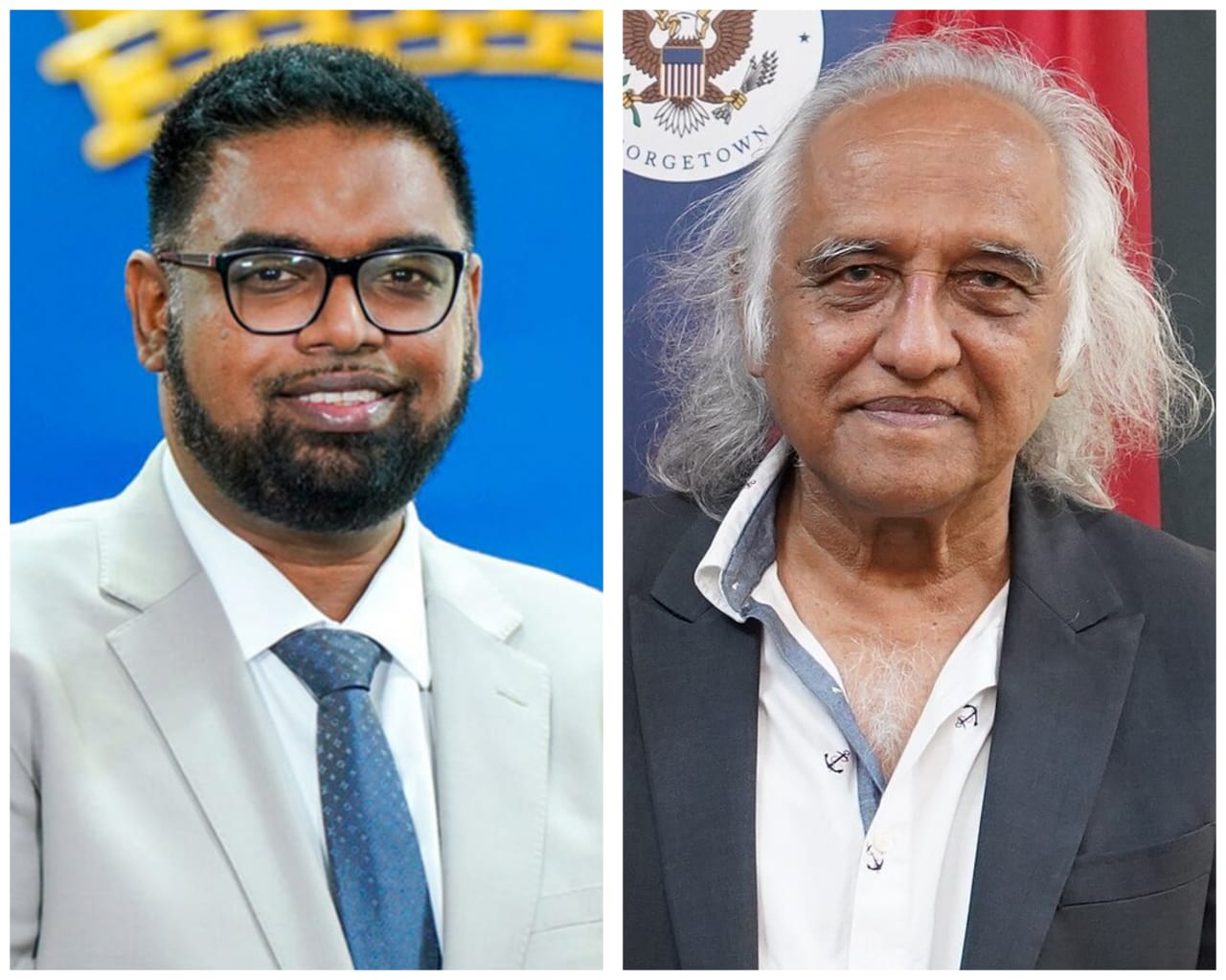
Chartered Accountant and Attorney-at-Law Christopher Ram has raised concerns about President Irfaan Ali’s approach to governance, suggesting it has impacted the perception of the presidency. Ram pointed to what he sees as a preference for loyalty over merit, limited transparency, and an increasingly partisan style of leadership that could affect public confidence in the institution.
He further noted that under President Ali’s tenure, the presidency appears to be more closely aligned with party interests than with broader national priorities. As an example, Ram cited the president’s handling of recent allegations involving the undervaluation of a high-end vehicle for customs purposes. According to Ram, President Ali dismissed the concerns and claimed he could not recall the events, despite public documentation related to the issue.
The incident referenced by Ram involves allegations that President Irfaan Ali and Vice President Bharrat Jagdeo assisted in facilitating reduced clearance fees for a Lamborghini imported by embattled businessman Azruddin Mohamed.
In a Facebook post, Mohamed shared what he claims are messages between himself and President Ali, allegedly showing the President’s involvement in seeking a reduction of tax obligations on the vehicle. President Ali has denied any recollection of the exchanges. Meanwhile, Mohamed is currently facing legal proceedings brought by the Guyana Revenue Authority, which accuses him of underpaying the required taxes on the luxury car.
Ram’s letter also criticises President Ali’s failure to renegotiate the 2016 oil agreement, which Ram describes as one of the worst in modern oil deals. Despite campaigning on a promise to address the agreement, Ram accuses the president of hiding behind the doctrine of sanctity of contract and refusing to release pertinent reports, thereby failing to protect the nation’s interests.
Ram further condemns the government’s refusal to disclose who issues tax certificates to oil companies, alleging that this lack of transparency facilitates offshore tax evasion. He also points to the Oil Spill Liability Bill, which he claims neglects environmental risks to neighboring countries and dismisses citizens’ rights to participate in the legislative process.
At the domestic level, Ram criticises the government’s handling of the Mahdia tragedy, where twenty children perished in state custody. He accuses President Ali of appointing a commission of inquiry designed to control the outcome and enabling the buying off of an Amerindian child victim of serious sexual misconduct. Ram describes the president’s recent declaration to dedicate his life to uplifting the children of Guyana as hypocritical.
The letter also raises concerns about judicial independence, pointing to President Irfaan Ali’s unfulfilled commitment to confirm the appointments of the Chancellor and Chief Justice. Despite the constitutional requirement for agreement between the President and the Leader of the Opposition—and Aubrey Norton’s stated support for confirming Acting Chancellor Yonette Cummings-Edwards and Acting Chief Justice Roxane George-Wiltshire—President Ali has not moved forward with the appointments. Both judges have been serving in an acting capacity since 2017.
In April 2022, then President of the Caribbean Court of Justice (CCJ), Justice Adrian Saunders, publicly called for their formal appointment. Praising the judiciary’s leadership, Saunders stated:
“It is currently ably led, for a few years now, by two forward-looking and progressive judges in the persons of the Acting Chancellor and the Acting Chief Justice. The length of time the cases that reach us have been in the system has grown considerably shorter. So far as I can tell, the judgments are being delivered in a far more timely fashion.”
Ram accuses the government of rewarding those who cross the floor and punishing dissenters, citing the cases of Dr. Asha Kissoon and Charrandass Persaud as examples.
Ram concludes by asserting that President Ali’s actions constitute a grave betrayal of the Guyanese public, who entrusted him with leadership. He calls for the president’s resignation, stating that in an enlightened country driven by truth, principle, and integrity, such a betrayal should preclude re-election. He expresses concern that the public’s fears about the country’s future may be well-founded, with the upcoming election serving as a critical juncture.