Thursday, April 16, 2026
Village Voice News
ADVERTISEMENT
  • Home
  • News
  • Sports
  • Editorial
  • Letters
  • Global
  • Columns
    • Eye On Guyana
    • Hindsight
    • Lincoln Lewis Speaks
    • Future Notes
    • Blackout
    • From The Desk of Roysdale Forde SC
    • Diplomatic Speak
    • Mark’s Take
    • In the village
    • Mind Your Business
    • Bad & Bold
    • The Voice of Labour
    • The Herbal Section
    • Politics 101 with Dr. David Hinds
    • Talking Dollars & Making Sense
    • Book Review 
  • Education & Technology
  • E-Paper
  • Contact Us
No Result
View All Result
  • Home
  • News
  • Sports
  • Editorial
  • Letters
  • Global
  • Columns
    • Eye On Guyana
    • Hindsight
    • Lincoln Lewis Speaks
    • Future Notes
    • Blackout
    • From The Desk of Roysdale Forde SC
    • Diplomatic Speak
    • Mark’s Take
    • In the village
    • Mind Your Business
    • Bad & Bold
    • The Voice of Labour
    • The Herbal Section
    • Politics 101 with Dr. David Hinds
    • Talking Dollars & Making Sense
    • Book Review 
  • Education & Technology
  • E-Paper
  • Contact Us
No Result
View All Result
Village Voice News
No Result
View All Result
Home News

From Boat to Plate: Guyana’s small-scale seabob producers sharpened their food safety skills

Admin by Admin
May 12, 2025
in News
Banmattie Vanbrook, Fisher, Vendor & Processor (c)FAO

Banmattie Vanbrook, Fisher, Vendor & Processor (c)FAO

0
SHARES
0
VIEWS
Share on FacebookShare on Twitter

The salty air of the Atlantic carries more than just the scent of the sea for the hardworking men and women of Guyana’s seabob industry. Their livelihoods are intricately tied to this small crustacean that is a delicacy locally and internationally. But ensuring that every ounce that is caught meets the high-quality safety and standard that the market demands is important as it journeys from the boat to our plates.

Preparing the seabob itself is not easy.  “Cleaning shrimps does bore your fingers, and people prefer to buy the freshly picked shrimp,” says Bhagmatie Omar, a fisher, vendor, and processor. She explained that seabob is very delicate and has to be cleaned and sold quickly or kept frozen without the head. Handling it, she explained, is very difficult; “it is better when we wear gloves, mask, aprons, and long boots, because the process can damage our skin.”  

READ ALSO

Guyana to mark 60th independence anniversary with commemorative gold medallion

New inpatient facility for Mabaruma Regional Hospital

Under the FISH4ACP initiative, funded by the European Union (EU) and the German Federal Ministry for Economic Cooperation and Development (BMZ), and implemented by the Food and Agriculture Organization of the United Nations (FAO), food safety training and personal protective equipment (PPE) was provided to small scale fishers of Three Door Koker and Rosignol, Region 5.
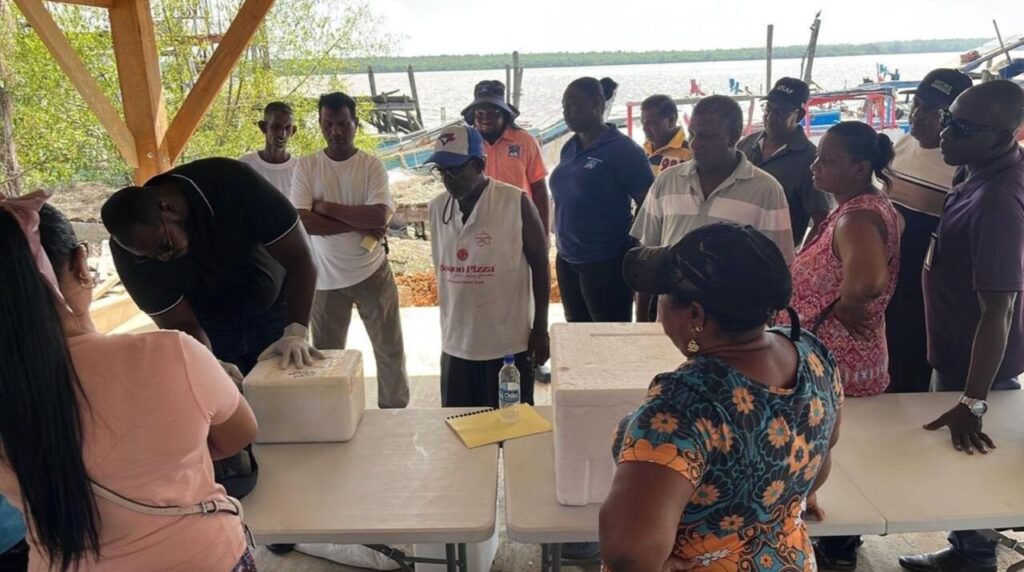
Practical trainer with fishers, vendors and processors of Three Door Koker and Rosignol

 And it seems that the training has made improvements in the participants’ seabob icing and handling processes. The training emphasized crucial initial steps for maintaining catch quality and freshness from the moment it leaves the water. Participants also gained a deeper understanding of food safety hygiene, including environmental, physical, and biological factors affecting seabob quality during its transit to consumers.

For many, they have learned simple yet effective strategies for minimizing losses, which potentially increase their earnings and reduce waste. The training provided clear guidance on best practices, empowering these dedicated individuals to handle seabob in a way that not only preserves its quality but also ensures they use protective wear to protect themselves at all times. 

Safina Iqbal, a vendor for over 25 years, who sells cleaned seabob at the Rosignol market on Fridays and Saturdays, said, “I’m getting accustomed to using PPEs.  The gloves do make cleaning a bit harder, but they protect my hands from the water and ice”. She added that the communal spirit is encouraging, “we buy catch from fishers and share among vendors so that everyone can have an income, and we are learning to do things together differently.”

Overall, strengthening the fishers, vendors, and processors’ ability to improve their practices will help them to be more competitive, enhance the appeal of their product, and help them to access more lucrative markets.

Banmattie Vanbrook, former Chair of the Three Door Fish Cooperative and a fisher, vendor, and processor, reported that the training has helped her reduce post-harvest waste. She further noted a positive shift, with more vendors implementing improved storage and handling practices since the training. Banmattie and other members are now seeking additional support for improved co-op management, which aligns with the next phase of the FISH4ACP Project launched to strengthen fish cooperatives.

With each newly acquired skill and commitment to this arduous sector, small-scale fisherfolk are becoming stronger links in the value chain. However, much more support is needed to ensure the unwavering spirit of the fishing community dedicated to this livelihood activity is sustained for future generations.

ShareTweetSendShareSend

Related Posts

The Golden Arrowhead- Guyana's National Flag
News

Guyana to mark 60th independence anniversary with commemorative gold medallion

by Admin
April 16, 2026

The government on Wednesday announced plans to mark the country’s 60th anniversary of political independence from Britain with a limited-edition...

Read moreDetails
News

New inpatient facility for Mabaruma Regional Hospital

by Admin
April 16, 2026

Region One residents are set to benefit from a significant boost in healthcare services as Minister of Health Dr Frank...

Read moreDetails
The Strait of Hormuz is a critical waterway between the Persian Gulf and the Gulf of Oman
News

Govt moves to cushion effects of global supply shocks – Pres Ali

by Admin
April 16, 2026

As the war in the Middle East disrupts global energy and food supply systems, President Dr Mohamed Irfaan Ali says...

Read moreDetails
Next Post

Safety precautions for the transportation, handling, storage, installation, and use of cooking gas cylinders


EDITOR'S PICK

Wilbert Benjamin

Former national cyclist dies one month after accident 

September 15, 2020
U.S. Vice President Kamala Harris arrives at Cape Coast Castle in Ghana, Tuesday March 28, 2023. This castle was one of around 40 “slave castles” that served as prisons and embarkation points for slaves en route to the Americas. Harris is on a seven-day African visit that will also take her to Tanzania and Zambia. (AP Photo/Misper Apawu)

Harris launches US$1B fund to empower women during Ghana visit

March 31, 2023

What to expect at the 2024 International Labour Conference Opening Monday

June 2, 2024

Today UG hosts In-Person Roundtable on “Women, Culture and Society”

May 24, 2023

© 2024 Village Voice

No Result
View All Result
  • Home
  • News
  • Sports
  • Editorial
  • Letters
  • Global
  • Columns
    • Eye On Guyana
    • Hindsight
    • Lincoln Lewis Speaks
    • Future Notes
    • Blackout
    • From The Desk of Roysdale Forde SC
    • Diplomatic Speak
    • Mark’s Take
    • In the village
    • Mind Your Business
    • Bad & Bold
    • The Voice of Labour
    • The Herbal Section
    • Politics 101 with Dr. David Hinds
    • Talking Dollars & Making Sense
    • Book Review 
  • Education & Technology
  • E-Paper
  • Contact Us

© 2024 Village Voice