As early as the 1600s, officials, physicians, naturalists and amateurs from Europe traveled across the colonized world, collecting local plants and animals, as well as artistic and cultural objects produced by people who lived in these territories. Many objects they brought back, as well as items formally archived through natural history expeditions, are housed today in European libraries and museums.
In recent decades, museums have begun to repatriate some objects to their places of origin. As loan agreements and full repatriations become more common, natural history collections are reckoning with the origins of many of their holdings, including plants and animals.
Archaeologist and curator Chip Colwell explains how some museums are confronting their legacies of taking important objects from other cultures.
The field of natural history has benefited from the diverse geographies and ecologies that formed European empires. For example, “The Civil and Natural History of Jamaica,” by Patrick Browne, published in 1755, was the first text in the English language to use the system of classifying plants developed by Carl Linnaeus. The book shows how major advancements in natural history, botany and biology relied on field work conducted far beyond metropolitan Europe.
Colonial sites where scientific studies took place received little attention in natural history accounts. Exploration and collecting specimens often relied on the knowledge and labor of enslaved persons who acted as field assistants and guides – but the historical record has little to say about their roles.
Expeditions and experiments that focused on plants, especially those of economic or medicinal value, created global botanical networks. Today, organizations such as Kew Royal Botanical Gardens in England and the New York Botanical Garden continue to rely on the knowledge and collections derived from colonial-era tropical botanical gardens in places like the Caribbean islands of St. Vincent and Jamaica.
Species loss in Jamaica
In Jamaica, there was a direct relationship between geological exploration and the plantation system. The first geological surveys of Jamaica were conducted by naturalist Sir Henry De la Beche, the son of a Jamaican plantation owner and first director of the Geological Survey of Great Britain.
British physician and naturalist Sir Hans Sloane’s extensive holdings of books, manuscripts and specimens became the founding collection of the British Museum. Sloane gathered and documented objects across an expanding British Empire while serving as a physician to colonial officials. His collections include more than 1,500 plant specimens from Jamaica, which he acquired there from 1687 to 1689.
Figure 9 from Hans Sloane’s ‘A Voyage to the Islands Madera, Barbados, Nieves, S. Christophers and Jamaica,’ vol. 2 (1707) appears to be the Jamaican giant galliwasp, based on Sloan’s text notes. Biodiversity Heritage Library, CC BY-ND
After England gained formal possession of Jamaica in 1670, it established monoculture production of sugarcane across the island. Extensive land clearance, damage to local ecosystems and exotic food consumption exacted a heavy toll. Some of the plant and animal specimens that collectors extracted and exported abroad may be the only ones that exist today.
Colonizers also introduced harmful species, such as the Indian gray mongoose (H. edwardsii), which was brought to Jamaica to prey on rats in plantation sugarcane fields. Mongooses are omnivores that eat diverse foods including mice, lizards, snakes, beetles, birds and eggs.
The Indian grey mongoose quickly became a major threat to numerous species, including the Jamaican giant galliwasp. It remains a key adversary today in the struggle to stabilize the population of the critically endangered Jamaican iguana.
Introduced to the Caribbean for rat control on sugar plantations, the Indian gray mongoose has become a serious threat to many native species. J.M. Garg/Wikimedia, CC BY-SA
Repairing an island’s ecology
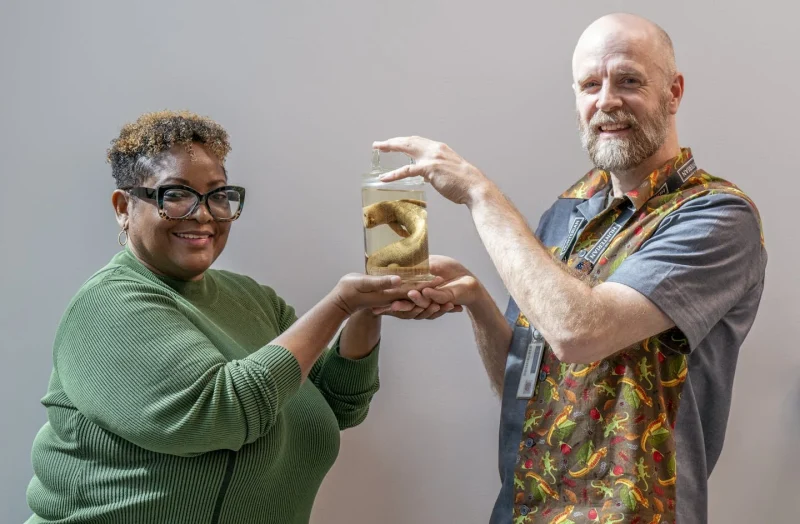
Celeste is the first natural history specimen to be formally repatriated to the Caribbean, but not the first object. In 2009, the British Museum returned the Anthony Robinson Volumes to the Institute of Jamaica, which had loaned them in 1920 to support preparation of a book on Jamaican plants. These papers were unpublished notes and illustrations by a naturalist who died in Jamaica in 1768 after some 20 years of observing and collecting flora and fauna.
Subsequently, in 2016, the University of London’s Royal Holloway College donated an estimated 10,000 World War II and pre-independence aerial photographs of West Indian British colonies to The University of the West Indies. These photographs can aid the study of natural landscape or rural land cover changes due to agricultural expansion or abandonment. They also offer a frame of reference to track modern urban expansion.
Returning specimens, artifacts and other materials is an important way to show respect for the societies and cultures that produced them. Plant and animal specimens can also support ecological repair.
The Jamaican giant galliwasp’s classification as possibly extinct in the wild reflects optimism from the almost unbelievable rediscovery of the Jamaican iguana (Cyclura collei). Prior to 1990, this species was presumed extinct, but then scientists discovered a remnant population in the island’s Hellshire Hills. That find offers hope for other species presumed extinct that may be surviving in small, isolated locations.
A critically endangered Jamaican iguana, photographed at the St. Louis Zoo. Rob Buhlman/Flickr, CC BY
Finally, Celeste’s return to Jamaica shows how repatriating material artifacts can serve as part of a broader process of reparations for colonialism. Celeste is not a lone example. We have ascertained that the American Museum of Natural History in New York City has the holotype of Xenothrix mcgregori, described as a Jamaican monkey. The skull of this monkey was collected in a cave in Trelawny in 1920. There are also fossil specimens of Oryzomys antillarum, the Jamaican rice rat, in the University of Florida Vertebrate Paleontology collection and one in the Natural History Museum of London, which was collected by P.H. Gosse in 1845.
While largely symbolic, Celeste’s return acknowledges how colonialism facilitated multiple forms of plunder with lasting consequences, and shows the need for decolonization in natural history. Rather than sitting in storage, Celeste has returned to Jamaica to be a centerpiece in the story of Jamaican environmental history. Rather than sitting in storage, Celeste has returned to Jamaica to be a centerpiece in the story of Jamaican environmental history. (The Conversation)