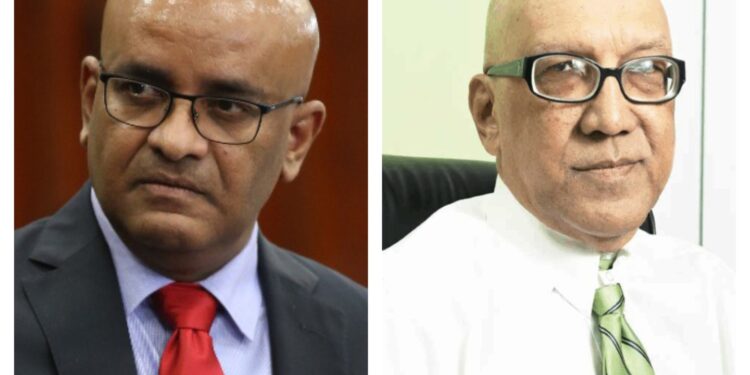
The ninth installment of the Guyana Business Journal (GBJ) and Caribbean Policy Consortium (CPC) webinar series, “Transforming Guyana,” focused on “Guyana’s Agricultural Sector and the Oil and Gas Economy.”
Farming and energy production are seemingly disparate industries, yet they have a bond. Agriculture necessitates utilizing energy resources, like fossil fuels, and producing fertilizers and pesticides. The extraction, transportation, and utilization of fossil fuels can positively and negatively affect agriculture. Because of this interplay, this episode considered the agricultural sector in Guyana and its essential role in Guyana’s emerging Oil and Gas economy.
In his opening remarks, Dr. Lewis reflected on his first visit to the country in 1982, when there was a discussion of the potential for Guyana to become a major food producer in the Caribbean. He pointed out that this transformation did not materialize due to investment needs, technology, infrastructure, and other resource limitations. He defined the present task as leveraging these linkages to contribute to Guyana’s growth and development. He observed, “Because Guyana, regardless of how big and how dominant the oil and gas sector is going to become, beyond the numbers and the statistics, what’s going to happen is the rest of the economy needs to continue to live, and we need to find ways to get that to leverage.”
Dr. Chesney, a leading agricultural professional in the Caribbean who was awarded the Golden Arrowhead of Achievement for his contributions to agricultural development in Guyana and the Caribbean, emphasized that one must understand Guyana’s agrarian sector through its critical link to regional agriculture and food security. Dr. Chesney stressed that Guyana has fully embraced this idea. He noted that in 2020, the nation had taken the initiative of Caricom in agriculture and had been fundamental in accelerating the process, referring to the various farming projects carried out by the present government. Dr. Chesney emphasized that agriculture is not simply providing food and producing primary commodities. Instead, he stated that it is essential for the region’s sustainable progress. Within this context, Dr. Chesney noted that the oil and gas sector provides the opportunity for increasing agricultural activities: “With the proposed refinery and gas-to-shore project, we can produce inputs, whether it be fertilizers, pesticides, et cetera, and better processing capacity because of the cheaper electricity that would be provided.”
He noted that this is a chance to evolve and modify Guyana’s agricultural industry, encouraging individuals to view it as an enterprise rather than an exclusively labor-intensive pursuit. He believes that involving traditional farm product exporters would help provide a steady market with fair prices and would benefit the region’s overall agricultural sustainability.
Dr. Chesney also called for eliminating current obstacles to regional trading, such as inadequate transportation infrastructure, preventing this sector from being more active. Additionally, Dr. Chesney mentioned that non-tariff limitations, such as food safety standards, financing, communication, and geospatial diversification, must be addressed.
Joel Bhagwandin, a professional in the business and finance industries who has worked for over 15 years in the financial sector, reported that Guyana is progressing toward its aim of being developed by 2025. He stated that if one looks at the agricultural GDP growth of the previous ten years, the nation achieved the most significant growth in 2022 at 12 percent, its highest since 2013.
Bhagwandin remarked that the budget for 2020 to 2023 had grown by 65 percent, taking it to a total of GY$15 billion dollars from GY$9.4 billion dollars. He also highlighted that the agricultural sector makes up 25% of the non-oil GDP. He then explained that the government invested in the industry to increase food production and improve regional food security. However, this should be looked at in context with the other sectors. To further this goal, Bhagwandin asserted that infrastructure investments and energy projects were essential for creating value-added products and decreasing energy costs.
When posed a query by a viewer regarding an opinion piece that declared the Dutch disease was “damaging Guyana’s agricultural industry,” The Dutch disease is an economic term for the negative consequences that can arise from a spike in the value of a nation’s currency. It is primarily associated with the discovery or exploitation of a valuable natural resource and the unexpected repercussions that such a discovery can have on the overall economy of a nation. Bhagwandin denied this was accurate. He highlighted that if the exchange rate were to surge, it would cause agricultural exports to decrease since they would become more expensive, and he noted that this is not occurring. He said that while the government is creating a healthy atmosphere for farming, he believed that Guyana’s corporate sector needed to be more creative to take advantage of the opportunities in the agricultural industry.
Dr. Chesney commented that when agriculture is affiliated with the Caribbean Single Market and Economy (CSME), the migration of skills becomes crucial. He emphasized that “there is a lack of expertise, not necessarily a lack of labor, in addition to a lack of organization. Some of us are collaborating with universities to investigate how their curriculums can be improved to meet the demands of the intersection of the Region’s agricultural and oil and gas sectors. You must start putting in place that training capacity, enhancing the human capacity of the region to be able to provide the skills that are required.” He also pointed out that it would be unfair to suggest Guyana will experience the resource curse, the significant social, economic, and political challenges unique to countries rich in oil, gas, and minerals due to the relatively well-managed oil and gas industry.
In response to a question posed on efforts being made by the government to give investors confidence to enter the market, Bhagwandin said he is unaware of institutional barriers from a governmental perspective to enter the agricultural sector. He noted, however, that some bureaucracy is related to processes such as approvals, processing of licenses, etcetera. He said the government is investing in improving the overall public service delivery.
As highlighted in this month’s episode of Transforming Guyana, there are many ways in which Guyana’s agricultural and oil and gas sectors can leverage each other to contribute to and drive economic growth. Dr. Chesney predicts that the country will see steady growth in this sector in the coming years, with investment in infrastructure, training, international trade agreements, and business-to-business relationships, and he has cautioned us to manage this growth in the best possible way to ensure optimal outcomes for Guyana and the Guyanese people.
Utamu Belle is an award-winning Guyanese journalist with a career spanning over a decade. Her experience includes writing for print, television, and online media. In addition, she has worked as a Radio and Television host. She is the Founder of A-to-Z Media (Guyana), a News and Digital Editor with Upscale Magazine, and a Digital Coordinator/News Editor with The Guyana Business Journal and Magazine.
Dr. Terrence Richard Blackman is a member of the Guyanese diaspora. He is an associate professor of mathematics and a founding member of the Undergraduate Program in Mathematics at Medgar Evers College. In addition, he is a former Dr. Martin Luther King Jr. Visiting Professor at MIT and a member of The School of Mathematics at The Institute for Advanced Study. He previously served as Chair of the Mathematics Department and Dean of the School of Science, Health, and Technology at Medgar Evers College, where he has worked for more than twenty-five years. He graduated from Queen’s College, Guyana, Brooklyn College, CUNY, and the City University of New York Graduate School.