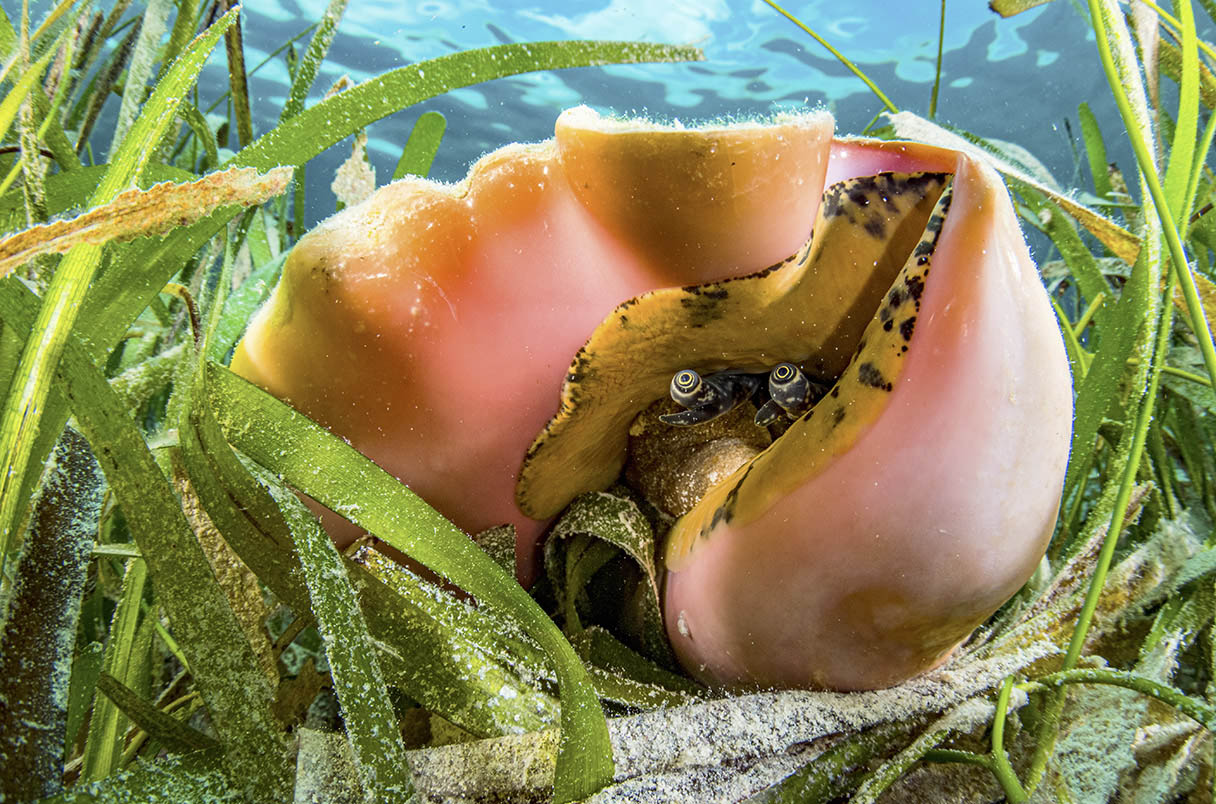
Overfishing may put the queen conch—a large marine snail known for its showy shell and delectable flesh—on the path to extinction, U.S. government researchers concluded earlier this year after an extensive review of the species. Federal officials are now considering whether to list the Caribbean species as threatened under the Endangered Species Act, having wrapped up collecting public comments on the proposal last week. But fishing communities in several countries are opposing the move, worried that such a listing could end their ability to export conch meat to the United States, their largest market.
“We are not convinced that listing the species under the ESA is justified at this time, or the best option available to protect the species,” said Maren Headley, a fisheries scientist with the Caribbean Regional Fisheries Mechanism, an intergovernmental organization, at a public hearing hosted online last month by the U.S. National Oceanic and Atmospheric Administration (NOAA). Citing “grave concern” about the potential economic impact of listing the species as threatened, she said improving fisheries management should be the objective.
The queen conch, which lives in seagrass meadows throughout the Caribbean Sea, has been fished for its meat for centuries. In the Bahamas, where a conch rests atop the country’s coat of arms, large piles of shells are a testament to the history and scale of exploitation. “The extraction from the world’s largest seagrass ecosystem has been immense,” says Andrew Kough, a marine biologist at the Shedd Aquarium in Chicago.
The species has few defenses against divers who seek its valuable meat. Some conchs stay safe by living in remote or deep water. Older individuals, which grow up to 35 centimeters in length, can become camouflaged over time with algae or coral growing on their shells.
Because of overexploitation, conch fishing was banned in Florida in 1975. Population declines followed in other countries, and in 1992 international trade in the species was regulated by the Convention on International Trade in Endangered Species of Wild Fauna and Flora (CITES). Concerned about continued overharvesting, CITES in 2003 called for nations to ban conch imports from Honduras, Haiti, and the Dominican Republic.
Today, numbers are thin across almost all its range, and larvae are not dispersing adequately to maintain gene flow between remaining local populations, according to a scientific review completed by NOAA in May. Some populations are still reproducing in the Bahamas, Jamaica, and few other locations, but these fisheries will likely become unsustainable sometime in the next 30 years. If that happens, poaching will probably worsen and the species would face a “moderate” risk of extinction, NOAA says.
A U.S. designation of the queen conch as threatened would not, by itself, require other nations to act to protect the snail. But NOAA Fisheries notes that a listing could justify blocking imports in the future, potentially increasing incentives to better manage the snail fisheries. In 2018, the U.S. imported $33 million worth of conch meat for fritters, chowder, and other dishes. A U.S. listing “sends a clear message that this species is in danger,” says Nick Higgs, a marine biologist at the Cape Eleuthera Institute, a research center in the Bahamas.
Not everyone agrees. “My view of the status is not nearly as dire as the report makes out,” says Richard Appeldoorn, a fisheries biologist at the University of Puerto Rico. He says NOAA’s risk analysis does not account for the fact that conchs congregate before mating, which means that a low population density observed in a survey can look deceptively bad. Surveys should note whether conchs are mating or have released eggs to present a more accurate view of the population health, he says.
Tapping into the local knowledge of conch fishing communities would improve these surveys, said Raimundo Espinoza, director of Conservación ConCiencia, a nonprofit conservation organization in Puerto Rico, at the hearing. “The best scientists are not the best at finding conch,” he said. “There is an opportunity to advance collecting data for science.”
Some countries say they are doing their best to manage conchs responsibly. In the public hearing, Mauro Gongora of the Belize Fisheries Department pointed out that 15,000 people in his country benefit from conchs, especially in small coastal fishing villages, and that the conch population there is reproducing well. “We’re making a lot of effort to manage the conch as best we can, because we recognize the importance of this fishery.”
But many Caribbean nations lack the regulations or resources for enforcement, NOAA says. In its review, the agency concluded that more action is needed to halt population declines: “There is very little indication that regulatory mechanisms will be able to reverse this trend in the foreseeable future.”
At the hearing, Stephen Smikle, director of fisheries in Jamaica, said what’s needed is more support from the U.S. government to combat illegal, unreported, and unregulated fishing of the conch. Higgs points out that listing the species as threatened might catalyze such funding. “It suddenly becomes a priority for conservation and rebuilding populations.”
More funding to help hatchery operations expand and maximize output could also make a difference, Kough says. “It’s like putting a Band-Aid on a pretty grievous wound. It will help stem the bleeding a bit.” But the only way to repopulate billions of conchs is through natural reproduction, he adds. Ultimately, Kough hopes NOAA will list the species: “Fingers crossed that it has an outpouring of public support and creative thought towards helping these animals into the future.”
By Rik Stokstad- Science Insider