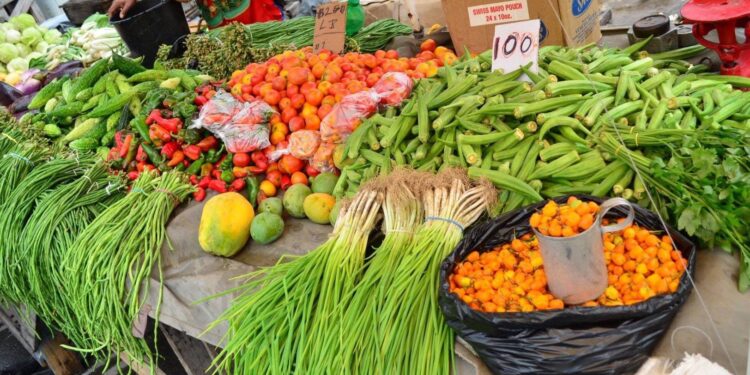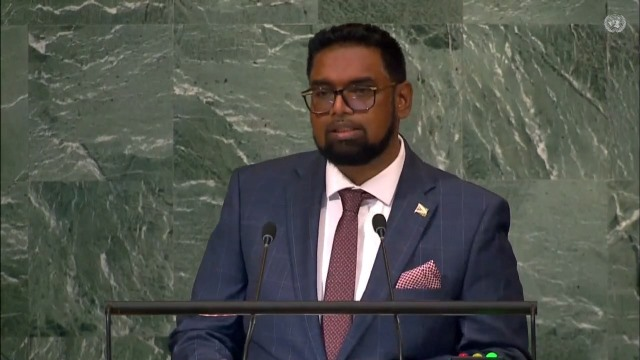
Last Monday President Irfaan Ali, at a Science Summit of the United Nations General Assembly, said for far too long there has been a passive approach to food security, which has amplified the problem at the regional level.
He was the keynote speaker at the food security forum which he addressed via zoom. In his presentation Ali proposed an overhauling of the regional agriculture system to not only make it less laborious but to encourage women and youth into the workforce.
Enhanced technological use, he pointed out, would be imperative to develop the new system.
“How do we ensure that more women are leading farms, using science and technology as aids? We cannot build an agricultural system or a production system that does not have the future in mind. What we have now is a lot of young people not going into agriculture. The question is, why? Because we still promote agriculture in the traditional way.”
The President said to change the system governments need to make larger investments, remove the red tape hampering the flow, use individual strengths for the collective good and enhance private sector partnerships.
“If the Caribbean believes that we can do this singularly, we’re fooling ourselves. This requires partnership and a willingness of all stakeholders to work in a cohesive manner, utilising each other’s competitive advantage and pushing each other’s competitive advantage to the benefit of the Region. That is what we’re doing.”
Ali also spoke of the land available in Guyana and Suriname, the technological know-how of Roraima, Brazil and the unique advantages of several Caribbean islands. Overall, he explained, the Region should be investing at least 7.5% of their national budgets in agriculture and food production in the short term for there to be a possibility of achieving a 25% reduction in food importation by 2025.
He also highlighted general cooperation and country-to-country partnerships, especially between Guyana and Barbados.
The urgency in food security, the President stated, is not only a CARICOM concern but a global issue. Reference was made to the hindering factors, including the pandemic, which have skyrocketed the global food import bill to its staggering US$1.8tn projection.
The president said that as of June 2022, the number of acute food insecure persons has increased to 345 million in 82 countries and out of that amount, some 2.8 million or nearly 40% of the population in the English-speaking Caribbean, are food insecure.
He emphasised that at all levels, there need to be short and long-term responses to boost food production and nutrition, improved food security, reduce risk and the strengthening of the food systems.
“The global, regional, and national food systems must become more responsive to the needs of the population. The system has to be responsive to the needs of the population to give them healthy and affordable diets, inclusive of food sustainable sustenance and enforce good livelihood for all, especially small economies.”
The President said that food security was the main issue at the UN General Assembly this year, which demonstrated its urgency.
“Did we actually realise what took place in the UN? For the first time, the macro issues for food security, climate change, and everything else fell under the umbrella of food security. Every single address at the UN, every single side event had the issue of food security.”
With the spotlight on food security, President Ali said that it is now time for Small Island Developing States and Low-Lying Coastal Countries to push funding agencies and to work with the Food and Agriculture Organisation (FAO) of the UN to become food secure.
“If we can’t do it now, then we will be in serious problems in the long term.”