By Mark DaCosta- As continues to be the case with other ancestral lands, the problem of Indigenous lands has gone on for far too long. What may make the problem more noteworthy, though, is the special status accorded to Indigenous peoples by internationally recognised treaties, agreements, and conventions. Additionally, in the case of Guyana, archeologists have found incontrovertible evidence that our Indigenous peoples have lived on this land for no fewer that 12,000 years. Compare that length of time with when Jesus was said to have walked the earth some 2,000 years ago. As we observe Indigenous Heritage Month, it would be opportune to raise the issue of Indigenous lands.
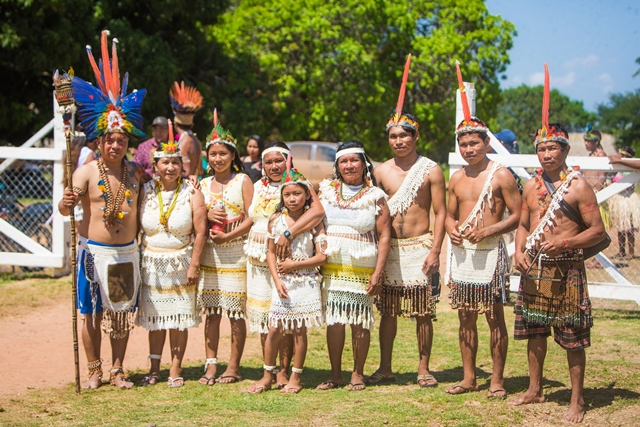
There are currently nine distinct tribes of Indigenous peoples in Guyana: Lokono (Arawak), Akawaio (Kapon), Arecuna (Pemon), Macusi, Warrau, Wapisiana, Wai Wai, Patamona and Kalina (Carib). Those peoples comprise about 9.16 per cent of our total population. The issue of land ownership and control by Guyana’s first peoples is one that has dragged out for about 400 years. That is, since Guyana was colonised by the dutch in the 17th century. The issue has still not been settled to this day even though Guyana has been an independent, self-governing State for over half a century.
Cultural Survival — a network of Indigenous partners and international human rights advocates across the globe — released a statement critical of Guyana’s government. “Independent Guyana’s policy towards Indigenous peoples is essentially based upon colonial policy and law, maintaining strong elements of wardship, indirect rule and assimilation.
“Both the Dutch and the British, and the successor State of Guyana, asserted that all lands not held under grant from the State were crown lands effectively denying Indigenous title and sovereignty, “the statement said.
The statement highlighted specific aspects of the unjust state of affairs in Guyana. The statement said, “The primary law relating to Indigenous peoples is the Amerindian Act of 1951, amended in 1961 and 1976, and is essentially an expanded version of a 1902 law. This law, among others, authorises the Minister of Amerindian Affairs to arbitrarily take, modify or suspend Indigenous land titles in six different ways, including taking a land title if two or more members of a community have shown themselves to be `disloyal or disaffected to the State or have done any voluntary act which is incompatible with their loyalty to the State’ (Sec. 20A(4)(d)).
Government officials may also: take, sell or otherwise dispose of Indigenous property for `purposes of its care, management or protection’ (Sec. 12 (1)(a)); the Minister may take Indigenous children into custody for purposes of their education, welfare or to apprentice them in the service of others (Sec. 40(2) (c)(d)); may relocate Indigenous communities to any region of Guyana (Sec. 40(2)(a)); may prohibit cultural and religious activities that the Minister believes may be harmful (Sec. 40 (2)(f)); and, requires that any non-Amerindian wishing to visit Indigenous lands, even if invited by the community, receive the permission of the Minister of Amerindian Affairs under penalty of fine and imprisonment (Sec. 5).” The idea that a politician can wield such discretionary and coercive power over Guyana’s first peoples absolutely boggles the mind.
In 2017, former President, Brigadier David Granger of the A Partnership for National Unity + Alliance For Change (APNU+AFC) government, established a Commission of Inquiry to settle the matter of Indigenous Lands. Also, during the tenure of the APNU+AFC administration, consultations were begun between the government and Indigenous leaders regarding amendments to the Amerindian Act, which would have included the matter of ancestral lands. However, after the People’s Progressive Party (PPP) regime came to power in August 2020, the consultation process was halted by the PPP regime.
Owing to the fact that the consultations were halted, the list of recommendations submitted to the PPP regime by Indigenous leaders, and which is currently in the possession of the PPP, is also incomplete. To date, the PPP regime has made no moves to reengage with Indigenous leaders.
While Guyana observes Indigenous Heritage Month, one notes the flamboyant rhetoric of the PPP regime in praise of Guyana’s first peoples. However, no amount of speeches and words will correct the historical wrong that our Indigenous peoples continue to endure. The issue of the status of lands that rightfully belong to our first peoples must be settled. Government has a responsibility to fix a problem that has continued to plague Guyanese for too long.