Monday, August 24, 2026
Village Voice News
ADVERTISEMENT
  • Home
  • News
  • Sports
  • Editorial
  • Letters
  • Global
  • Columns
    • Eye On Guyana
    • Hindsight
    • Lincoln Lewis Speaks
    • Future Notes
    • Blackout
    • From The Desk of Roysdale Forde SC
    • Diplomatic Speak
    • Mark’s Take
    • In the village
    • Mind Your Business
    • Bad & Bold
    • The Voice of Labour
    • The Herbal Section
    • Politics 101 with Dr. David Hinds
    • Talking Dollars & Making Sense
    • Book Review 
  • Education & Technology
  • E-Paper
  • Contact Us
No Result
View All Result
  • Home
  • News
  • Sports
  • Editorial
  • Letters
  • Global
  • Columns
    • Eye On Guyana
    • Hindsight
    • Lincoln Lewis Speaks
    • Future Notes
    • Blackout
    • From The Desk of Roysdale Forde SC
    • Diplomatic Speak
    • Mark’s Take
    • In the village
    • Mind Your Business
    • Bad & Bold
    • The Voice of Labour
    • The Herbal Section
    • Politics 101 with Dr. David Hinds
    • Talking Dollars & Making Sense
    • Book Review 
  • Education & Technology
  • E-Paper
  • Contact Us
No Result
View All Result
Village Voice News
No Result
View All Result
Home News

World’s largest bacterium found in Caribbean swamp

Staff Writer by Staff Writer
June 25, 2022
in News
0
SHARES
0
VIEWS
Share on FacebookShare on Twitter

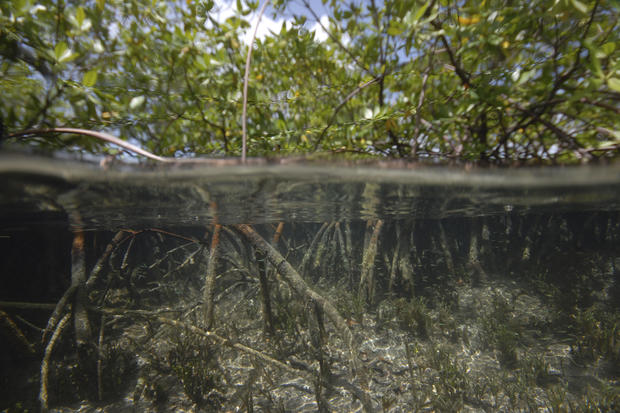
(AP News) Scientists have discovered the world’s largest bacterium in a Caribbean mangrove swamp. Most bacteria are microscopic — but this one is so big it can be seen with the naked eye.

The thin white filament, approximately the size of a human eyelash, is “by far the largest bacterium known to date,” said Jean-Marie Volland, a marine biologist at the Lawrence Berkeley National Laboratory and co-author of a paper announcing the discovery Thursday in the journal Science.

READ ALSO

Fire Halts ExxonMobil Operations Offshore Guyana

WIN, APNU Begin Talks on Opposition Cooperation, Agree to Joint Statement

Olivier Gros, a co-author and biologist at the University of the French West Indies and Guiana, found the first example of this bacterium — named Thiomargarita magnifica, or “magnificent sulfur pearl” — clinging to sunken mangrove leaves in the archipelago of Guadeloupe in 2009.

But he didn’t immediately know it was a bacterium because of its surprisingly large size — these bacteria, on average, reach a length of a third of an inch. Only later genetic analysis revealed the organism to be a single bacterial cell.

“It’s an amazing discovery,” said Petra Levin, a microbiologist at Washington University in St Louis, who was not involved in the study. “It opens up the question of how many of these giant bacteria are out there — and reminds us we should never, ever underestimate bacteria.”

Gros also found the bacterium attached to oyster shells, rocks and glass bottles in the swamp. Scientists have not yet been able to grow it in lab culture, but the researchers’ say the cell has a structure that’s unusual for bacteria. One key difference: It has a large central compartment, or vacuole, that allows some cell functions to happen in that controlled environment instead of throughout the cell.

“The acquisition of this large central vacuole definitely helps a cell to bypass physical limitations … on how big a cell can be,” said Manuel Campos, a biologist at the French National Center for Scientific Research, who was not involved in the study.

The researchers said they aren’t certain why the bacterium is so large, but co-author Volland hypothesized it may be an adaptation to help it avoid being eaten by smaller organisms.

ShareTweetSendShareSend

Related Posts

Kathrine Schmidt/Energy Intelligence
News

Fire Halts ExxonMobil Operations Offshore Guyana

by Admin
August 24, 2026

A small fire aboard ExxonMobil Guyana’s Liza Unity floating production, storage and offloading (FPSO) vessel has forced the temporary suspension of operations...

Read moreDetails
News

WIN, APNU Begin Talks on Opposition Cooperation, Agree to Joint Statement

by Admin
August 24, 2026

Representatives of We Invest in Nationhood (WIN) and A Partnership for National Unity (APNU) met Monday morning in Campbellville for...

Read moreDetails
GTUC General Secretary Lincoln Lewis
News

Lewis Urges Guyanese to Mobilise for Full Share of Oil Profits

by Admin
August 24, 2026

Guyana Trades Union Congress (GTUC) General Secretary Lincoln Lewis is urging Guyanese to unite and demand greater control, transparency and...

Read moreDetails
Next Post

Baroness Patrica Scotland retained position as Commonwealth Secretary-General


EDITOR'S PICK

WORD OF THE DAY: MISANTHROPE

January 27, 2023

GTUC hammers GYSBI for breach of labour laws 

July 25, 2021

WORD OF THE DAY: GRANDILOQUENCE

November 17, 2024
The Carter Centre observer team at the Campbellville Secondary School monitoring the voting process on March 2, 2020 (Newsroom photo)

Analysts Slam Carter Center’s Silence on Bloated Voter List Between 2020 and 2025, Raising Questions About Observer Credibility

September 4, 2025

© 2024 Village Voice

No Result
View All Result
  • Home
  • News
  • Sports
  • Editorial
  • Letters
  • Global
  • Columns
    • Eye On Guyana
    • Hindsight
    • Lincoln Lewis Speaks
    • Future Notes
    • Blackout
    • From The Desk of Roysdale Forde SC
    • Diplomatic Speak
    • Mark’s Take
    • In the village
    • Mind Your Business
    • Bad & Bold
    • The Voice of Labour
    • The Herbal Section
    • Politics 101 with Dr. David Hinds
    • Talking Dollars & Making Sense
    • Book Review 
  • Education & Technology
  • E-Paper
  • Contact Us

© 2024 Village Voice