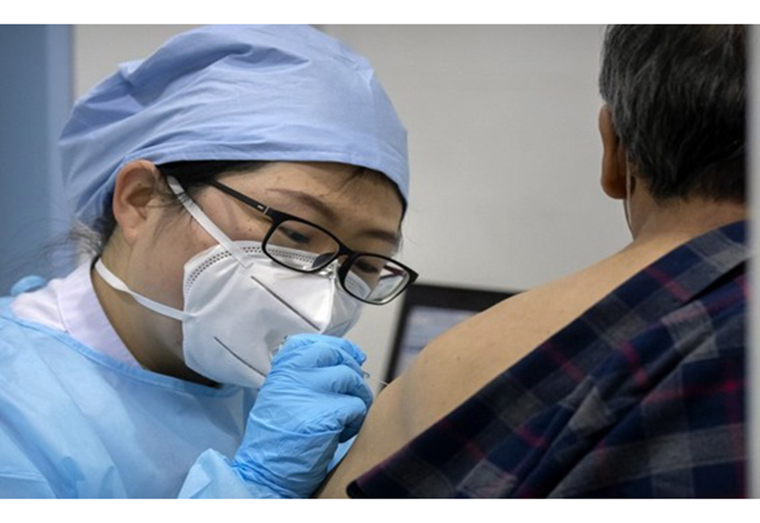
NEW DELHI (AP) — India started inoculating health workers Saturday in what is likely the world’s largest COVID-19 vaccination campaign, joining the ranks of wealthier nations where the effort is already well underway.
India is home to the world’s largest vaccine makers and has one of the biggest immunization programs. But there is no playbook for the enormity of the current challenge.
Indian authorities hope to give shots to 300 million people, roughly the population of the U.S and several times more than its existing program that targets 26 million infants. The recipients include 30 million doctors, nurses and other front-line workers, to be followed by 270 million people who are either over 50 years old or have illnesses that make them vulnerable to COVID-19.
For workers who have pulled India’s battered healthcare system through the pandemic, the shots offered confidence that life can start returning to normal. Many burst with pride.
“I am excited that I am among the first to get the vaccine,” Gita Devi, a nurse, said as she lifted her left sleeve to receive the shot.
“I am happy to get an India-made vaccine and that we do not have to depend on others for it,” said Devi, who has treated patients throughout the pandemic in a hospital in Lucknow, the capital of Uttar Pradesh state in India’s heartland.
The first dose was administered to a sanitation worker at the All Indian Institute of Medical Sciences in the capital. New Delhi, after Prime Minister Narendra Modi kickstarted the campaign with a nationally televised speech.
“We are launching the world’s biggest vaccination drive and it shows the world our capability,” Modi said. He implored citizens to keep their guard up and not to believe any “rumors about the safety of the vaccines.”
It was not clear whether Modi, 70, had taken the vaccine himself like other world leaders as an example of the shot’s safety. His government has said politicians will not be considered priority groups in the first phase of the rollout.
Health officials haven’t specified what percentage of India’s nearly 1.4 billion people will be targeted by the campaign. But experts say it will almost certainly be the largest such drive globally.
The sheer scale has its obstacles. For instance, India plans to rely heavily on a digital platform to track the shipment and delivery of vaccines. But public health experts point out that the internet remains patchy in large parts of the country, with some remote villages entirely unconnected.
Around 100 people were to be vaccinated in each of the 3,006 centers across the country on the first day, the Health Ministry said.
News cameras captured the injections across hundreds of hospitals, underscoring the pent-up hopes that vaccination was the first step in getting past the pandemic that has devastated the lives of so many Indians and bruised the country’s economy.
India on Jan. 4 approved emergency use of two vaccines, one developed by Oxford University and U.K.-based drugmaker AstraZeneca, and another by Indian company Bharat Biotech. Cargo planes flew 16.5 million shots to different Indian cities last week.
But doubts over the effectiveness of the homegrown vaccine is creating hurdles for the ambitious plan.
Health experts worry that the regulatory shortcut taken to approve the Bharat Biotech vaccine without waiting for concrete data that would show its efficacy in preventing illness from the coronavirus could amplify vaccine hesitancy. At least one state health minister has opposed its use.
In New Delhi, doctors at Ram Manohar Lohia Hospital, one of the largest in the city, demanded they be administered the AstraZeneca vaccine instead of the one developed by Bharat Biotech. A doctors union at the hospital said many of its members were a “bit apprehensive about the lack of complete trial” for the homegrown vaccine.
“Right now, we don’t have the option to chose between the vaccines,” said Dr. Nirmalaya Mohapatra, vice president of the hospital’s Resident Doctors Association.
India’s Health Ministry has bristled at the criticism and says the vaccines are safe, but maintains that health workers will have no choice in deciding which vaccine they will get themselves.
According to Dr. S.P. Kalantri, the director of a rural hospital in Maharashtra, India’s worst-hit state, such an approach was worrying because he said the regulatory approval was hasty and not backed by science.
“In a hurry to be populist, the government (is) taking decisions that might not be in the best interest of the common man,” Kalantri said.
Against the backdrop of the rising global COVID-19 death toll — it topped 2 million on Friday — the clock is ticking to vaccinate as many people as possible. But the campaign has been uneven.
In wealthy countries including the United States, Britain, Israel, Canada and Germany, millions of citizens have already been given some measure of protection with at least one dose of vaccines developed with revolutionary speed and quickly authorized for use.
But elsewhere, immunization drives have barely gotten off the ground. Many experts are predicting another year of loss and hardship in places like Iran, India, Mexico and Brazil, which together account for about a quarter of the world’s COVID-19 deaths.
India is second to the U.S. with 10.5 million confirmed cases, and ranks third in the number of deaths, behind the U.S. and Brazil, with 152,000.
Over 35 million doses of various COVID-19 vaccines have been administered around the world, according to the University of Oxford.
While the majority of the COVID-19 vaccine doses have already been snapped up by wealthy countries, COVAX, a U.N.-backed project to supply shots to developing parts of the world, has found itself short of vaccines, money and logistical help.
As a result, the World Health Organization’s chief scientist, Dr. Soumya Swaminathan, warned this week that it is highly unlikely that herd immunity — which would require at least 70% of the globe to be vaccinated — will be achieved this year.
“Even if it happens in a couple of pockets, in a few countries, it’s not going to protect people across the world,” she said.