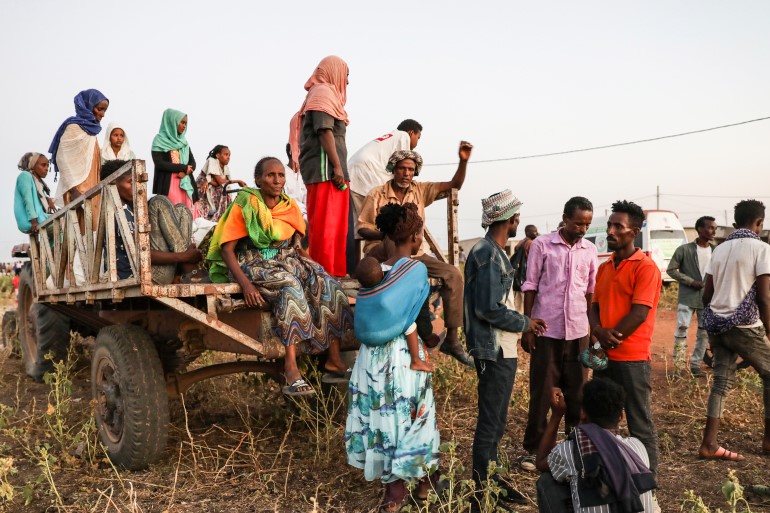
Thousands of Ethiopian refugees have continued pouring into Sudan, escaping a worsening conflict that has spilled over Ethiopia’s borders and threatens to destabilise the wider Horn of Africa region.
The United Nations refugee agency said on Sunday that more than 20,000 people have crossed into Sudan from Ethiopia’s northern Tigray region, where federal government troops are battling forces loyal to the Tigray People’s Liberation Front (TPLF), the party of the regional government. Sudanese state media put the number of refugees at almost 25,000.
It came after the leader of the TPLF said on Sunday that his forces fired a volley of rockets at neighbouring Eritrea’s capital, Asmara, late on Saturday. Debretsion Gebremichael also claimed that 16 Eritrean military divisions are fighting alongside the Ethiopian government troops against the TPLF forces – an assertion that both the governments in Addis Ababa and Asmara have denied.
“Those who attack Tigray will not just attack and return home. We will retaliate while they are here, and strike the airports from which they launched attacks,” said Debretsion. “There is no place that we can’t reach and we will continue to attack selected targets that the invading forces are using against us.”
Although it was not possible to determine whether the rockets fired into Asmara had caused any casualties (Eritrea is one of the world’s most reclusive states), the attack marked a major escalation in the almost two-week war that has killed hundreds of people.
“This takes the conflict to a whole new level,” said Al Jazeera’s Mohammed Adow, reporting from the Ethiopian city of Gondar. “It has spilled across the borders of Ethiopia, and now another country, Eritrea, is about to be sucked in.”
The governments of Ethiopia and Eritrea agreed in 2018 to end decades of hostilities, a deal that resulted in Ethiopian Prime Minister Abiy Ahmed winning the 2019 Nobel Peace Prize. However, there is still a deep-seated animosity between Eritrean President Isaias Afwerki’s government and the battle-hardened TPLF over the devastating 1998-2000 Ethiopian-Eritrean border conflict, in which some 70,000 people died.
“President Isaias sees Tigrayans as his nemesis in the world and is determined to rid himself of them,” Horn of Africa expert Martin Plaut told Al Jazeera.
“What the Tigrayans are now finding themselves in is in a pincer movement – from north and south, from Eritrea and from the federal forces from Addis Ababa,” he said. “They are fighting for their lives, there is no way that they can give up.”
Plaut added: “In a sense, Prime Minister Abiy has also painted himself into a corner which is why any suggestion this is going to be a short conflict is probably mistaken, unless there is huge pressure from the international community on both sides to resolve this conflict.”
Abiy, however, has rejected mediation efforts and international calls for an immediate de-escalation, vowing to “see this operation to its end”. “Ethiopia is more than capable of attaining the objectives of the operation by itself,” he said in a statement that did not mention the attack on Eritrea. “Justice will prevail. Ethiopia will prevail!”
But as the worsening conflict drags on, concerns grow that other outside forces could also be pulled in. Senior TPLF official Getachew Reda on Sunday asserted on Twitter, without offering any evidence, that Abiy “is now enlisting the support of UAE drones based in [the Eritrean city of] Assab in his devastating war against the people of Tigray”. There was no comment by the United Arab Emirates.

Calling Abu Dhabi a “critical” player in the region, Mahtani said: “The UAE has been an important diplomatic partner in the background bringing Ethiopia and Eritrea together under Abiy’s watch. There have also have been financial contributions given by the UAE to stabilise Ethiopia’s economy.”
In a statement on Twitter on Sunday, Tibor Nagy, the United States assistant secretary of state in Africa, said Washington “strongly condemns” the TPLF’s “unjustifiable” attack on Eritrea “and its efforts to internationalise the conflict in Tigray”.
But analysts agreed that Ethiopia’s brewing civil war had already become an international affair.
“For all intents and purposes, there is no question that this conflict is becoming internationalised,” Matt Bryden, strategic adviser at the Sahan Research think-tank, told Al Jazeera. “The likelihood is that as it escalates, given the scale of the forces involved and the degree to which they seem to be relatively evenly matched, more and more of Ethiopia’s neighbours, regional partners and international actors are likely to be drawn in.”
‘Existential clash’
The TPLF was the leading force in Ethiopia’s politics after the end of communist rule in 1991, but the party’s dominance ended when Abiy took office in 2018. Relations between Tigray and the federal government in Addis Ababa have since deteriorated, with TPLF leaders quitting Ethiopia’s governing coalition amid complaints of being unfairly targeted and increasingly sidelined by Abiy.
Tensions reached a flashpoint when Abiy earlier this year postponed national elections until 2021 due to the coronavirus pandemic and Tigray went on to hold its own local vote in September despite Addis Ababa branding it illegal. Abiy responded by declaring a state of emergency and on November 4 he launched a military operation in Tigray after an alleged attack on federal army troops stationed there.
“Tigray sees itself as defending its own sovereignty, the federal government Ethiopia’s unity – so this is shaping up to be an existential clash between the two sides,” said Bryden.
“The terrain in Tigray favours the defenders who are very heavily armed and equipped; they have fought for decades in those mountains before and the longer this goes on, more grievances will be accumulated and the harder this conflict will be to resolve.”
Plaut, meanwhile, warned of the “real danger” that other ethnic groups – in a country that has experienced a number of incidents of intercommunal and ethnic violence in recent years – now face a conflict that they could “be drawn into, or feel they could be drawn into”.
“There is a real fragility,” he said.
As fighting in Tigray intensifies, ethnic profiling and massacres have been reported and both sides have faced accusations of committing atrocities, forcing thousands to flee to Sudan amid the unfolding humanitarian disaster.
Axel Bisschop, UNHCR representative in Sudan, said half of the more than 20,000 people seeking refuge are children.
“Many people are coming without anything. They don’t have any means of actually surviving so we have to take care of them,” he told Al Jazeera, describing an “urgent” situation that required international attention to address the growing needs for food and purified water.
Al Jazeera’s Hiba Morgan, reporting from the refugee reception centre at the border town of Hamdayeet, said the refugees were living in poor conditions.
“Most of them live out in the open with no shelter and no proper sanitation,” Morgan said. “This is raising concern among aid organisations especially medics who are saying that this will create a health crisis.”
She reported that doctors in the area said many of the people arriving suffered from chest infections and malaria “due to exhaustion after travelling for days due to fighting in the Tigray region”, with more expected to arrive in the coming days.
“Sudan says it expects up to 200,000 refugees arriving in the next week,” Morgan said, adding the country is appealing to aid organisations for help.
Ethiopian researcher and lawyer Mastewal Taddese said the refugee crisis was “truly concerning”.
“People have had to just pack up and leave without ever thinking of returning back home,” Taddese told Al Jazeera. “Overflow of refugees is going to affect the limited resources there [in Sudan] and will create problems for existing refugees.” (Aljazeera)