By Fabio Teixeira, Anastasia Moloney and Oscar Lopez
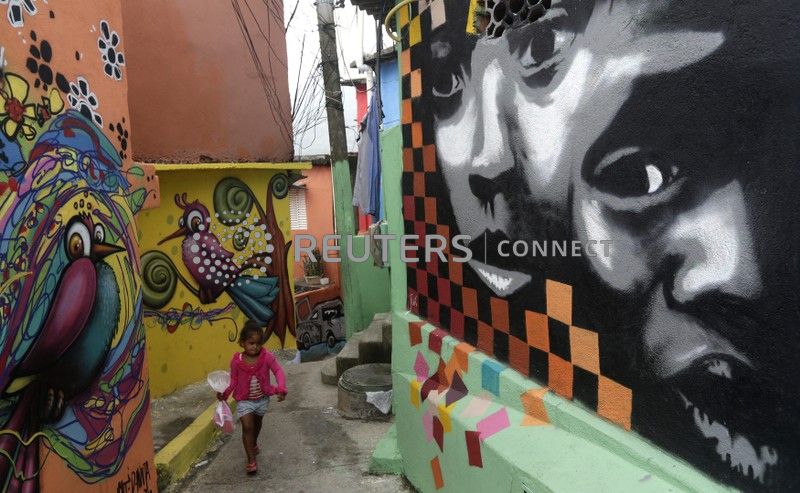
RIO DE JANEIRO/BOGOTA/MEXICO CITY (Thomson Reuters Foundation) – Huddled over sewing machines in their cramped homes in Mare, a sprawling complex of favelas in Rio de Janeiro, about 50 women are on a mission to make two free face masks for each of the area’s 140,000 slum residents within the next two months.
The women – the majority of whom lost their jobs to the coronavirus pandemic – watched videos on how to make face masks and are being paid above the market rate, said Andreza Lopes, who coordinates the project for the nonprofit Redes da Mare.
“Almost half of the women in Mare are financially responsible for their homes,” Lopes, 32, said over the phone, adding that the project is backed by three Brazilian banks.
“Now they are very happy, and grateful to be working on something that has a higher purpose.”
The project is one of dozens of initiatives taking place in shanty towns across the region – from Brazil to Venezuela, Colombia to Mexico – as poor communities come together to help the most vulnerable during the pandemic.
Latin America is emerging as the new epicenter of the novel coronavirus outbreak.
The respiratory disease is spreading quickly through the region, claiming the lives of more than 31,000 people and infecting more than 570,000, according to a tally by the World Health Organization (WHO).
Across Latin America and the Caribbean, about 113 million people – nearly one in five – live in slums, where health experts say COVID-19 infection rates tend to be higher due to poor nutrition, cramped housing and ill health.
But many slum dwellers say they have received little or no government aid to help them cope with the economic and health fallout, leaving them to fend for themselves and community leaders to fill the gaps.
“It’s a very tragic situation right now … nothing significant is being done by the state,” said Alessandra Orofino, head of the Brazilian nonprofit Nossas, which works in favelas and creates technology tools for social movements.
A spokesman for Brazil’s health ministry did not reply to a request for comment.
SLUMS HIT HARD
With limited access to sanitation and millions of people crammed together in close quarters, Latin American slums are especially vulnerable to the pandemic, health experts say.
“In those places where you have high human density, and you have overcrowding … you have a perfect environment for transmission,” said Federico Costa, an infectious disease expert and professor at Brazil’s Federal University of Bahia.
In the poor neighborhoods of Argentina’s capital Buenos Aires, for example, COVID-19 infection rates are nearly 30% higher than in other parts of the city, government figures show.
In Brazil, where Johns Hopkins University has reported more than 22,000 COVID-19 deaths – leading the WHO to label the country the latest coronavirus hotspot – about 15 million people live in favelas.
“It’s 140,000 people in just over four kilometers … how do you social distance in this context?” asked Lopes about the situation in Mare.
Nossas is helping community groups in Rio’s favelas to set up crowdfunding campaigns to raise money to combat COVID-19.
In late April, the nonprofit and other local groups hosted a live streamed concert featuring popular Brazilian musicians – many born and bred in the favelas.
The concert, with over eight million online views, raised about $50,000 to buy and deliver food parcels and hygiene kits to Rio’s favela residents, said Orofino, the head of Nossas.
“Favelas have built resilience over time and are now deploying that,” she said.
“We don’t think by any means that this crowdfunding and self-organizing is going to halt COVID-19. It’s just that we don’t have the time to wait for the state to do something.”
PROTESTS
Since the start of the outbreak, some governments in the region have been delivering food parcels and cash payments to vulnerable communities.
Colombia has allocated $120 million to help three million informal economy workers, while in Argentina the government has announced low-income workers would receive a one-time payment of 10,000 pesos ($147).
Chile has announced emergency cash transfers that will reach about 4.5 million people, and the Dominican Republic has allocated cash payments to 1.5 million families.
Meanwhile, Argentina, Ecuador and Colombia have banned utility shut-offs for tenants defaulting on payment during the pandemic, and in Peru low-income homes were told they could postpone payment of utility bills.
But many slum dwellers say that’s not enough.
Street vendors and other informal workers who have lost their jobs due to lockdown measures have taken to the streets in several cities, including in Bogota in Colombia and the Chilean capital Santiago, to demand government help.
After a deadly police raid in a Rio favela earlier this month, residents complained that the government was offering little aid to contain the pandemic but was still engaging in violent police operations.
‘LOVE OUR NEIGHBOR’
As residents and activists call for more state aid, they are also tapping into neighborhood networks to reach out to the people most in need.
As Mexican officials began urging people to stay home in March to contain the outbreak, HIV-positive transgender activist Kenya Cuevas saw that many homeless people and drug users in downtown Mexico City were going hungry.
“It annoyed me. So, I decided I’d better do something,” she said in a phone interview.
Cuevas set up a program with support from a private donor to feed the homeless and other vulnerable groups, serving about 240 meals a week since the start of April.
The shelter for trans sex workers that she runs in the city’s north is also feeding neighbors affected by the pandemic, giving out nearly 80 meals a day, according to the United Nations.
“As trans women, we know how to love and to love our neighbor,” said Cuevas. “We have always had that quality.”
City officials said in a March press conference that 90% of Mexico City’s more than 480 soup kitchens remain open and the government is doing mobile medical checkups in areas with high numbers of homeless people.
In Bogota’s southern hillside slums, among the hardest hit are Venezuelan migrants who rely on daily cash-in-hand earnings as street sellers.
Unable to make an income during Colombia’s strict coronavirus lockdown, many have been relying on their support networks of fellow migrants, who keep in touch on Facebook and WhatsApp.
When Venezuelan Milsen Solano heard that one of her neighbors, an unemployed young migrant, got kicked out of his flat in April, she took him in to live with her and her family in their small apartment in downtown Bogota.
“He doesn’t have the money to pay his rent,” said Solano.
“If six people already live here, another person can, too. You have to help when you can.”
($1 = 67.9440 Argentine pesos)
Credit the Thomson Reuters Foundation, the charitable arm of Thomson Reuters, that covers the lives of people around the world who struggle to live freely or fairly.
![Short dramas produced by Flytoto Culture &Technology Co draw crowds of visitors at the 23rd China-ASEAN Expo. [Photo provided to CHINA DAILY]](https://villagevoicenews.com/wp-content/uploads/2026/10/6abeef0ce4b06d4a392d76e2-750x375.jpeg)