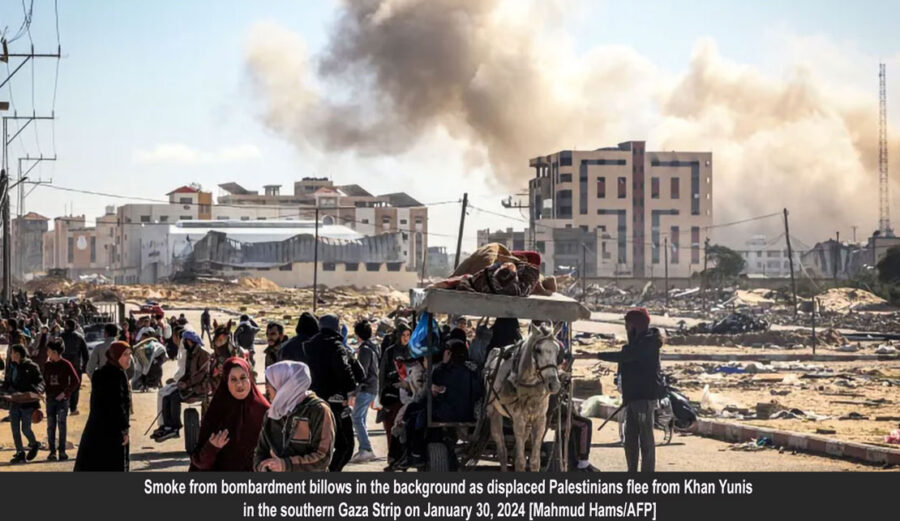
In a profound critique that sheds light on the entrenched biases of Western media, journalist Vidya Krishnan exposes the deep-seated colonial underpinnings influencing the coverage of Israel’s war on Gaza.
According to Krishnan, this coverage represents not just a failure in journalistic standards but a glaring example of ‘coloniser journalism’ at work. This perspective comes at a time when the world grapples with the images and stories emanating from Gaza, expecting the media to provide an unbiased narrative of events.
Krishnan points to the coverage of The New York Times on August 6, 2022, as a stark example of the issue at hand. The delayed acknowledgment of Palestinian casualties, juxtaposed with immediate justifications for Israeli actions, highlights a pattern of selective reporting.

This, Krishnan argues, is emblematic of a wider trend in Western journalism that has, for over 75 years, shaped a narrative justifying Israel’s occupation and aggression towards Palestinians.
The critique extends beyond individual reports, addressing the systemic failure within Western newsrooms to adhere to journalistic integrity when covering conflicts involving their geopolitical allies.
Krishnan’s analysis suggests that such bias is not merely a lapse in professionalism but a reflection of a colonial mindset that permeates Western journalism.
This mindset, she asserts, prioritizes the narratives of ‘victors’ and marginalises the voices of the oppressed, effectively dehumanising the Palestinian experience.
The implications of this biased coverage are far-reaching, influencing public opinion and international policy in ways that perpetuate the conflict and undermine the principles of justice and equity.
Krishnan’s call to action is for a journalism that transcends colonial legacies, one that serves to illuminate truth in all its complexity rather than obscure it in the service of power.
In conclusion, as Krishnan’s perspective gains traction, it challenges not only the practices of individual news organisations but the very ethos of Western journalism.
The call for a reformed, ethical approach to reporting on conflicts like the one in Gaza is not just about improving journalistic standards but about challenging the power structures that dictate whose stories are told and how. The legacy of this critique may well be a turning point in how conflicts are covered, demanding a journalism that is both revelatory and just.
This examination of Krishnan’s critique serves as a stark reminder of the responsibility that comes with the power of the press, urging a reevaluation of the role media plays in shaping the narrative of conflicts and the lives it affects.
Continuing from the critical examination of Western media’s approach to the Israel-Gaza conflict, Krishnan’s analysis further delves into the historical biases that have long influenced the portrayal of post-colonial nations in the Western press.
This historical context is crucial in understanding why current reporting not only fails to capture the essence of the conflict but actively contributes to a skewed narrative that favors the aggressor under the guise of neutrality.
Krishnan’s critique is not limited to the coverage of military actions or the immediate aftermath of confrontations. It extends to the portrayal of the Palestinian people themselves.
Drawing on Frantz Fanon’s analysis in “The Wretched of the Earth,” Krishnan highlights how the dehumanization of colonised peoples is perpetuated through language and narrative choices.
This tactic, she argues, is vividly present in the coverage of the Palestinian suffering, where victims are often presented as mere statistics or passive participants in their own demise, further entrenching the colonial narrative of the ‘civilized’ West versus the ‘barbaric’ other.
The consequences of such biased reporting are not abstract. They have tangible effects on the ground, influencing international policy, affecting aid distribution, and shaping the global discourse on human rights and sovereignty.
By prioritising one narrative over another, Western media effectively participates in the conflict, not as impartial observers but as actors with the power to influence the course of events.
Krishnan’s call for a shift towards more ethical journalism is echoed in her critique of the role Western journalists play in perpetuating these narratives.
She challenges them to reconsider their approach to conflict reporting, to prioritize humanity over ideology, and to recognize their part in the broader geopolitical landscape that shapes the lives of millions.
This is not merely a call for balance but for a fundamental reevaluation of what it means to report on conflict in a post-colonial world.
In closing, Vidya Krishnan’s incisive critique of Western media’s coverage of the Israel-Gaza conflict serves as a clarion call for change. It asks us to confront the uncomfortable realities of a journalistic tradition steeped in colonialism and to strive for a media landscape that respects the dignity and humanity of all peoples.
As the discourse around media bias and the responsibility of journalists continues to evolve, Krishnan’s analysis stands as a testament to the power of media to either bridge divides or deepen them.
The path forward demands a commitment to truth, integrity, and a relentless questioning of the narratives that have shaped our understanding of conflict and humanity. (WiredJA).