(AP) — United Nations’ (UN) Secretary-General Antonio Guterres warned Thursday that the rule of law is at grave risk of becoming “the Rule of Lawlessness,” pointing to a host of unlawful actions across the globe from Russia’s invasion of Ukraine and coups in Africa’s Sahel region to North Korea’s illegal nuclear weapons program and Afghanistan’s unprecedented attacks on women’s and girls’ rights.
The UN chief also cited as examples the breakdown of the rule of law in Myanmar since the military ousted the elected government of Aung San Suu Kyi in February 2021 leading to “a cycle of violence, repression and severe human rights violations,” and the weak rule of law in Haiti which is beset by widespread rights abuses, soaring crime rates, corruption and transnational crime.
“From the smallest village to the global stage, the rule of law is all that stands between peace and stability and a brutal struggle for power and resources,” Guterres told the UN Security Council.
The secretary-general lamented, however, that in every region of the world civilians are suffering the effects of conflicts, killings, rising poverty and hunger while countries continue “to flout international law with impunity” including by illegally using force and developing nuclear weapons.
As an example of the rule of law being violated, Guterres pointed first to Russia’s February 24 invasion of Ukraine.
The Ukraine conflict has created “a humanitarian and human rights catastrophe, traumatised a generation of children, and accelerated the global food and energy crisis,” the secretary-general said. And referring to Russia’s annexation of four regions in Ukraine in late September as well as its 2014 annexation of Crimea, he said any annexation resulting from the threat or use of force is a violation of the UN Charter and international law.
The UN chief then condemned unlawful killings and extremist acts against Palestinians and Israelis in 2022, and said Israel’s expansion of settlements — which the UN has repeatedly denounced as a violation of international law — “are driving anger and despair.”
Guterres said he is “very concerned” by unilateral initiatives in recent days by Prime Minister Benjamin Netanyahu’s new conservative government, which is implementing an ultra-nationalist agenda that could threaten a two-state solution.
“The rule of law is at the heart of achieving a just and comprehensive peace, based on a two-state solution, in line with UN resolutions, international law and previous agreements,” he stressed.
More broadly, the secretary-general said the rule of law is the foundation of the United Nations, and key to its efforts to find peaceful solutions to these conflicts and other crises.
He urged all 193 UN member states to uphold “the vision and the values” of the UN Charter and the Universal Declaration of Human Rights, to abide by international law, and to settle disputes peacefully.
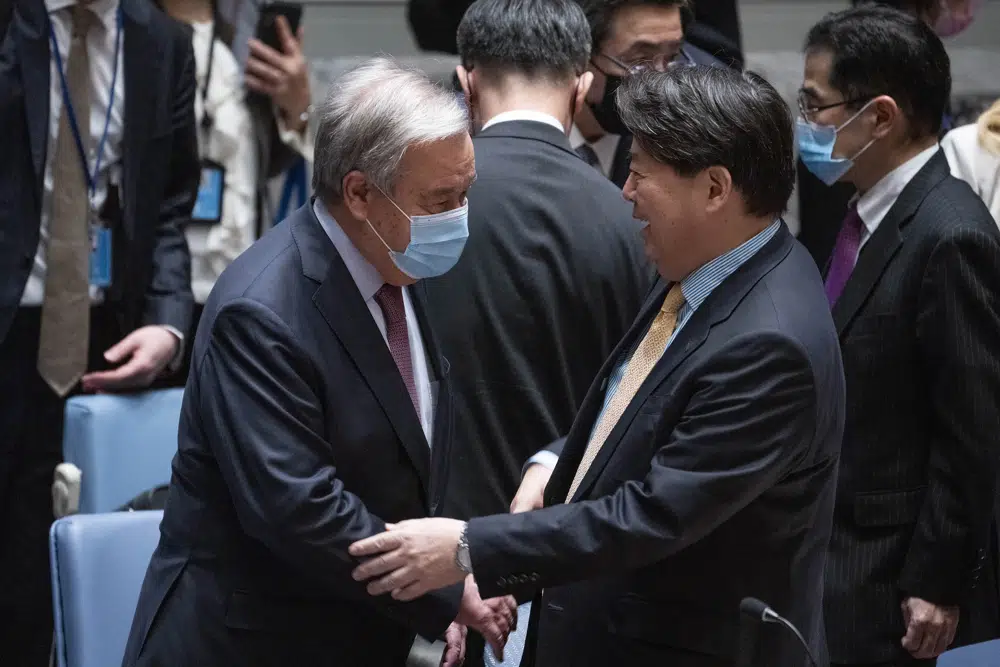
The council meeting on strengthening the rule of law, presided over by Japan’s Foreign Minister Yoshimasa Hayashi whose country decided on the topic, sparked clashes, especially over the war in Ukraine, between Russia and Western supporters of the Kyiv government. Nearly 80 countries spoke.
“Today, we are beset by the war of aggression in Europe and conflicts, violence, terrorism and geopolitical tensions, ranging from Africa to the Middle East to Latin America to Asia Pacific,” Hayashi said.
“We, the member states, should unite for the rule of law and cooperate with each other to stand up against violations of the Charter such as aggression” and “the acquisition of territory by force from a member state,” he said in a clear reference to the Russian invasion of Ukraine.
US Ambassador Linda Thomas-Greenfield told the council “an ironclad commitment” for the US and a fundamental principle of the United Nations is that “no person, no prime minister or president, no state or country is above the law.”
Despite “unparalleled” advancements toward peace and prosperity since the UN was founded on the ashes of World War II, she said some countries are failing in their commitment to the UN Charter’s principles — “the most glaring example” Russia — or are “enabling rule breakers to carry on without accountability.”
Thomas-Greenfield called for those who don’t respect sovereignty, territorial integrity, human rights and fundamental freedoms to be held accountable, naming Russia, North Korea, Iran, Syria, Myanmar, Belarus, Cuba, Sudan and Afghanistan’s Taliban rulers.
Russia’s UN Ambassador Vassily Nebenzia accused the West of using the council meeting “to sell the narrative about the apparent responsibility of Russia for causing threats to international peace and security, ignoring, however, their own egregious violations.”
He said that before last February 24, “international law was repeatedly flouted,” claiming the roots of the current situation “lie in the astonishing desire of Washington to play a role of global policeman.”
Nebenzia pointed to numerous instances including NATO bombings in former Yugoslavia and Libya, the US-led invasion of Iraq “using a false pretext” of the presence of weapons of mass destruction, of the “war on terror” in Afghanistan — and he blamed the West for what Moscow calls the current “special military operation.”
Ukraine’s First Deputy Foreign Minister Emine Dzhaparova said “it’s very black and white” that Russia is responsible for the crimes in Ukraine and should be held accountable.”
She also warned the Security Council: “The law of force that Russia has been barbarically practising today over Ukraine gives a very clear signal to everyone in this room: No one is secure any more.”