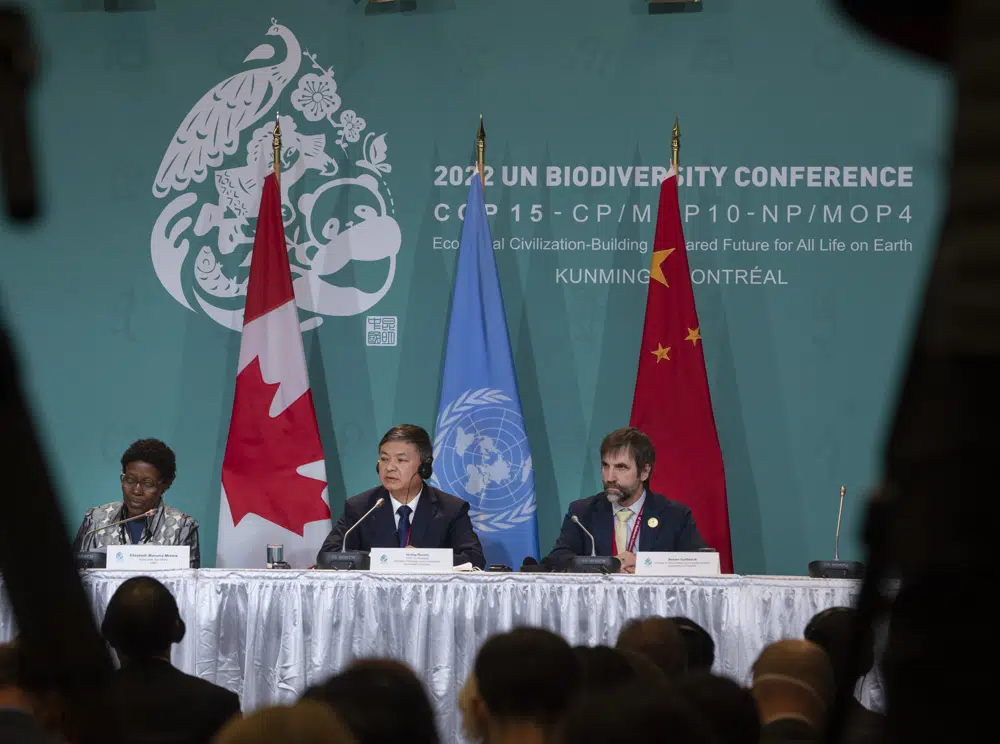
Michael Casey (AP) — Negotiators reached a historic deal at a U.N. biodiversity conference early Monday that would represent the most significant effort to protect the world’s lands and oceans and provide critical financing to save biodiversity in the developing world.
The global framework comes on the day the United Nations Biodiversity Conference, or COP15, is set to end in Montreal. China, which holds the presidency at this conference, released a new draft on Sunday that gave the sometimes contentious talks much-needed momentum.
“We have in our hands a package which I think can guide us as we all work together to halt and reverse biodiversity loss and put biodiversity on the path to recovery for the benefit of all people in the world,” Chinese Environment Minister Huang Runqiu told delegates before the package was adopted to rapturous applause just before dawn. “We can be truly proud.”
The most significant part of the agreement is a commitment to protect 30% of land and water considered important for biodiversity by 2030, known as 30 by 30. Currently, 17% of terrestrial and 10% of marine areas are protected.
The deal also calls for raising $200 billion by 2030 for biodiversity from a range of sources and working to phase out or reform subsidies that could provide another $500 billion for nature. As part of the financing package, the framework asks for increasing to at least $20 billion annually by 2025 the money that goes to poor countries. That number would increase to $30 billion each year by 2030.
Financing emerged late in the talks and risked derailing an agreement. Several African countries held up the final deal for almost nine hours. They wanted the creation of a new fund for biodiversity but agreed to the creation of one under the pre-existing Global Environmental Facility.
“Creating a fund under the GEF is the best way to obtain something immediate and efficient,” said Christophe Béchu, France’s minister for ecological transition who headed its delegation, adding that a completely new fund would have taken several years to establish and deprived developing countries of immediate cash for biodiversity.
Then as the agreement was about to be adopted, Congo stood up and said it opposed the deal because it didn’t set up that special biodiversity fund to provide developing countries with $100 billion by 2030.
Huang swept aside the opposition and the documents that make up the framework were adopted. The convention’s legal expert ruled Congo never formally objected to the document. Several other African countries, including Cameroon and Uganda, sided to no avail with Congo and said they would lodge a complaint.
“Many of us wanted more things in the text and more ambition but we got an ambitious package,” Canada’s Minister of Environment and Climate Change Steven Guilbeault said. “We have 30 by 30. Six months ago, who would have thought we could 30 by 30 in Montreal? We have an agreement to halt and reverse biodiversity loss, to work on restoration, to reduce the use of pesticides. This is tremendous progress.”
France’s Béchu called it a “historical deal.”
“It’s not a small deal. It’s a deal with very precise and quantified objectives on pesticides, on reduction of loss of species, on eliminating bad subsidies,” he said. “We double until 2025 and triple 2030 the finance for biodiversity.”
The ministers and government officials from about 190 countries have mostly agreed that protecting biodiversity has to be a priority, with many comparing those efforts to climate talks that wrapped up last month in Egypt.
Climate change coupled with habitat loss, pollution and development have hammered the world’s biodiversity, with one estimate in 2019 warning that a million plant and animal species face extinction within decades — a rate of loss 1,000 times greater than expected. Humans use about 50,000 wild species routinely, and 1 out of 5 people of the world’s 8 billion population depend on those species for food and income, the report said.
But they struggled for nearly two weeks to agree on what that protection looks like and who will pay for it.
The financing has been among the most contentious issues, with delegates from 70 African, South American and Asian countries walking out of negotiations Wednesday. They returned several hours later.
Brazil, speaking for developing countries during the week, said in a statement that a new funding mechanism dedicated to biodiversity should be established and that developed countries provide $100 billion annually in financial grants to emerging economies until 2030.
“All the elements are in there for a balance of unhappiness which is the secret to achieving agreement in U.N. bodies,” Pierre du Plessis, a negotiator from Namibia who is helping coordinate the African group, told The Associated Press before the vote. “Everyone got a bit of what they wanted, not necessarily everything they wanted.”
There were supporters of the framework who said it fell short in several areas.
The Wildlife Conservation Society and other environmental groups were concerned that the deal puts off until 2050 a goal of preventing the extinction of species, preserving the integrity of ecosystems and maintaining the genetic diversity within populations. They fear that timeline is not ambitions enough.
Some advocates also wanted tougher language around subsidies that make food and fuel so cheap in many parts of the world. The document only calls for identifying subsidies by 2025 that can be reformed or phased out and working to reduce them by 2030.
“The new text is a mixed bag,” Andrew Deutz, director of global policy, institutions and conservation finance for The Nature Conservancy, said. “It contains some strong signals on finance and biodiversity but it fails to advance beyond the targets of 10 years ago in terms of addressing drivers of biodiversity loss in productive sectors like agriculture, fisheries, and infrastructure and thus still risks being fully transformational.”