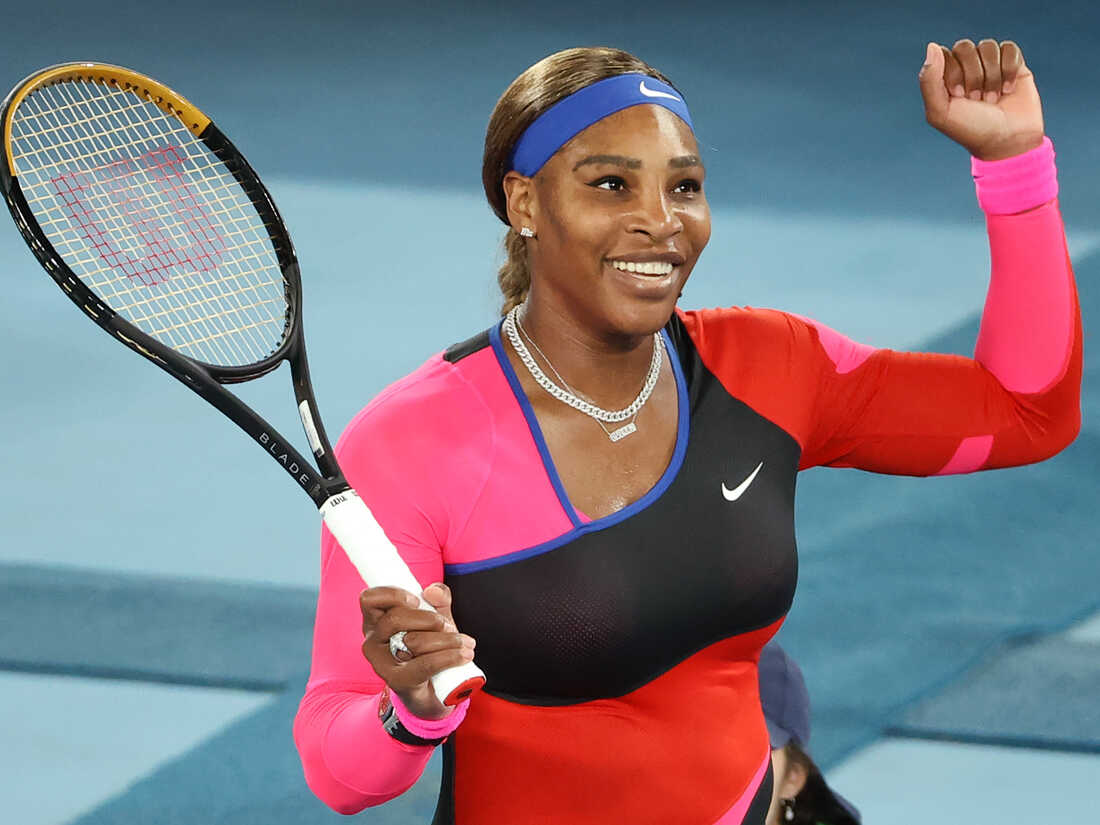
| By Afua Hirsh-Born in the same year as the tennis champion, I watched her face countless obstacles – and become the greatest of all time
We don’t deserve Serena Williams. Nothing about this world makes it likely that a little black girl from Compton – now “evolving” away from professional competition after her final match at the US Open – would become an indisputable Goat.
Witnessing Williams’s ascension to Greatest of All Time status has been an extraordinary, once-in-a-lifetime experience. The sheer longevity of her career sunk in for me when I discovered that Emma Raducanu, who Williams has played this season, had not even been born during one of Williams’s most memorable seasons: 2002, when she won three grand slam titles in a row.
But more than her impressive record, it is how Williams got here that I most celebrate – refusing to assimilate into the rarefied, exclusionary culture of tennis, and redefining it on her own terms.
One of my favourite interviews with the star, which surfaced only recently, shows an 11-year-old Williams standing shyly giggling beside older sister Venus. When asked: “If you were a tennis player, who would you want to be like?” she almost hesitates to reveal her self-belief. But her answer, when it comes, is unequivocal: “I’d like other people to be like me.”
Born the same year as Williams, I was 11 then, too. I didn’t have the language of being unapologetic, or taking up space, of authenticity or representation. I had nowhere near her confidence, and a Goat, as far as I was aware, was a hollow-horned mammal. Like Williams, I was a little black girl, whose own black consciousness blossomed in the unlikely terrain of the very same grassy, Wimbledon soil as Williams’ global sporting prowess.
Through her and Venus’ appearance there in 1998, in beaded braids, I watched young black women excel in even the most hostile spaces on their own terms. Bumping into the entire Williams family in our neighbourhood over the years, as they rented houses near our own during the tennis, my sister and I were the recipients of various acts of kindness – we learned first-hand that these sisters had a sense of solidarity with other black girls they encountered along the way.
And tennis was a hostile climate. Growing up in Wimbledon, I glimpsed only the tip of the iceberg when it came to the mountain of structural barriers stacked up against the Williams sisters. Theirs is a story about winning the game before they ever set foot on the tennis court – overcoming poverty, racism, colourism, class.
These factors are so often downplayed in the telling of Williams’ story, in favour of the personal characteristics that make her unique – of which, there are plenty: a seemingly more talented older sister, Venus, whose early success initially saw Serena’s own chances underestimated; her faith as a Jehovah’s Witness; remarkable parents; a level of self-criticism, the depths of which are still being revealed even now.
In her valedictory Vogue piece earlier this month, Williams reflected on her four Olympic gold medals, 14 grand slam doubles titles and 23 grand slam titles – almost every tennis record imaginable. And yet she still references the success of Margaret Court, who played before the advent of the Open era and won 24. “I didn’t show up the way I should have or could have. But I showed up 23 times,” was Williams’s consolatory verdict, “and that’s fine.”
There is no questioning Williams’s unique talent and drive, but the full truth is a more uncomfortable narrative. We don’t deserve Williams, because she should not exist. The idea that the Williams sisters succeeded because of their unique work ethic, raw talent and visionary father – a story of the American Dream generously extended to embrace a low-income black family – conceals a darker notion. By implication, people of colour who remain in disadvantaged circumstances are there due to their own fault.
Williams offers us clear insight into the unfairness of this. However much she is held up as an example of the American Dream, she has done her bit to problematise it. Writing about the especially emotive impact of being jeered at during a tournament that had a special meaning for her, she hinted at the intergenerational trauma that informs the African American experience. “It haunted Venus and our family as well. But most of all, it angered and saddened my father … sparking cold memories of his experiences growing up in the south.”
And when asked about the murder of George Floyd, Williams disclosed that she had not watched the video of his death at the hands of police, or any other video of a black person suffering the same fate. “I can’t,” she said. “It’s my life.”
This, and the many other instances of abuse she has weathered, have made many black women feel especially protective of Williams. From surviving childbirth in America as a black woman – a shocking percentage of whom do not, something she has publicly decried – to the overtly racist tropes too numerous to mention she has been tarred with.
It was this sense of protectiveness – and not a stake in the depressingly unwinnable competition of masculinities between Will Smith and Chris Rock – that angered me at this year’s Oscars. Serena and Venus executive-produced a film that offered a view of the world through their lens. When it was hijacked by a debate about which of two men – both of whom have form for failing to centre black women – was more wrong, I felt cheated on Williams’ behalf. She maintained a dignified silence.
Williams is selective about how she speaks about her emotional inner world. Which is why her letter announcing her retirement from tennis landed with such grace and honesty. “I hate it,” she said. “I don’t want it to be over, but at the same time I’m ready for what’s next.”
Serena Williams is more than a tennis great: she showed black women we could be ourselves What’s next is already under way. Like Beyoncé, Edward Enninful and so many other prominent black cultural figures, Williams grew up with a mother who doubled as a seamstress, bestowing on her a confidence in designing her own aesthetic. She has form in collaborating with other black creatives. After the Black Panther-inspired catsuit that she wore to the 2018 French Open – one of her most memorable on-court outfits – was subsequently banned by tennis officials, citing “respect” for the game, Williams collaborated with the late, great Virgil Abloh. Her 2019 look was no less bold – a striking black and white two-piece, with matching cape bearing the words “mère, championne, reine, déesse” (mother, champion, queen, goddess). In Abloh’s words, Williams is a “thought leader, not just a tennis player”.
The more Williams was bullied about her physique by various detractors over the years, the more she seemed to draw attention to her figure with bold designs – another tendency for which I appreciate her deeply. Her first forays into fashion design, which only her most ardent fans will remember, stretch back to the early noughties, with the launch of her clothing line Aneres (Serena spelled backwards) in 2003, which has over the years evolved into her current body-inclusive brand S by Serena, founded in 2019.
And she has been quietly, but successfully, angel investing for more than a decade, injecting capital into companies with diverse points of view in an act of multi-hyphenation that – speaking for myself at least – makes her more, not less, relevant to generations of side-hustling, entrepreneurial women.
“Over the years, I hope that people come to think of me as symbolising something bigger than tennis,” Williams wished as she bade farewell to tennis. That, she maybe does not fully realise yet, is already done. My hope now is that Serena Williams’ story will come to symbolise something even bigger than herself – the reality facing every young black person with a dream. ( (Guardian) _________________ About the author Afua Hirsch is a writer, broadcaster and former barrister |

Shadab leads Falcons past Patriots to fourth place on the table
Antigua and Barbuda Falcons 191 for 7 (Lewis 48, Nawaz 33, Shadab 30, Holder 2-39) beat St Kitts and Nevis Patriots 187 for...
Read moreDetails