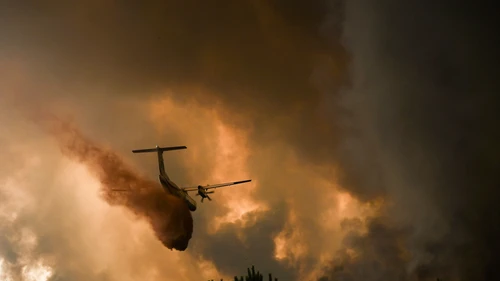
| Becky Ferreira- Climate change, which is driven by the human consumption of fossil fuels, is making extreme weather events such as hurricanes, heatwaves, floods, and droughts much more intense. Not only does this trend threaten people and ecosystems around the world, but a new study concludes that it could destabilise entire societies.
Extreme heat and drought, which frequently overlap in our warming world, can produce “cascading impacts” that “propagate through numerous sectors with far reaching consequences, potentially being able to destabilise entire socio-economic systems,” according to a study published on Wednesday in PLOS Climate. Researchers led by Laura Niggli, a PhD student in glaciology and geomorphodynamics at the University of Zurich, reached this conclusion after examining eight concurrent heat and drought events in Europe, Africa, and Australia that have occurred within the past two decades. The team analysed how these double-whammies affected human communities and supply chains, and found that they had the most serious impact on the health, energy, and agriculture and food production sectors. “A relevant finding of our study is that the impact of compound heat and drought is not just the sum of their separate impact on different systems,” Niggli said in an email. “It is well known how severely the impacts of extreme events can be e.g. for health (with high excess mortality related to extreme heat or bad air quality), food production (with large losses in the agriculture sector due to dry spells or extreme precipitation, and limited availability of fodder and water for animals), energy (related to limited cooling water for nuclear power plants, or limited water for hydropower generation) or mobility (e.g. waterway transport restrictions due to low flows in rivers, or buckling of rail tracks) etc.” In an interconnected and interdependent society, she said, “the impacts of such events can propagate through numerous sectors and cause multiple indirect impacts and consequences related to maladaptation in other sectors. We learnt that events or impacts that are ‘relatively minor’ when regarded independently can have far reaching consequences for critical systems, potentially being able to destabilize complete socially relevant systems, for example causing global trade instability.” The team was able to establish these interwoven relationships by reviewing case studies of severe combinations of heat and drought, and their impacts across critical human infrastructure. The examples included three extreme heat events during the European summers of 2003, 2015, and 2018, and three events in Australia during southern summers of 2009, 2012 to 2013, and 2019 to 2020. The researchers also looked at a sweltering heat wave that swept through Russia in the summer of 2010, and a multiyear drought that hit South Africa from 2015 to 2018. When taken together, these case studies resulted in tens of thousands of excess deaths as well as a spike in heat-related emergencies that imposed a major strain on healthcare workers. Animals also tragically perished in high numbers during some of these events; more than a billion were killed by the Australian bushfires in 2019 and 2020. Niggli and her colleagues also broadened the aperture to include all kinds of coincident damage during the eight case studies. Supply chains and transportation routes were often disrupted by buckled train tracks and melted roads, and droughts that dried up waterways. Heat-drought combinations also sparked wildfires that destroyed thousands of buildings, caused major drops in crop yields, and produced power outages, to name just a few deleterious effects. In addition to the lives lost, these extreme heat events cost tens of billions of dollars in some cases. “Based on our findings we suggest that rather than to compartmentalize risk assessment into single extreme events, impacts and sectors, it is essential to systematically consider the interconnectedness of sectors and systems, in order to improve the adaptive capacity and resilience of affected regions,” Niggli said. “I think that there is clearly a need for stronger efforts and investment in risk management and adaptation including transformative changes,” she noted. “The interconnected nature of the various sectors affected by heat and drought events and the cascading nature of their impacts calls for intersectorial but also international collaboration.” To that end, the team hopes that their findings will spur more research into the complex and interlocking effects of extreme weather on human communities and ecosystems, and inform efforts to help vulnerable populations prepare for the climate-related “wildcards” and “grey swan” events to come (“grey swans” are considered imaginable but unlikely, whereas the related “black swan” events are typically thought of us as completely unpredictable). “When coming from the policy side, climate change adaptation is mostly designed for impacts that have been experienced before to a comparable degree,” Niggli said. “In contrast, it is difficult to prepare for events without historical precedence. This is—not only but also—due to a limited understanding, interest and concern about low-probability-high-risk events” such as wildcards and grey swans. “We consider compound events to be potentially important wildcards that have so far not received enough attention despite their increasing probability associated with the change of the climate,” she concluded. (VICE)
|

AI Could Overhaul Guyana’s Entrepreneurial Future, Professor Shamir Ally Says
Artificial Intelligence (AI) is poised to transform far more than the technology sector, potentially reshaping how Guyana educates entrepreneurs, manages...
Read moreDetails