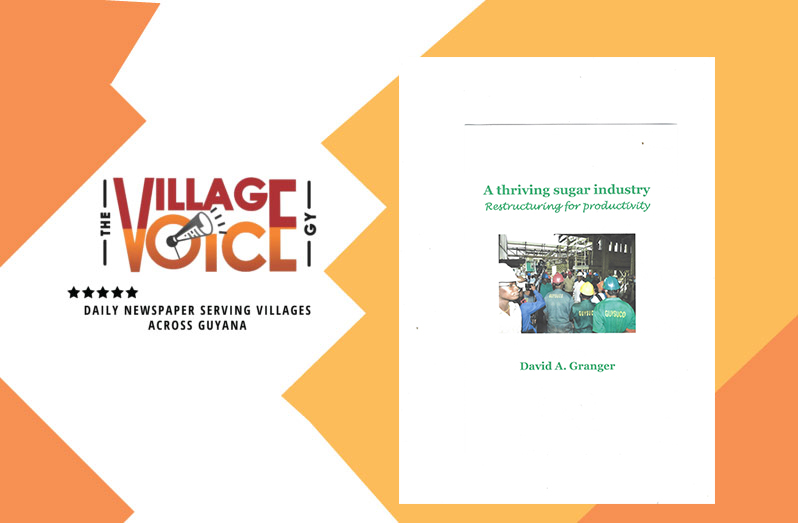

David Granger’s, A Thriving Sugar Industry. Restructuring for productivity, debunks the myth that Guyana’s Coalition Administration was determined to close the industry and to place thousands of workers on the breadline. The book reveals that, to the contrary, the actions which the David Granger administration took on assuming office in
May 2015 were intended to protect jobs, preserve the industry and prevent the total collapse of the state-owned sugar corporation.
David Granger, as President in June 2019, personally visited Albion Estate to speak with executives and workers and to see the conditions in the factory and the industry for himself. The book, therefore, reflects the then President’s realistic assessment of the industry. It sets the record straight about the approach by A Partnership for
National Unity+Alliance For Change (APNU+AFC) Coalition to sugar. It outlines the efforts to save rather than sink the sugar industry.
The crisis in Guyana’s sugar industry did not erupt overnight. Granger outlines the sugar industry’s efforts to adapt to recurrent crises for more than 200 years. He highlights the constant need, historically, for the consolidation of plantations, dating back of colonial times.
The PPPC administration which succeeded the APNU+AFC administration, and which has accused the latter of wanting to close the industry, itself was guilty of closing sugar factories and consolidating sugar estates. Granger documents the PPPC’s complicity in the consolidation of the East Demerara plantations.
A Thriving Sugar Industry. Restructuring for productivity reveals that it was not the Granger administration which initiated the loss of jobs in the industry. The State-owned industry slashed more than 5,000 jobs between 1992 and 2015 when the PPPC was in office.
Guyana’s sugar, simply, remains uncompetitive. The cost of production is multiple times the world market price. The industry, for more than three decades, was being kept afloat because of the favourable European market which provided assured access and preferential prices for sugar. Those preferences, however, began to be eroded by the second decade of this century, thereby precipitating the industry’s downward spiral from which it has never recovered.
The PPPC administration had a so-called ‘turnaround’ plan for the industry. However, this plan did not work and the state-owned sugar corporation continued to hemorrhage. The already dire situation was exacerbated by the catastrophic decision to construct a new factory at Pln. Skeldon which was to be the lynchpin of the PPPC’s ‘turnaround’ plan for the industry. Instead, it became a ‘white-elephant’ and sounded the death-knell for sugar in that part of the East Berbice-Corentyne Region.
Granger notes other problems which compounded the woes of the industry. These include the decline in sugar production, the decreased in productivity, inadequate maintenance and poor industrial relations, all of which combined to deepen the crisis in the country’s oldest industry.
The APNU+AFC therefore inherited a sugar industry in deep crisis and which required multiple, massive multi-billion dollar bailouts from the State. In four years, the government disbursed G$42.6 billion dollars to the industry. Financially, a strong case existed for the closure of the industry which was bleeding the public purse.
A Thriving Sugar Industry. Restructuring for productivity relates the efforts which the Granger administration took to try to save the industry. The APNU+AFC established a Commission of Inquiry into the industry; it subsequently appointed a Task Force to make recommendations to restructure the industry.
A State Paper on the Future of the Industry was published and a Corporate Restructuring Plan initiated. Meetings were held between the Cabinet and the main unions in the industry – Guyana Agricultural and General Workers’ Union (GAWU) and National Association of Agricultural, Commercial and Industrial Employees (NAACIE) – and an agreement was reached to cooperate to seek solutions to the industry’s problems. Meetings were held, also, with the Guyana Sugar Corporation (GUYSUCO) and the National Industrial and Commercial Investments Limited (NICIL). Though not mentioned in the book, the then administration also secured a bond to the extent of G$30Billion to support planned reforms. Granger’s plans were lofty and well-intentioned. He argues in the book that:
The Government is aiming for a smaller, stronger but smarter and more sustainable industry. A competitive sugar industry will act as a catalyst for the revitalization of the rural economy. A viable sugar industry will eventually be able to provide additional employment opportunities, including to those affected by the restructuring of the industry.
While the APNU+AFC administration’s political rivals have made political currency out of the decision to close the Canje, Skeldon and Wales factories and to terminate the services of thousands of sugar workers, the book points out that this decision, painful and difficult as it was, was necessary to allow for saving the jobs of the thousands of others employed in the industry. Granger argues that, had the Guyana Sugar Corporation not been restructured and sugar production not been consolidated, the entire industry would have collapsed.
A Thriving Sugar Industry. Restructuring for productivity argues that the APNU+AFC did not set out to close the industry. It engaged in restructuring to right-size the industry, to save the industry from a total collapse and to eventually ensure a viable sugar corporation.
Granger, in the book, provides a compelling rationale for the steps which his government took to ensure the industry’s survival. He cautions against attempts to revert to a model which led to the financial hemorrhaging of the sugar corporation. In this regard, the incumbent PPPC administration can learn much from the Granger administration’s methodical approach to restructuring the industry.
The PPPC administration, unfortunately, has gone ahead, cavalierly, and taken decision to reopen some of the closed estates. It has done so without the benefit of an in-depth study to determine the financial or economic impact of its proposed move. It has not detailed any restructuring or yet another ‘turnaround’ plan, nor determined the costs of the reopening closed estates. It has not detailed from whence the resources will come to initiate its plans. Nor has it outlined a vision for the industry beyond fulfilling an election promise to its supporters.
Sugar has been part of the economic lifeblood of the country for more than three hundred years. If sugar is to continue to be bedrock of country’s rural economy and remain
a principal source of economic livelihoods for tens of thousands of households then its restructuring must be properly managed.
Those into whose hands the task of managing the industry falls will do well to read David Granger’s A Thriving Sugar Industry. Restructuring for productivity. Not only does it disabuse the political propaganda of the APNU+AFC Coalition’s being opposed to sugar, but it also outlines a pathway to a viable industry.