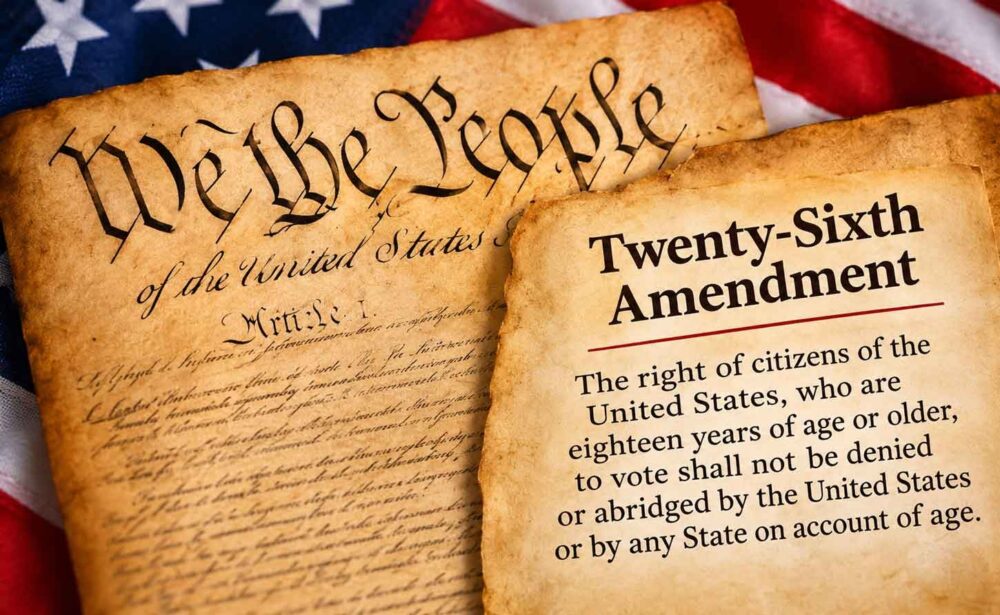
The 26th Amendment to the U.S. Constitution is remembered as a rare moment of American unity. In truth it was dragged out of Washington by a war, a fractured Supreme Court and the threat of an election-day fiasco.
By Calvin Brown (WiredJA)— America likes to tell the story of the 26th Amendment as a civics-class fairy tale: a grateful nation, moved by the sacrifice of its young, lowers the voting age from 21 to 18 in a burst of bipartisan harmony. The numbers seem to bear it out. The Senate voted 94–0. The House followed, 401–19. Thirty-eight states ratified in roughly 100 days, the fastest ratification in the republic’s history.
But speed is not the same as consensus. The 26th Amendment was not a gift. It was a concession, extracted after three decades of stalling, by a generation being conscripted for Vietnam and by a court ruling that left the states staring at an administrative catastrophe.
Thirty Years of “Not Yet”
The slogan was born in the Second World War, when Washington lowered the draft age to 18: old enough to fight, old enough to vote. The state of Georgia took the point in 1943. Congress did not. West Virginia’s Jennings Randolph introduced a constitutional amendment during the war and kept reintroducing it for the better part of 30 years. Presidents Eisenhower, Johnson and Nixon all endorsed the idea. Nothing moved.
One reason sat in the chair of the House Judiciary Committee. Emanuel Celler of New York, gatekeeper for constitutional amendments, spent decades arguing that the young lacked the judgement to be trusted with a ballot. A rifle, apparently, was another matter.
Vietnam broke the stalemate. By the late 1960s, eighteen-year-olds were being drafted into a war they had no say in, and student organisers, alongside the NAACP and other civic groups, turned an old slogan into a national campaign.
The Court That Broke the System
In 1970 Congress tried a shortcut, writing an 18-year-old vote for all elections into its extension of the Voting Rights Act. Nixon signed it despite doubting its constitutionality. Oregon and Texas went to court. On 21 December 1970, a deeply divided Supreme Court, in Oregon v. Mitchell, split the difference: Congress could set the voting age for federal elections, but not for state and local ones.
The result was absurd. An 18-year-old could vote for president but not for sheriff. States faced the prospect of running two sets of voter rolls for the 1972 election. Senator Birch Bayh surveyed election officials in 47 states and put the bill at roughly US$20 million.
That, not a sudden outbreak of conscience, is the engine behind the famous record. Legislatures that had ignored the moral argument for thirty years discovered great urgency once the invoice arrived.
Legislatures that had ignored the moral argument for thirty years discovered great urgency once the invoice arrived.
A Stampede, With Asterisks
Even the finish line is disputed. Nixon publicly congratulated Ohio as the 38th state on the night of 30 June 1971; the official congressional record gives the honour to North Carolina on 1 July. The amendment was certified on 5 July not by the president, who merely signed as a witness, but by the head of the General Services Administration. And the “near-unanimous” nation? Seven states never ratified at all.
Nor did the resistance vanish; it changed address. The amendment created some 11 million new voters, and officials in college towns soon found ways to keep them at arm’s length. As late as 1979 the Supreme Court had to uphold a ruling against a Texas county registrar who made students at a historically Black university, Prairie View A&M, prove their residency through a special questionnaire. Voting-rights groups argue that today’s strict voter-ID laws and scarce campus polling places do similar work by quieter means; their defenders call them safeguards against fraud.
The Legend and Its Uses
The tidy legend matters because it is still doing political work. The same Constitution that moved in 100 days for the young has left the Equal Rights Amendment in limbo for half a century. Congress passed it in 1972 with a ratification deadline attached; its 38th state, Virginia, arrived only in 2020. Joe Biden declared it the law of the land on his way out of office in January 2025, but never directed the national archivist to publish it. Supporters insist the deadline was always invalid. Harvard’s Stephen Sachs called the attempt to ignore it “constitutional vandalism”.
There is an irony here with Biden’s name on it. In 1972, the first election in which 18-year-olds could vote nationwide, a 29-year-old Biden unseated a sitting Delaware senator by just 3,162 votes, the closest Senate race of that year. By his own account, the state’s young people helped carry him there. The politician launched by America’s fastest amendment left office unable, or unwilling, to finish its slowest.
Seen from the Caribbean, the contrast is instructive. Jamaica lowered its own voting age from 21 to 18 in 1972 by act of Parliament. Britain had done so in 1969 and is now moving to 16. America needed a war, a lawsuit and a budget scare.
That is the real lesson of the 26th Amendment. The American Constitution does not move when the argument is won; the young had won it by 1943. It moves when delay becomes more expensive than justice. For the diaspora’s young voters, and for anyone at home who still believes rights arrive by goodwill, that is the story worth remembering.
The writer was alerted to this story by a piece from journalist Joy-Ann Reid, formerly of MSNBC and now of Image Lab Media Group, in one of the latest editions of Joy’s House.