Residents of Region Six have endured approximately 48 hours without electricity as Guyana Power and Light (GPL) engineers struggled to resolve a series of technical problems at the Cane Field substation in East Berbice. Although the company has now confirmed that the substation is operational and electricity is being restored incrementally, explanations from senior officials have raised questions about maintenance, infrastructure reliability and emergency preparedness.
In an earlier update, GPL Deputy CEO Harbinohn explained that engineers had repaired defects in the substation switchgear but encountered another problem when they attempted to restore electricity.
“As we were attempting to restore power after correcting the defects on the substation switch gears in the control room, we encountered another problem,” he explained.
The new problem involved a power cable connecting the transformer to the switchgear panel room. According to Harbinohn, an electrical arc developed around the cable during the restoration attempt, causing the circuit breaker to trip.
Engineers subsequently conducted an insulation resistance test and discovered that one phase of the cable had developed a fault to ground.
Harbinohn explained that the damaged cable was an upgraded installation and that repairing it would require considerable time. An older cable remained available, allowing engineers to reconnect it temporarily while investigating the failure.
He expressed confidence that electricity could be restored that evening. However, approximately two hours after his statement, affected residents were still awaiting restoration.
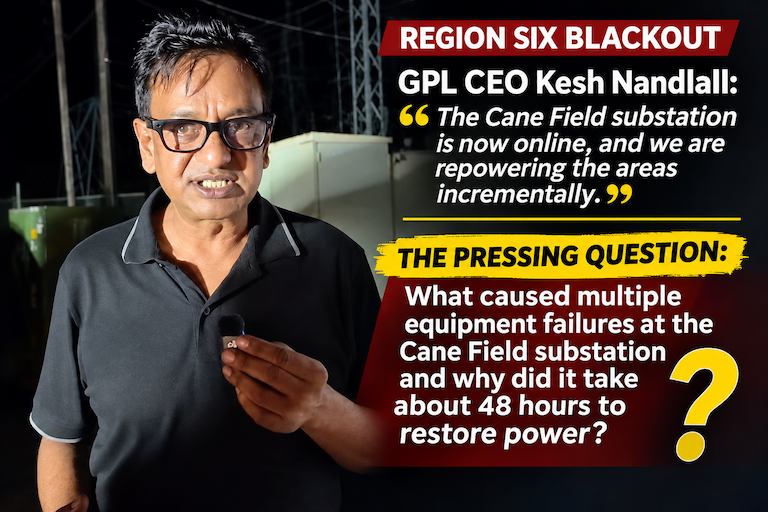
In a subsequent update, GPL CEO Kesh Nandlal apologized to consumers and confirmed that the Cane Field substation had been restored to service.
“We have worked around the clock to restore the substation, which is now online,” Nandlal stated.
He reported that electricity had been restored from Mara through New Amsterdam to Number 19 Village, with engineers continuing to reconnect other affected communities.
GPL official Ryan Ross explained that restoration was proceeding incrementally because a distribution feeder had tripped when engineers attempted to energize it. He attributed the difficulty to increased electricity demand along the Corentyne Coast.
An electrical engineering assessment of GPL’s explanation suggests that from a technical standpoint, the explanation is plausible. According to the assessment, following a prolonged blackout, the simultaneous reconnection of electrical equipment can produce a significant increase in demand, requiring engineers to restore circuits gradually to avoid overloading the system or triggering protective devices.
However, a feeder trip does not necessarily establish that the distribution network lacks sufficient capacity. The interruption could result from temporary restoration demand, an electrical fault or the operation of protective equipment.
The sequence of events raises several important questions.
What caused the original defects in the switchgear? Why did the upgraded transformer cable fail? When was that cable installed, and what maintenance and testing had been performed before engineers attempted to restore power?
Were appropriate diagnostic tests conducted before the initial restoration attempt, and could the cable fault have been identified earlier?
The availability of an older cable also raises questions about GPL’s contingency arrangements. Was that cable maintained as an emergency backup, and could it have been deployed sooner?
Ross’s explanation introduces another concern. If increased electricity demand contributed to the feeder trip, has GPL adequately assessed the growing electricity requirements of communities along the Corentyne Coast? Are existing feeders and protection systems capable of handling current demand?
Perhaps the most important unanswered question concerns the duration of the blackout itself.
GPL has explained several difficulties encountered during restoration, but it has not provided a detailed timeline accounting for the approximately 48 hours residents spent without electricity.
Prolonged outages carry real consequences. Households risk losing refrigerated food, businesses suffer interruptions and financial losses, and residents who depend on electricity for essential services face considerable hardship.
The efforts of engineers working to restore electricity deserve acknowledgment. However, their dedication does not remove management’s responsibility to maintain reliable infrastructure and prepare for equipment failures.
GPL should publish a comprehensive incident report identifying the original cause of the outage, the sequence of equipment failures, the time required for each repair and the corrective measures planned.
Was this prolonged blackout unavoidable, or did weaknesses in maintenance, fault detection, infrastructure capacity and contingency planning contribute to its duration?
For Region Six residents, restoring electricity is the immediate priority. Ensuring that another equipment failure does not leave entire communities without power for two days must be the next.