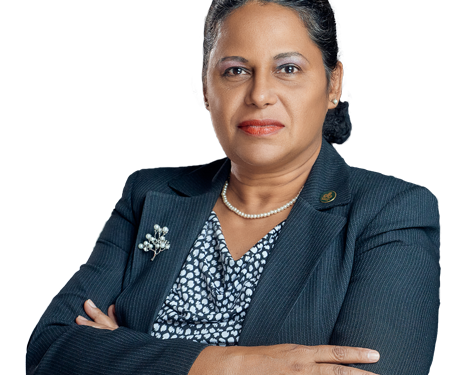
Former Minister and former Member of Parliament Annette Ferguson has criticised the Irfaan Ali-led People’s Progressive Party/Civic (PPP/C) Government over its push to pass the Former Presidents (Benefits and Other Facilities) Bill 2026, accusing the administration of using its parliamentary majority to advance legislation while pressing concerns affecting ordinary Guyanese remain inadequately addressed.
Ferguson’s criticism, however, was not confined to the Government. She also took aim at the collective parliamentary Opposition, accusing it of failing to mount a sufficiently strong and coordinated campaign against the proposed legislation, both inside and outside the National Assembly.
In a letter to the editor, Ferguson described the Government’s use of its 36-seat majority to advance the Bill as an “unnecessary and vulgar display of parliamentary power”, arguing that the administration should have prioritised legislation addressing the cost of living, economic hardship, corruption, governance and the treatment of the Leader of the Opposition.
The Bill has not yet been passed. Debate began in the National Assembly on Wednesday, November 18, and continued into the early hours of Thursday, November 19, before Speaker Manzoor Nadir adjourned the sitting without a final vote. Debate is scheduled to resume on Monday, November 23, at 10:00 a.m.
Ferguson questioned why the Government had demonstrated such urgency in advancing the legislation while pensioners, vulnerable citizens and struggling families continued to face economic pressures.
“At a time when Guyanese are grappling with an escalating cost of living, growing economic pressures, corruption, poor governance and the unfair treatment of the Leader of the Opposition, one would have expected the Government to prioritise legislation and policies that address the pressing concerns affecting ordinary citizens.”
She was particularly critical of arguments advanced during the parliamentary debate, singling out Attorney General and Minister of Legal Affairs Priya Manickchand and James Bond.
Ferguson said she had expected a more substantive discussion grounded in constitutional principles, fairness, accountability and responsible management of public resources, rather than what she described as political point-scoring.
She also challenged Bond’s argument concerning the history of capped benefits for former Presidents. According to Ferguson, his reference to voting for capped benefits in 2012 failed to account for subsequent legislative developments.
She said the legislation passed in 2012 was not assented to by then President Donald Ramotar and noted that Bond was not a Member of Parliament when the legislation was subsequently tabled in the Eleventh Parliament under the APNU+AFC Coalition administration.
Ferguson argued that selective references to parliamentary history risk misleading the public and insisted that the legislative record must be examined in its entirety.
On former President David Granger’s benefits, she maintained that if he is receiving entitlements under the provisions introduced in 2015, he is accessing benefits established through legislative changes made during his administration.
But it was her assessment of the Opposition’s response that formed another major part of the letter.
In a direct rebuke, Ferguson declared:
“If anyone were to ask whether I am disappointed with the collective Opposition on this matter, I would be bold enough to say YES!”
She argued that resistance to legislation of such significance should not have been restricted to parliamentary speeches and votes. Instead, the Opposition should have pursued a broader campaign involving religious leaders, women’s and youth organisations, trade unions, professional bodies and other civil society groups.
She questioned what efforts had been made to educate the public, build stakeholder support and mobilise citizens before the Bill reached the National Assembly.
“An Opposition cannot simply wait until legislation reaches the National Assembly before mobilising its response. It must be proactive, strategic and prepared to engage the wider society.”
Ferguson also turned attention to the economic circumstances facing ordinary Guyanese, highlighting National Insurance Scheme (NIS) pensioners awaiting a meaningful increase in their minimum pension, elderly citizens struggling to afford medication and food, persons living with disabilities and families facing financial hardship.
She questioned why the Government had not demonstrated comparable urgency in addressing those concerns and ensuring public spending translated into improved living conditions.
Ferguson further questioned whether the proposed legislation was genuinely intended to promote good governance and responsible financial management or whether it represented an exercise of political power against perceived opponents.
The Bill seeks to repeal the 2015 Former Presidents (Benefits and Other Facilities) Act and restore the uncapped framework established under the 2009 legislation. Among the proposed entitlements are utilities, household and clerical assistance, medical care, full-time security and State-maintained vehicles.
While maintaining her opposition to the Bill in its present form, Ferguson warned that a parliamentary majority does not give any administration unlimited authority to govern without accountability or regard for opposing views.
“A parliamentary majority is not a licence to govern without restraint, nor does the possession of 36 seats automatically make every legislative decision morally defensible or in the national interest.”
Ferguson, who served as a former MP, said Parliament must never become an instrument for settling political scores and that legislation should be guided by national interest rather than personalities.
She concluded by insisting that Guyana must not allow parliamentary dominance to become a substitute for good governance, fairness and accountability.