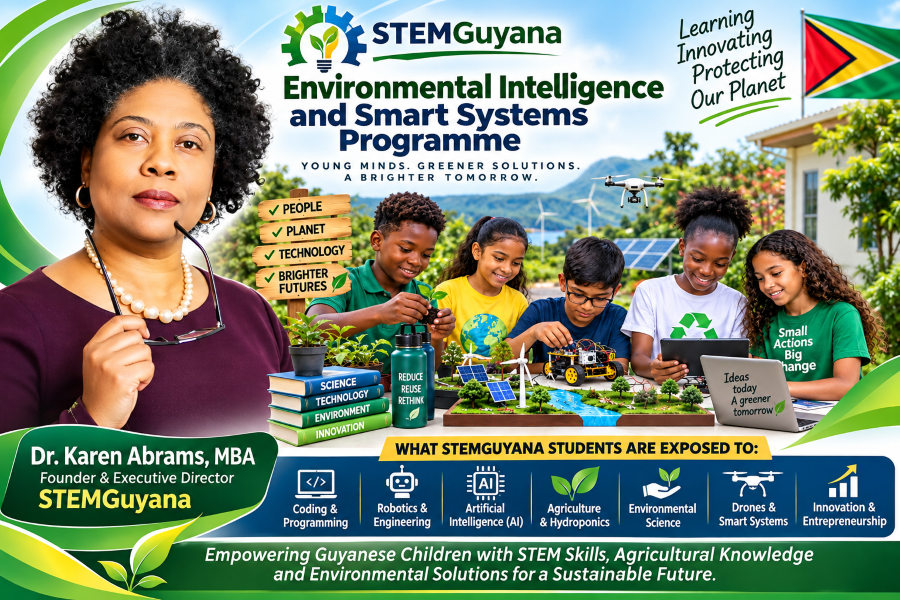
Dr. Karen Abrams, founder and Executive Director of STEMGuyana and Pathway Online Academy is calling for agriculture to become a more prominent part of children’s education, arguing that school gardens, hydroponics and modern farming technology can help prepare young Guyanese for careers in science, innovation and food production.
Abrams believes children should be introduced to agriculture long before they reach the Caribbean Secondary Education Certificate (CSEC) level, giving them opportunities to understand how food is produced while applying science, mathematics, engineering and technology to practical challenges.
In an article published in Kaieteur News on November 8, 2026, titled “NAREI is helping to grow Guyana’s future,” she praised the National Agricultural Research and Extension Institute (NAREI) for sharing its technical expertise with organisations working with young people.
She disclosed that STEMGuyana had received assistance from NAREI in establishing a hydroponic system, allowing students to gain practical exposure to modern agricultural methods.
“There is a difference between reading about a growing system and having knowledgeable people help you put one into practice,” Abrams wrote, highlighting the importance of connecting classroom learning with hands-on experience.
Her proposal builds on STEMGuyana’s existing work exposing children to science and technology. Founded in 2017, the organisation provides young people with opportunities to explore robotics, computer programming, coding, artificial intelligence, digital design, mathematics and engineering through after-school clubs, summer camps, school visits and other educational activities.
According to STEMGuyana’s published programme information, students are exposed to robotics and hardware programming, Python and JavaScript, web development, mobile application development, data science, machine learning and the Internet of Things. Its programmes also include activities involving drones, coding competitions, hackathons and technology showcases.
The organisation’s advanced Genius Workshop gives students who have participated in its programmes for at least two years an opportunity to develop applications, build prototypes and use engineering and coding skills to address real-world problems.
STEMGuyana reports that it has reached approximately 20,000 students across all 10 administrative regions and trained more than 200 mentors. Its stated objective is to make technology education accessible to young people regardless of their background.
Abrams now wants agricultural education to become another practical component of that exposure.
She specifically praised NAREI’s shade house programme, which provides support to farmers, schools, farmers’ groups, religious organisations and non-governmental organisations through growing facilities, equipment, irrigation systems, training and technical assistance.
The programme is intended to reduce the initial costs associated with protected agriculture while encouraging year-round crop production and opportunities for agricultural entrepreneurship.
NAREI’s 2023 annual report recorded the establishment of 105 new shade houses during that year, including 33 at schools. Between 2021 and 2023, a total of 54 schools benefited from the initiative.
Abrams also highlighted the importance of training teachers in school shade house management and plant propagation, arguing that educators equipped with practical knowledge can introduce agricultural concepts to children more effectively.
She believes school gardens can provide lessons that extend beyond planting and harvesting. Children could measure plant growth, compare watering methods, calculate production costs and investigate why certain crops thrive under particular conditions.
Technology, she said, offers additional opportunities for learning. Students could explore moisture sensors to determine when plants need water, understand drip irrigation and examine how efficient fertiliser application can improve production while reducing waste.
“A child who measures plant growth, compares watering methods or calculates the cost of a harvest is using mathematics and science for a purpose they can understand,” Abrams argued.
She also proposed establishing gardens at community centres, where children, families and experienced gardeners could work together. Such initiatives, she suggested, need not require elaborate installations. Container gardens could provide a starting point for families without access to suitable land.
STEMGuyana’s existing environmental science activities provide another opportunity to connect agricultural education with practical problem-solving. Abrams said students have been researching mangroves, excessively hot classrooms and El Niño, examining their effects and developing possible solutions.
She sees opportunities for students to extend that work into agriculture by testing ideas in gardens and shade houses, using environmental measurements and smart systems to investigate challenges affecting food production.
The Guyana School of Agriculture has also introduced students to modern agricultural techniques through its greenhouse facility, commissioned in 2024, which incorporates hydroponics and aquaculture.
Abrams said STEMGuyana would welcome collaboration with NAREI, government agencies and local and international organisations to make practical agricultural experiences more widely available to children.
Her proposal is rooted in the belief that early exposure to agriculture and technology could influence the subjects young people pursue, the businesses they establish and their eventual contribution to national food production.
“Helping more children encounter that expertise early could influence what they study, the businesses they eventually build, and how they feed their own families,” she wrote.
The call places agricultural education within a wider discussion about developing Guyana’s future workforce, encouraging innovation and preparing young people to use science and technology to address the country’s food security and environmental challenges.