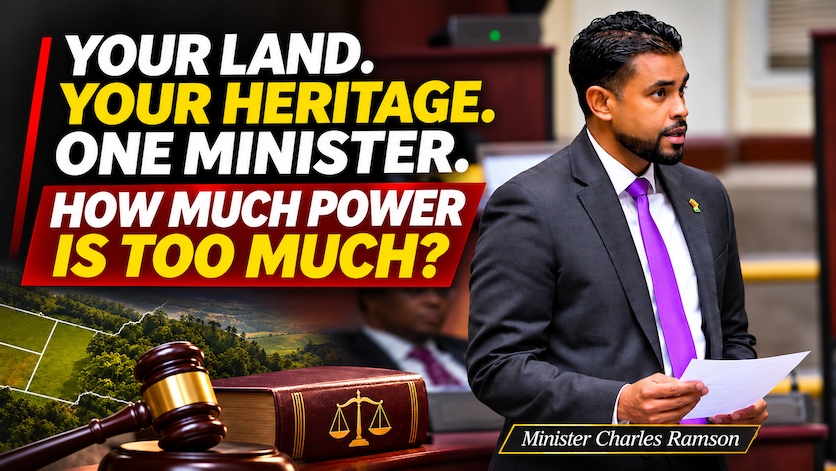
Guyana’s National Heritage Preservation Bill 2026 is being presented as legislation to protect our country’s historical and cultural heritage. But a careful reading of the bill reveals something that should concern every Guyanese, particularly our Indigenous communities. Behind the language of preservation are sweeping powers to control how land is used, restrict activities on privately owned property, seize heritage objects and, under certain circumstances, compulsorily acquire land. The bill places extraordinary authority in the hands of the Minister responsible for cultural affairs, while leaving serious questions about Indigenous consent, community rights and independent oversight unanswered.
First, consider the treatment of Indigenous heritage. Section 2 defines “national heritage” to include “any Amerindian cultural heritage”. The bill also defines cultural heritage broadly enough to include matters associated with the prehistoric, historic or contemporary ways of life of Guyanese. Traditions and cultural practices may also fall within the legislation where they are connected to tangible heritage.
What does this mean for Indigenous communities whose cultural heritage is inseparable from their land, sacred places and traditional practices? The bill appears to recognise Amerindian cultural heritage as national heritage from the outset, but it does not clearly explain how Indigenous communities will exercise their right to consent to decisions affecting that heritage. Nor does it clearly explain how the usual procedures for assessing and declaring specific heritage sites will apply to heritage already included within the statutory definition.
Meanwhile, Section 6 establishes a National Heritage Preservation Council whose eight appointed members are selected by the minister. There are provisions for representatives nominated through agencies responsible for lands, planning, environmental protection, tourism and local government, but no guaranteed representation for the National Toshaos Council, Indigenous village leaders or the Ministry of Amerindian Affairs.
How do you draft legislation covering Indigenous heritage without guaranteeing Indigenous people a seat at the table?
The minister appoints the Council’s chairperson and deputy chairperson, can revoke members’ appointments, and may issue general policy directions that the Council is required to follow. This is the body that will assess heritage significance and advise on decisions affecting people’s property. How independent can it reasonably be when its members serve at the minister’s discretion?
Second, the bill creates serious concerns about Indigenous land rights. Section 2 expressly includes Village lands within its definition of “private lands”. Section 69 then authorises the minister to compulsorily acquire property with heritage significance, whether or not that property has been entered in the Heritage Register.
This power is subject to conditions. The minister must act on a report from the Council and be satisfied that the property is abandoned, neglected, endangered, deteriorating, or that its preservation cannot reasonably be secured through other measures. Acquisition must also be considered necessary for public preservation purposes.
But here is the troubling part. Once the minister publishes the acquisition order in the Gazette, ownership transfers to the State. The former owner does not have to sign a conveyance or other instrument transferring the property.
The bill provides for compensation, assessed with reference to market value, and allows disputes concerning acquisition to be taken to the High Court. These are important safeguards and should be acknowledged. But Section 69 does not expressly require the consent of an Indigenous Village Council or Village General Meeting before village land is acquired. It also does not expressly provide for a prior hearing before the acquisition order takes effect.
This raises a fundamental question about the relationship between the proposed legislation and the Amerindian Act of 2006, which establishes important protections for village governance and decision-making over village lands. Parliament should explain precisely how these laws will operate together. Indigenous land rights should not be left dependent on a future minister’s interpretation.
Third, the bill threatens to place ordinary activities within protected heritage areas under government control. Section 88 prohibits a range of activities within heritage sites, districts and conservation areas without written approval from the Council. These include digging, building, planting trees, irrigating land and clearing vegetation. Breaches can attract a fine of G$1 million and six months’ imprisonment.
Let us understand what this could mean in practice. If part of an Indigenous village is designated as a heritage site or conservation area, could residents require permission from a government-appointed Council before clearing land for a cassava farm, planting trees or carrying out customary maintenance? The bill does not make all traditional farming illegal, and designation does not automatically transfer ownership. But the restrictions are sufficiently broad to raise legitimate concerns about traditional land use.
Where are the explicit protections for customary subsistence activities? Where is the requirement to consult the Village General Meeting before restrictions are imposed? Why should legislation intended to protect cultural heritage create uncertainty about the very practices through which that heritage survives?
Fourth, there are troubling powers concerning artefacts and historical objects. Under Section 42, a person who discovers an object reasonably believed to have heritage significance must notify the Council and, where possible, deliver it for assessment. Failure to comply knowingly can result in a G$500,000 fine and six months’ imprisonment.
The bill does recognise private ownership. Section 45 provides that heritage objects discovered on private land belong to the landowner, and declaration as a heritage object does not automatically transfer ownership to the Council.
However, Section 87 separately empowers the Council to detain or seize heritage items. It also limits the recovery of damages and legal costs unless the seizure was made without reasonable cause. For Indigenous communities, this raises important questions about who controls ancestral artefacts, sacred objects and other items of cultural significance. Why is there no explicit requirement for consultation with the community’s traditional authorities before such items are taken into custody?
The government’s answer may be that the bill contains procedures for notification, objection and compensation. And it does. Sections 30 to 32 provide notice and an opportunity to object to proposed heritage designations, with objections heard by an arbiter appointed by the Council. Section 69 provides access to the High Court in acquisition disputes.
But Section 86 requires appeals against Council decisions to be made to the minister. That is the same minister who appoints and can remove Council members, directs the Council’s general policies, and exercises the power of compulsory acquisition. The existence of an appeal procedure does not, by itself, resolve concerns about institutional independence.
The broader context also demands attention. Guyana is experiencing major development pressures involving mining, infrastructure and land use. Heritage protection should apply consistently, including where commercially valuable resources or major development projects are involved. Will the government be equally determined to protect Indigenous heritage when a mining or infrastructure project threatens a culturally significant site? Or will heritage protection become a convenient justification for restricting the activities of communities while powerful commercial interests continue to receive approval?
These questions deserve answers before the legislation becomes law.
Protecting Guyana’s heritage is a legitimate and necessary public responsibility. Historic buildings should be preserved. Archaeological discoveries should be protected. Sacred sites and culturally important landscapes deserve care. But protection must not become an excuse for placing excessive power over communities and their property in the hands of political officials.
Parliament should amend this bill to guarantee Indigenous representation on the Heritage Council, require meaningful community consent before village lands can be compulsorily acquired, expressly protect customary subsistence practices, establish stronger independent review of ministerial decisions, and provide clearer safeguards against the seizure of privately owned and community-held cultural objects.
There should also be independent scrutiny before compulsory acquisition takes effect, rather than leaving owners to challenge decisions after title has already passed to the State.
Indigenous communities must be directly consulted, including through the National Toshaos Council and Village General Meetings. These are the people whose land, history and traditional practices may be affected. They deserve a meaningful role in determining how their heritage is preserved.
Heritage legislation should protect the rights of the people whose history it seeks to preserve. If protecting a community’s heritage requires taking control away from that community, Parliament needs to explain whose interests are really being served.